

Entry Level Remote Jobs for Freshers: 15 Roles and Salaries
Entry level remote jobs are no longer reserved for people with years of experience and a referral. In 2026 they are a real category of work for freshers who know which roles hire beginners, what they pay, and how to apply in a way that gets a reply. This guide covers all three: 15 remote entry level jobs that hire beginners, honest salary ranges for the US and India, where to find them, and a 30-day action plan.
Remote hiring did not disappear after the 2021 boom. According to the U.S. Bureau of Labor Statistics, a large share of knowledge work is now done at least partly from home. The problem is that remote and entry level rarely appear in the same posting, so freshers waste weeks on roles that quietly expect experience.
Why entry level remote jobs are realistic for freshers
Two forces make remote jobs entry level candidates can get more common than they look. Companies that went remote-first built the tooling to onboard people they never meet, and a whole layer of work (support, content, QA, data labeling, junior development) is teachable and location-independent. That is where freshers fit. Most beginners still treat the search like a lottery, firing off 200 identical applications and hoping. Instead, target the role families open to beginners and go deep on a shortlist. If you are still deciding whether remote work suits you, our guide to work from home jobs for freshers covers the tradeoffs.
15 entry level remote jobs for freshers, with salaries
Here are 15 remote entry level jobs that hire beginners, grouped by skill. Ranges are annual, blended from US and India postings and adjusted to 2026 norms.
Tech and adjacent roles
- Junior software developer: US $60k to $85k, India Rs 4.5 to 9 lakh. Front-end and full-stack roles hire freshers who show two or three finished projects.
- QA and test engineer: US $50k to $72k, India Rs 3.5 to 7 lakh. A forgiving entry point into engineering.
- Data annotation specialist: US $18 to $28 per hour, India Rs 2.5 to 5 lakh. The training data behind AI models is labeled remotely.
- Technical support engineer: US $48k to $68k, India Rs 3 to 6 lakh. You debug customer problems and often move into engineering within a year.
- No-code and automation builder: US $45k to $70k, India Rs 3 to 6.5 lakh. Build workflows without a computer science degree.
Content, marketing, and creative roles
- Content writer: US $42k to $62k, India Rs 3 to 6 lakh. A strong writing sample beats a resume.
- SEO analyst: US $45k to $65k, India Rs 3.5 to 6.5 lakh. Learnable in weeks.
- Social media coordinator: US $40k to $58k, India Rs 3 to 5.5 lakh. A page with real engagement is your portfolio.
- Graphic designer: US $45k to $68k, India Rs 3 to 6 lakh. Freelance-to-full-time is common.
- Video editor: US $42k to $65k, India Rs 3 to 6.5 lakh. Short-form demand keeps growing.
Operations and support roles
- Customer support representative: US $38k to $52k, India Rs 2.5 to 5 lakh. The most common remote entry point.
- Virtual assistant: US $18 to $30 per hour, India Rs 2.5 to 5 lakh. A fast way to build a track record.
- Data entry and operations associate: US $17 to $24 per hour, India Rs 2.2 to 4 lakh. Low barrier, real remote experience.
- Sales development representative: US $45k to $60k base plus commission, India Rs 3.5 to 7 lakh. Strong upside, few prerequisites.
- Online tutor: US $20 to $35 per hour, India Rs 2.5 to 5.5 lakh. If you know a subject well, you can start this week.
Where companies hire freshers for remote roles
Giant aggregators are where freshers go to be ignored. Use boards that specialize in remote work or let you filter for entry level jobs remote candidates can win. Try We Work Remotely for tech, support, and marketing roles, FlexJobs for vetted, scam-free listings, and LinkedIn with the Remote and Entry level filters both on.
The companies most likely to hire beginners are early-stage startups, customer-heavy software companies, agencies, and AI data companies. Your first remote job is a stepping stone, not a destination.
What salaries to expect, and why the range is wide
Remote pay is set by three things: the company's location, your location, and your leverage. A US startup hiring a fresher in India pays above the local market but below the US market, the arbitrage we cover in our post on remote salary arbitrage. As a fresher your leverage is low, so the first offer lands near the bottom of the range. The goal is to convert no experience into one year of remote experience, which roughly doubles your pay for the second job. When an offer arrives, do not accept on the spot; even beginners can move the number, as we show in your first salary negotiation guide.
The 30-day action plan to land your first remote job
A plan beats motivation. Treat this four-week sequence as a part-time job with daily reps.
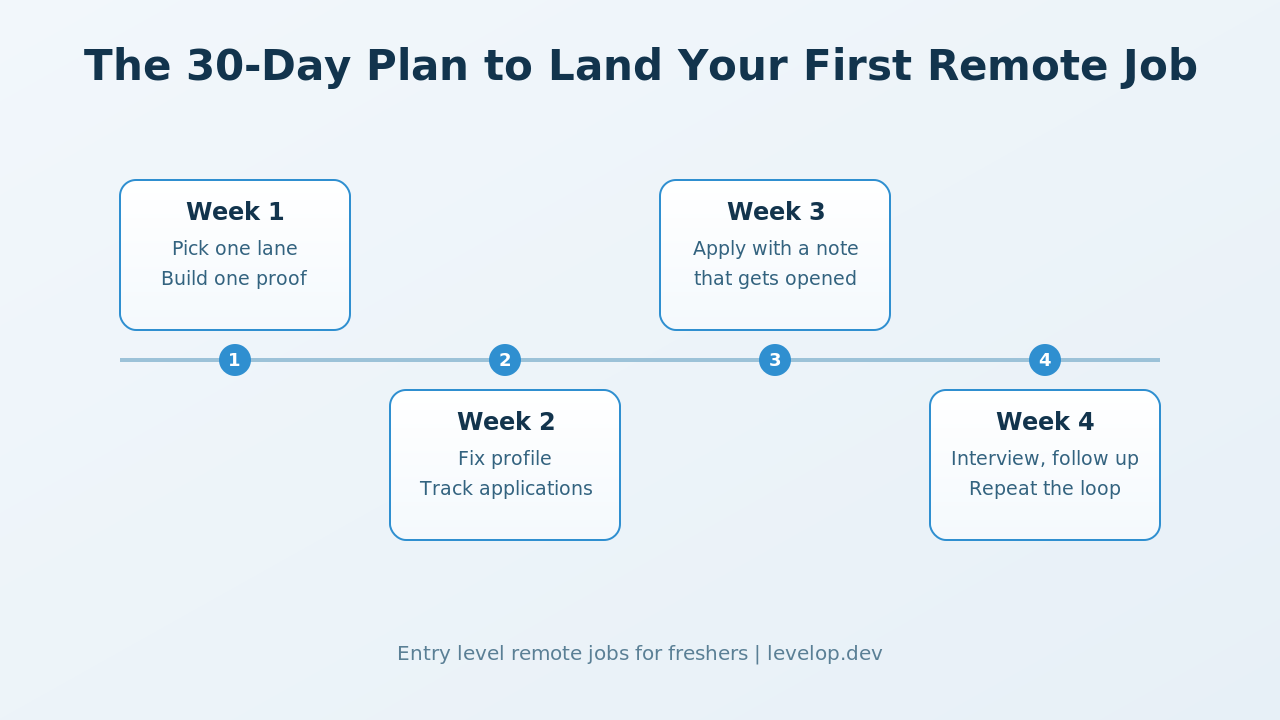
Week 1, pick a lane and build one proof. Choose a single role family, not five, then build one artifact: a small project, a writing sample, three edited videos, a mock support base. For development roles, our guide to developer portfolio projects that land interviews shows what strong work looks like.
Week 2, fix your profile and track applications. Rewrite your resume and LinkedIn headline around the one role you chose. Recruiters screen most applications through applicant tracking systems, so run a simple tracking system of your own:
Company | Role    | Source   | Applied | Followed up | Status
Acme    | QA      | WWR      | Aug 15  | Aug 20      | Waiting
Bolt    | Support | LinkedIn | Aug 16  | -           | Applied
Fifteen well-targeted applications with a tailored note beat 150 blind ones.
Week 3, apply with a note that gets opened. Send a short message to a real human, not just the form:
Subject: Junior QA application + a bug I found in your app

Hi Jane, I applied for the remote QA role. While testing your signup
flow I found a validation bug (screenshot attached) and wrote up how
to reproduce and fix it. Happy to walk through it. Thanks.
That note shows initiative and proves the skill. For the full playbook, see our post on job search strategies that get callbacks.
Week 4, interview, follow up, and repeat. Remote interviews test written communication and self-direction, so reply quickly and clearly and have one story ready about finishing something without being told how. If week four ends without an offer, keep the same lane, widen the company list, and run the loop again. Most freshers who stick with a system land a role within two to three cycles.
Common mistakes that keep freshers unemployed
Three errors sink more remote job searches than a weak resume ever will. First, applying everywhere instead of anywhere specific, which produces a pile of ignored applications. Second, waiting to feel ready before building proof, when the proof is what makes you ready. Third, treating the first offer as final and either grabbing it in a panic or ghosting out of fear. Once you land the role, the first three months decide how fast you grow, which our first 90 days survival guide maps out.
How Levelop helps you go from fresher to hired
Landing entry level remote jobs is a skills problem as much as a search problem. On the Levelop blog we publish interview prep and system design practice that turns studied into demonstrated. If your target lane is a development or QA role, practice the exact skills those interviews test, then point to that work in your outreach.
Frequently asked questions
Are entry level remote jobs real or mostly scams?
They are real, but scams cluster around them because beginners are easier to target. Stick to reputable boards like We Work Remotely and FlexJobs, never pay to get a job, and treat any role that asks for money upfront as a red flag. Legitimate remote jobs entry level workers can get always interview you before hiring.
Which entry level remote job pays the most for a fresher?
Junior software developer and no-code or automation builder roles top the list, often starting at US $60k or more, because the skills are scarce and tied to revenue. A few months on a small portfolio gives the best return of any beginner-friendly remote path.
Do I need a degree to get remote entry level jobs?
For most of these 15 roles, no. Support, content, QA, data labeling, and design care about proof of skill more than a diploma. A strong sample or portfolio opens more doors for a fresher than a certificate alone.
How long does it take a fresher to land a remote job?
With a focused plan, most freshers land a first remote role within four to twelve weeks. The variable is consistency: one role family, real proof, and tailored applications daily. Spraying generic applications stretches the search to months with worse results.
What is the best first remote job to build experience quickly?
Customer support and virtual assistant roles are the fastest on-ramps because demand is constant and the barrier is low. They convert no experience into remote experience in months, the most valuable upgrade for landing a better second role.