
Software Engineer Portfolio Projects That Land Interviews
Every hiring season, thousands of developers ship the same three projects: a to-do app, a weather dashboard, and a clone of a streaming service. They land in the same folder on the same laptop of the same recruiter, and they get the same result, which is silence. A strong software engineer portfolio is not a gallery of tutorials you finished. It is evidence that you can make decisions, ship under constraints, and reason about tradeoffs the way a working engineer does.
This guide breaks down what actually moves the needle when a hiring manager opens your GitHub. We will look at why the tutorial project fails, what a portfolio is really signaling, four categories of projects that get callbacks, and how to present them so a busy reviewer gets the point in ninety seconds. If you are early in your job search, pair this with our job search strategies that get callbacks so your portfolio and your outreach pull in the same direction.
Why the to-do app fails as a portfolio project
The to-do app is not bad because it is simple. It is weak because it answers a question nobody asked. When a reviewer opens a to-do app, they learn that you can follow a framework tutorial. They already assumed that. What they cannot tell is whether you can scope a problem, handle failure, or make a call when two reasonable options conflict.
A tutorial project has a fatal property: the hard decisions were already made for you. Someone else chose the data model, the state management approach, and the deployment target. You typed along. That is genuinely useful for learning, but it produces a portfolio piece with no fingerprints on it. The reviewer sees a competent copy and nothing about you.
There is also a saturation problem. Recruiters and engineers who screen candidates see the same clones constantly, so these projects have negative signal now. They read as doing the minimum to have something on GitHub. A distinctive developer portfolio project does the opposite: it makes the reviewer curious enough to read your README, and curiosity is what earns the screen call.
What a portfolio actually signals to a hiring manager
Before you pick a project, get clear on what the artifact is for. A software engineer portfolio is a risk-reduction tool for the person deciding whether to spend an hour interviewing you. Every hour of interviewer time is expensive, so your job is to lower the perceived risk that the hour is wasted. You do that by demonstrating four things.
The first is scoping judgment: can you take a fuzzy goal and cut it down to something shippable? The second is engineering tradeoffs: do you know why you chose Postgres over a document store, or why you skipped a cache you did not need? The third is follow-through: did you finish, deploy, and document, or did you stop at works on my machine? The fourth is communication: can a stranger understand what you built and why without a call?
Notice that none of these require a novel algorithm or a huge codebase. A small project that shows all four beats a large one that shows none. This is also why the interview and the portfolio are connected. The same judgment a reviewer looks for in your repo is what they will probe in the loop, so a good portfolio doubles as interview prep. Our coding interview prep guide for 2026 covers how to talk about these decisions out loud once you get the call.
Four categories of portfolio projects that get callbacks
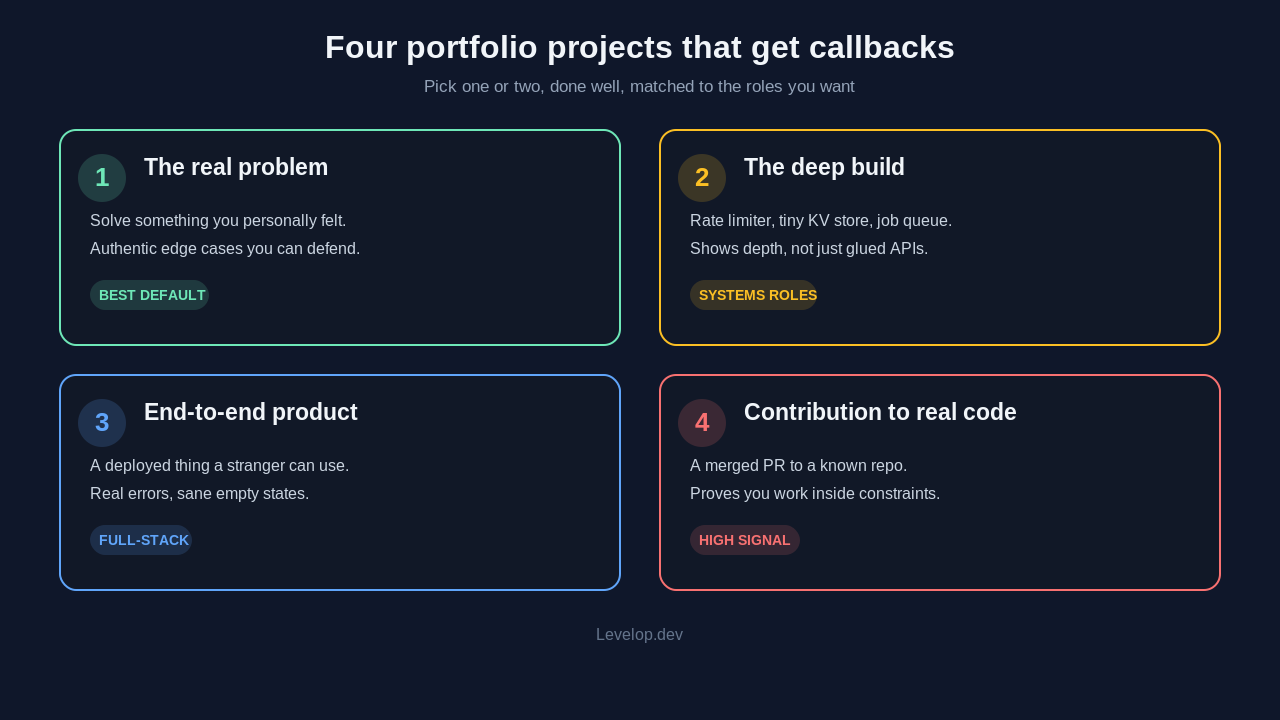
You do not need all four. You need one or two done well. Pick based on the roles you are targeting and the stories you want to be able to tell.
1. The real problem you actually have
The strongest portfolio projects for developers solve a problem the builder personally felt. Maybe you automated a tedious part of your current job, built a tool your climbing gym needed, or scraped and analyzed data for a hobby. The advantage is authenticity: you can talk for twenty minutes about the edge cases because you lived them. A reviewer can tell the difference between a project a tutorial told you to build and one you built because you were annoyed every Tuesday.
These projects also naturally include the messy parts real engineering has: unreliable inputs, weird user behavior, and requirements that changed halfway through. That mess is the signal. It shows you can operate outside the clean boundaries of a course assignment.
2. The deep technical build
If you are targeting infrastructure, backend, or systems roles, build something that shows depth. Write a small key-value store with a write-ahead log, a rate limiter with a token bucket, a toy database with a query planner, or a job queue with retries and idempotency. You are not competing with Redis. You are proving you understand what Redis does under the hood.
Depth projects are the strongest antidote to the impression that you just glued APIs together. They pair beautifully with a blog post explaining what you learned, which we will come back to. If systems design is your target, our overview of three system design patterns every engineer should know is a good place to find a concept worth implementing from scratch.
# A token-bucket rate limiter: small, but it shows you understand
# concurrency, time, and graceful failure, not just CRUD.
import time
import threading

class TokenBucket:
    def __init__(self, capacity: int, refill_rate: float):
        self.capacity = capacity
        self.tokens = capacity
        self.refill_rate = refill_rate  # tokens per second
        self.last = time.monotonic()
        self.lock = threading.Lock()

    def allow(self, cost: int = 1) -> bool:
        with self.lock:
            now = time.monotonic()
            self.tokens = min(
                self.capacity,
                self.tokens + (now - self.last) * self.refill_rate,
            )
            self.last = now
            if self.tokens >= cost:
                self.tokens -= cost
                return True
            return False
A reviewer who sees this learns more about you than a whole streaming clone would. It is thirty lines, but it shows thread safety, a monotonic clock choice, and a clear failure mode. That is what going beyond the to-do app looks like in practice.
3. The end-to-end product
Full-stack and product-minded roles reward a project that a stranger can actually use. Not a demo behind a login you control, but a deployed thing with a URL, real error handling, and a sane empty state. This is where a web developer portfolio piece earns its keep, because polish and product sense are exactly what those roles screen for.
The bar here is not visual perfection. It is coherence: the thing works, it fails gracefully, and it does one job well. A single tightly-scoped product beats a sprawling app with ten broken features. Reviewers notice when you had the discipline to say no to scope.
4. The contribution to something real
Contributing to open source or building a genuinely useful library flips the usual dynamic. Instead of asking a reviewer to trust your synthetic project, you point to code that other people already depend on. Even a small merged pull request to a well-known repository signals that you can read a large unfamiliar codebase, follow contribution norms, and take feedback in review, which are the exact skills you will use on day one.
How to present your projects so reviewers actually read them
Most developers lose the reviewer not on the code but on the presentation. Your repository has about ninety seconds to make its case. Here is how to use them.
Lead with a README that answers three questions in the first screen: what is this, why did you build it, and what was hard about it. Skip the wall of setup instructions at the top. A reviewer wants the story before the shell commands. Include one screenshot or a short GIF if there is a UI, because a picture collapses thirty seconds of reading into two.
Then make the interesting decisions visible. A short design notes section that says I chose X over Y because Z, and here is the tradeoff I accepted is worth more than a thousand lines of code, because it hands the reviewer the exact narrative they were trying to reconstruct. This is also the single best thing you can do to make your coding projects for resume bullet points write themselves.
Pin your best two or three repositories on your GitHub profile and let the rest fade. Reviewers judge you by your strongest work when it is easy to find and your weakest when it is not. Curate ruthlessly. A clean profile with three sharp projects reads as senior; a cluttered one with twenty forks reads as noise.
Turning a project into interview leverage
The final move most people miss is converting the project into a story you can tell. Write a short blog post about one hard decision: the bug that took a day, the rewrite you regretted, the tradeoff you would make differently now. This does two things. It creates a permanent artifact a recruiter can find, and it forces you to rehearse the exact narrative an interviewer will ask for.
When you walk into a loop, the interviewer will say tell me about a project you are proud of. If you built the project on purpose, with real decisions and a written record, that question becomes the easiest twenty minutes of your day instead of the scariest. The portfolio and the interview are one system. Building deliberately for one prepares you for the other, which is the whole point of going beyond the to-do app. Once you land the role, our guide to the first 90 days as a software engineer helps you turn that momentum into a strong start.
For broader context on how hiring is shifting, GitHub's State of the Octoverse reports on the languages and project types gaining traction, and the Stack Overflow Developer Survey is a reliable read on what tools working engineers actually use. Aligning at least one project with where the field is heading is a small edge that compounds.
Frequently asked questions
How many projects should a software engineer portfolio have?
Two or three finished, well-documented projects is the sweet spot. Reviewers weight your strongest project heavily and skim the rest, so depth and polish beat quantity. Ten abandoned repositories actively hurt you because they signal poor follow-through. Pin your best work and let the rest fade into the background.
Do I need a portfolio if I already have a computer science degree?
A portfolio helps regardless of your background because it shows applied judgment that a transcript cannot. It matters even more if you are self-taught or came through a bootcamp, since it is your primary proof of ability. For a fuller comparison of paths into the industry, see our breakdown of CS degree versus bootcamp versus self-taught.
What makes a developer portfolio project stand out to recruiters?
Three things: it solves a real problem, it shows a decision you can defend, and it is presented so a stranger understands it in ninety seconds. The technical difficulty matters less than the visible reasoning. A simple project with a clear README explaining your tradeoffs outperforms a complex one nobody can parse.
Should my portfolio projects use trendy technologies?
Chasing hype is a trap, but total isolation from the field is also a mistake. Pick tools you can explain and defend, and align at least one project with where the industry is moving. Depth in a proven stack beats surface familiarity with five trendy ones. Reviewers care that you understand your choices, not that you used the newest framework.
Will AI tools make personal portfolio projects less valuable?
The opposite. As AI makes it trivial to generate boilerplate, the differentiator becomes judgment: what to build, what to cut, and why. A portfolio that shows real decisions is more valuable now, not less. For more on how the role is changing, read will AI replace junior developers.
Build one thing that is unmistakably yours
You do not need a bigger portfolio. You need a truer one. Pick a single problem you actually care about, build it deliberately, write down the decisions, and present it so a busy reviewer gets the point fast. That is the whole game. A software engineer portfolio that shows judgment, follow-through, and clear communication will open more doors than any number of tutorial clones. Start with one project this month, ship it end to end, and let it become the story that earns your next interview. Explore more career and interview guides on the Levelop blog, or learn what we are building at Levelop.