

Is a Computer Science Degree Worth It in 2026?
Every few months someone messages me the same question, just worded differently. Is a computer science degree worth it, or should I do a bootcamp? Can I still get hired self-taught? Behind all three is one real anxiety: I want a software job, and I do not want to waste two or four years and a pile of money finding out I picked the wrong door.
So let us do this honestly. Not the recruiter-brochure version, and not the "degrees are dead" hot take either. Three paths into software engineering, what each one actually costs, what the data says about outcomes, and how hiring has shifted in 2026. By the end you should be able to tell which door fits your situation, because the correct answer really does change from person to person.
The three paths, defined
A computer science degree is the traditional route: a three or four year university program that teaches theory (algorithms, operating systems, discrete math, systems architecture) alongside programming. You leave with a credential, a cohort, and usually an internship or two.
A coding bootcamp is an intensive, career-focused program that runs roughly 12 to 40 weeks. It skips the theory that will not appear in a junior job and drills the practical stack: a language, a framework, version control, and enough project work to fill a portfolio.
The self-taught path is exactly what it sounds like. You assemble your own curriculum from documentation, video courses, open-source projects, and a lot of trial and error, then prove your ability through what you can build rather than what you enrolled in.
None of these is inherently superior. They trade different things: time, money, structure, and signal. Let us look at each trade.
Is a computer science degree worth it?
This is the highest-stakes version of the question because the degree is the most expensive path in both money and years. So is a computer science degree worth it in 2026? For a large group of people, yes, but the reasons have narrowed.
What you actually pay for is threefold. First, the theoretical foundation. When you later debug a race condition, reason about database isolation levels, or estimate the cost of an algorithm on a large input, the degree material is doing quiet work in the background. Second, the credential still opens doors that stay shut otherwise: some large employers, most visa-sponsored roles, and nearly all graduate programs filter on it. Third, the four-year runway gives you internships, research, and a peer network that compounds for a decade.
The catch is cost and time. A degree can run from very affordable at a public university to genuinely alarming at a private one, and it takes years during which you are mostly not earning. If your goal is simply to get a junior developer job as fast as possible, the degree is the slow lane.
Here is the honest framing. A CS degree is worth it if you value depth, you may want to work on hard systems problems or research, you want the widest possible set of employers open to you, and you can complete it without crippling debt. It is a weaker choice if you already have another degree, you are changing careers at 30, or the debt would dominate your first five years of salary.
Coding bootcamp vs computer science degree
The coding bootcamp vs computer science degree comparison is really a comparison of speed versus depth.
A bootcamp gets you to employable junior developer in months, not years, at a fraction of the cost. According to Course Report's outcomes data, a majority of bootcamp graduates find a job in their field within six months, with average starting salaries in the neighborhood of $70,000, rising meaningfully by the second and third role. That is a strong return on a program that takes a season of your life.
What a bootcamp does not give you is the theoretical floor. Bootcamp graduates sometimes hit a ceiling when a role demands systems thinking they were never taught, and they often have to backfill algorithms and data structures on their own to pass technical interviews. The best bootcamp grads I have seen treat the program as the launchpad and keep studying fundamentals afterward.
So the pattern is clear. Choose the degree if you have the time and money and you want the deepest foundation and the widest door. Choose the bootcamp if you need to switch into the field quickly, you are disciplined enough to self-study the theory a bootcamp skips, and you can stomach that some employers still weigh the credential. For a fuller breakdown of where the bootcamp path leads financially, we walked through the numbers in the bootcamp-to-mid-level salary journey.
The self-taught software engineer path
The self-taught path is the cheapest and the most brutal. It is cheapest because your only real costs are a few subscriptions and your time. It is brutal because nobody hands you a syllabus, a deadline, or a cohort to keep you honest. The dropout rate is invisible but enormous.
And yet it works, at scale. The 2025 Stack Overflow Developer Survey found that only about half of professional developers learned to code in school, meaning a huge share of the working industry is self-taught or online-taught in practice. As InfoWorld summarized from the survey data, nearly half of developers have no computer science degree at all. Documentation and video tutorials are now the primary learning tools for a majority of developers, credential or not.
What makes or breaks a self-taught software engineer is not intelligence. It is structure and proof. You have to impose your own curriculum so you do not end up with ten half-built to-do apps and no depth. And because you have no credential, your portfolio has to carry the entire load of proving you can do the work. That is a higher bar, but it is also a purer one: nobody can argue with a running system you built and can explain.
What the data actually says
Strip away the anecdotes and the labor market itself is reassuring across all three paths. The U.S. Bureau of Labor Statistics projects employment of software developers, QA analysts, and testers to grow about 15 percent from 2024 to 2034, much faster than the average occupation, with roughly 129,200 openings each year over the decade. Pay sits far above the median for all jobs. Demand is not the problem for any route.
The differences show up in the on-ramp, not the destination:
- CS degree: 3 to 4 years, highest cost, signals depth and credential and network, main risk is time and debt.
- Bootcamp: 3 to 10 months, medium cost, signals a job-ready stack and portfolio, main risk is thin theory and variable quality.
- Self-taught: open-ended, lowest cost, signals proof of work and grit, main risk is no structure and no credential.
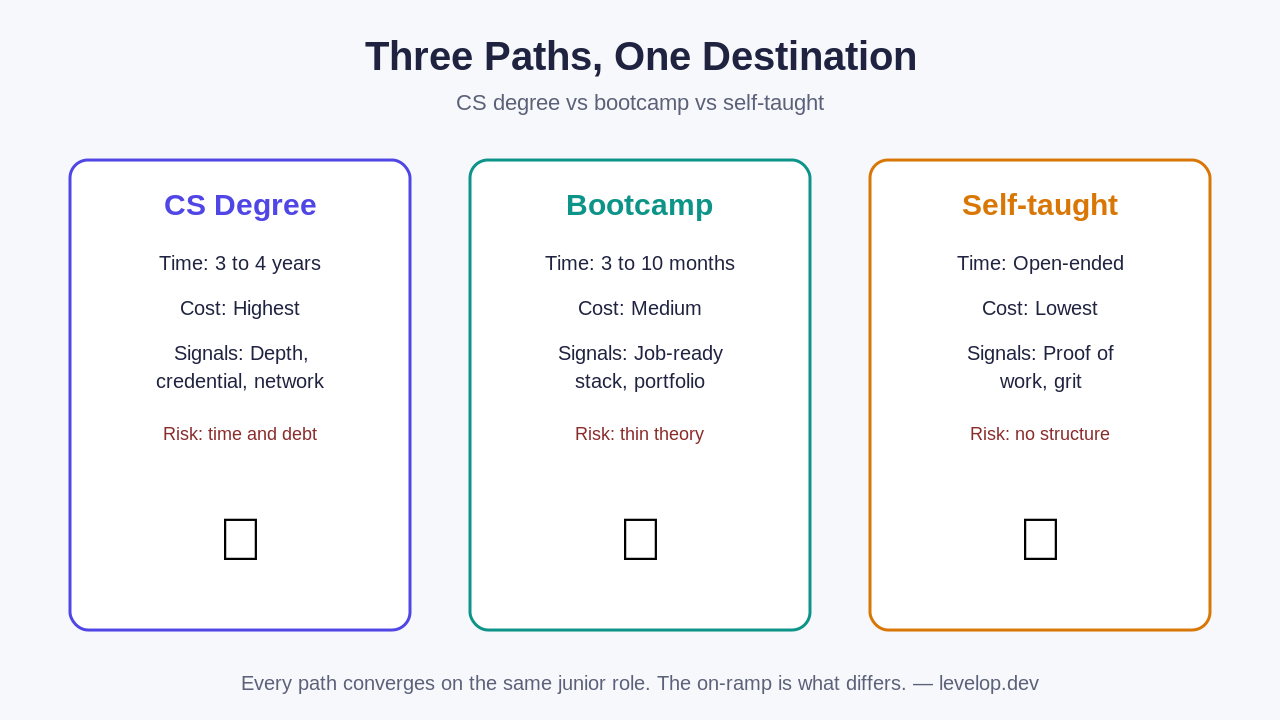
Notice that every path eventually converges on the same job. What differs is how long the on-ramp is, what it costs, and what you have to prove at the interview. A degree lets you lean partly on the credential. The other two paths make your portfolio and your problem-solving carry everything.
How hiring changed in 2026
Three shifts matter for this decision right now.
First, portfolios beat pedigree more than they used to. A growing number of teams run structured technical evaluations where a running project and a clear explanation outweigh where you studied. That helps bootcamp and self-taught candidates, and it means a CS degree alone no longer guarantees the interview it once did.
Second, the junior rung got narrower and stranger because of AI. Routine code that a junior used to write is now partly automated, which raises the bar on the judgment a junior is expected to show. We dug into what this actually means for early-career engineers in how AI is reshaping the junior developer role. The short version: the fundamentals and the ability to reason about systems matter more, not less, whichever path you took to get there.
Third, the skills that get people hired are increasingly the ones no path teaches automatically. Communication, debugging instinct, and the ability to break a vague problem into steps outrank raw coding speed. We made that case in the software engineer skills that matter more than coding speed. A degree, a bootcamp, or a self-study plan can all build these, but only if you deliberately practice them.
How to actually choose
Skip the identity debate and answer four questions about your own situation. Time: how many months or years can you go without a full salary? Money: how much can you spend, and how much debt is acceptable? Structure: do you finish things without external deadlines, or do you need a cohort and a syllabus? Goal: do you want the broadest set of employers and hard-systems work, or the fastest path to any solid junior role?
Here is that logic as a simple decision function:
def choose_path(months_runway, debt_tolerance, self_discipline, wants_depth):
    # wants_depth: research, hard systems, widest employer access
    if wants_depth and months_runway >= 24 and debt_tolerance != "none":
        return "CS degree"
    if months_runway < 12 and debt_tolerance in ("low", "medium"):
        return "Bootcamp"
    if debt_tolerance == "none" and self_discipline == "high":
        return "Self-taught"
    # Hybrid is often the real answer
    return "Self-study fundamentals now, then bootcamp or degree if a door needs it"
The last line is not a joke. The strongest candidates I meet rarely fit one box. They teach themselves the basics for free, do a bootcamp when they need speed and structure, and pick up degree-level theory on the side because interviews demand it. Treat the paths as tools, not tribes.
Whichever route you pick, the deciding factor at the interview is the same: can you take an unfamiliar problem and reason through it out loud. That skill is path-agnostic, and it is exactly what we built Levelop to train. Instead of grinding 2,500 random problems, you learn the handful of patterns that the rest are variations of, which is the fastest way for any of the three backgrounds to close the gap. When you are ready to apply, our job search strategies guide covers the part that comes after you can code.
Frequently asked questions
Is a computer science degree worth it if I want to work in AI or machine learning?
Here the degree tilts more clearly in favor. Research-heavy and ML roles lean on the math and theory a degree provides, and many still filter on the credential for graduate study or specialized teams. If AI research is the goal, the degree is usually the safer bet.
Can you really get a software job self-taught in 2026?
Yes, and many do. Around half of working developers did not learn to code in school. The bar is that your portfolio and interview performance have to fully replace the credential, which demands more structure and proof than most people expect going in.
Coding bootcamp vs computer science degree: which gets me hired faster?
The bootcamp, clearly. It is built to get you to a junior role in months rather than years. The tradeoff is a thinner theoretical base that you will need to backfill for interviews and for growth beyond the junior level.
Are coding bootcamps worth the money?
For career changers who need speed and structure, generally yes. Outcome reports show most graduates land field jobs within six months at solid starting salaries. Quality varies a lot between programs, so weight the specific bootcamp's verified outcomes over its marketing.
Does the path I choose limit my long-term salary?
Not much. All three converge on the same roles, and long-term pay tracks skill and experience far more than entry route. The BLS projects strong demand and pay across the field regardless of how you got in.
The bottom line
Is a computer science degree worth it? Yes, if you have the time and money and you want depth and the widest door. Is a bootcamp worth it? Yes, if you need speed and can self-study the theory it skips. Can you make it self-taught? Yes, if you can impose your own structure and prove your work. The path is a starting condition, not a destiny. What actually decides your career is whether you keep building, keep learning the fundamentals, and can reason through a hard problem when it counts. Pick the door that fits your life, then get to work. For more on the road after you land the first job, read the first 90 days as a software engineer, and browse the rest of the Levelop blog for the interview and career deep-dives.