
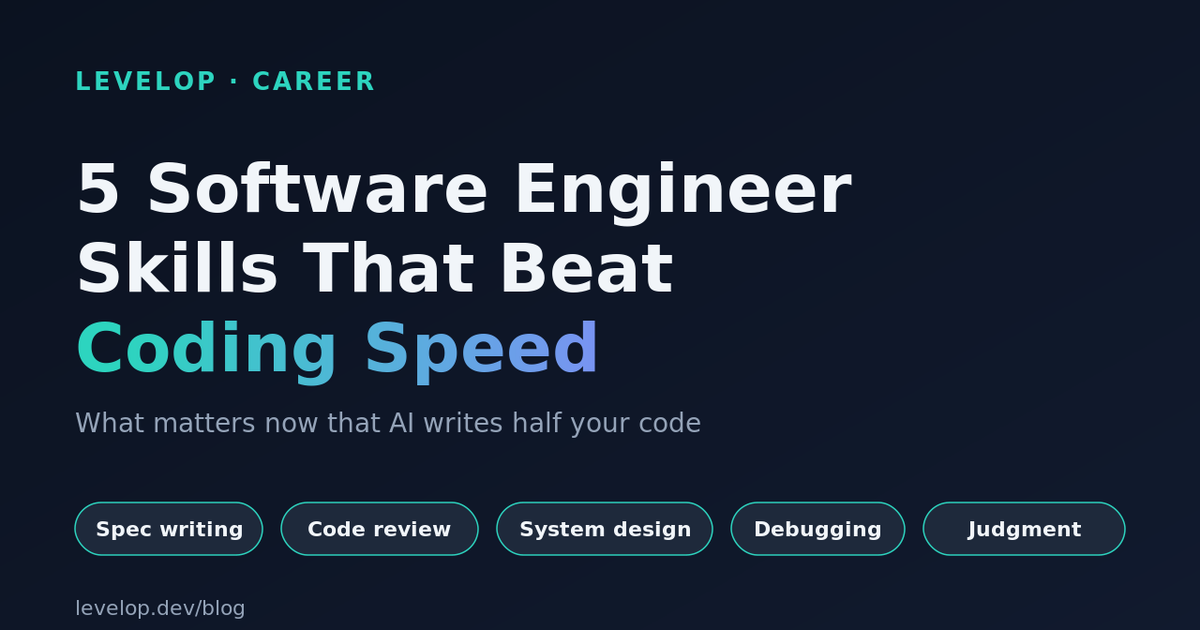
5 Software Engineer Skills Needed More Than Coding Speed
Back with another one in the series where I write down the things I keep re-learning on the job. This one is less about a specific algorithm and more about a question I could not shake for most of last year: if an AI can write a working function in ten seconds, what am I actually being paid for?
For a while I answered that question badly. I tried to get faster. I leaned harder on autocomplete, kept three chat windows open, and measured my day by how many lines I shipped. It felt productive. It was not. The stuff that actually moved projects forward had almost nothing to do with typing speed, and the more I paid attention, the clearer it got that the list of skills needed for software engineer roles in 2026 has quietly reshuffled.
So this is my honest attempt to name the five skills that started mattering more to me than raw coding speed, why each one is hard to fake, and what I did to get better at them. The conversation about ai skills for software engineers usually starts and stops at "learn to prompt," and that misses the point by a mile. If you have been feeling the same low-grade anxiety about where you fit now that the machine writes half your code, I hope this makes you feel a little less alone.
The real question is not how fast you type. It is what skills do software engineers need when the typing itself is basically free, and which software engineer skills needed for the next five years actually survive contact with these tools. Some of the answers are technical skills. A surprising number are soft skills. Almost none of them are coding speed.
Why coding speed stopped being the bottleneck
Here is the thing I got wrong. I assumed the value of an engineer was in producing code, so a tool that produces code faster must make me more valuable in the same direction. Just faster.
But code was never the point. Code is the byproduct of a hundred decisions about what to build, how it should behave, what happens when it breaks, and who has to maintain it. AI is genuinely good at the byproduct. It is much weaker at the decisions. When I started tracking where my time went, the pattern was obvious: generating a first draft of code was rarely the slow part. Figuring out what to ask for, checking whether the answer was actually correct, and fitting it into a system that already existed, that was the slow part. And none of it got faster just because the typing did.
That reframing is what the rest of this post is built on. If coding speed is no longer the constraint, then the skills that matter are the ones that surround the code, not the ones that produce it. The 10x engineer idea finally makes sense through this lens: the multiplier was never about output volume, it was about judgment applied at the right moments. This is happening right across the tech industry, and it is reshaping what a software engineering job actually rewards.
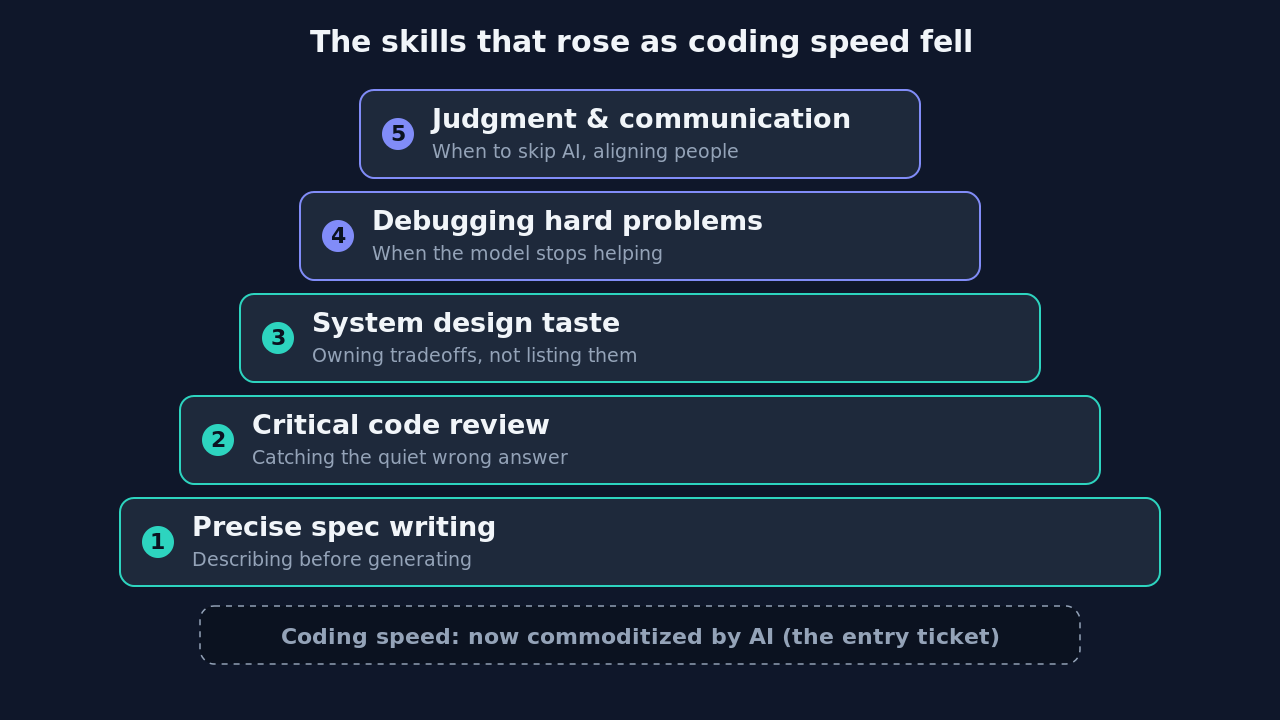
Skill 1: Turning a fuzzy problem into a precise spec
The single biggest jump in my usefulness came from getting better at describing what I wanted before I asked for it. This sounds obvious. It is not.
When you type a vague request into an AI, you get a vague answer that looks confident. "Add caching to this endpoint" produces something. Whether that something respects your invalidation rules, your memory budget, or the fact that two of your services already cache the same object, that depends entirely on how much context you loaded into the request. The model cannot read the parts of your system that live in your head.
So the skill is not prompting in the cute sense. It is the older discipline of writing a specification: stating the inputs, the constraints, the failure modes, and the thing you explicitly do not want. I started writing three or four sentences of spec before generating anything non-trivial, and the quality of what came back changed completely.
# Vague: you will get something, but you own every gap in it
# "write a function to dedupe user events"

# Precise: constraints stated, failure modes named
# "Dedupe a list of user events by (user_id, event_type) keeping the
#  latest by timestamp. Input can be up to 100k items and may contain
#  events with null timestamps, which should be dropped, not kept.
#  Return a new list; do not mutate the input."

def dedupe_events(events):
    seen = {}
    for e in events:
        if e.get('timestamp') is None:
            continue
        key = (e['user_id'], e['event_type'])
        if key not in seen or e['timestamp'] > seen[key]['timestamp']:
            seen[key] = e
    return list(seen.values())
The second version is not a better prompt because it is longer. It is better because it forced me to decide what "dedupe" even meant before the machine decided for me. This is the same shift the industry started calling context engineering rather than prompt engineering, and it is probably the most transferable skill on this list.
Skill 2: Reading code critically instead of trusting it
The flip side of generating code fast is reviewing code you did not write, at a volume you never had to before. This is where a lot of the risk now lives.
AI-generated code has a specific failure signature. It is usually syntactically clean, plausible, and wrong in a quiet way: an off-by-one on a boundary, a missing null check, an auth condition that is subtly too permissive, a query that works on your ten test rows and melts on production data. It rarely fails loudly. That is exactly what makes it dangerous, because the friction that used to catch bad code, the effort of writing it, is gone.
The skill here is old fashioned code review judgment, pointed at yourself. It is one of the problem solving skills that does not show up on a resume but decides whether your source code survives production. When I read AI output now, I read it the way I would read a pull request from a smart stranger who is occasionally overconfident. I ask where the edge cases are, what happens under load, and whether it does anything I did not ask for. The engineers I trust most in this new setup are not the ones who write code the fastest. They are the ones who catch the thing that would have shipped.
If you want to sharpen this deliberately, studying how AI code review actually catches or misses vulnerabilities is a good way to learn the failure patterns before they cost you an incident.
Skill 3: System design and the taste for tradeoffs
Ask an AI to build a URL shortener and it will happily produce one. Ask it whether you should use a relational database or a key-value store for your specific traffic pattern, budget, and team, and it will give you a balanced summary of options without owning the decision. Owning the decision is the job.
System design is the skill that has aged the best, in my experience, because it is fundamentally about tradeoffs that depend on your context. Latency versus cost. Consistency versus availability. Building versus buying. A model can enumerate the options and even recommend one, but it does not carry the consequences, and it does not know the twenty unwritten facts about your organization that make one choice right and another a slow disaster.
I got better at this the boring way, by reading real systems and forcing myself to justify choices out loud. Knowing the rough latency numbers every engineer should have memorized is part of it, because those numbers are what turn a vague "it should be fast" into an actual design. The point is not to have every answer. It is to have the taste to ask the right question and to defend a decision when the AI-generated summary runs out.
Skill 4: Debugging when the AI gets stuck
There is a specific moment that separates people who lean on AI from people who work with it: the moment the model stops helping. You paste the error, it suggests a fix, the fix does not work, you paste the new error, it suggests the same fix reworded. The loop closes and nothing improves.
When that happens, you are back to being an engineer with a debugger and a hypothesis. And debugging is a skill that AI has, if anything, made more valuable, because the bugs that survive AI assistance are the gnarly ones: race conditions, state that leaks across requests, a dependency that behaves differently in production, an assumption three layers down that everyone forgot about. These are not googleable. They require you to build a mental model of the system and narrow the problem down by evidence.
I try to protect this skill on purpose now. When something breaks, I give myself a real attempt at understanding it before I paste it into a chat window. Not out of pride, but because the muscle atrophies fast if you outsource every failure, and the day you actually need it, in an incident, at 2am, with the model shrugging, is the worst possible day to discover it is weak.
Skill 5: Judgment about when not to use AI, and how to work with people
The last one is the least technical and, I think, the most underrated. It is knowing when to close the AI window, and it is the human coordination that no tool touches.
Some tasks are genuinely faster and safer to do yourself. A five-line change to code you know cold does not need a generated draft you then have to review. A security-sensitive path is often not worth the risk of a plausible-but-wrong suggestion. Choosing correctly, spending the AI budget where it pays off and skipping it where it does not, is its own skill, and it only comes from doing the work enough to feel the difference.
The people part matters even more. Most of what makes software hard is not the code, it is the alignment: getting a team to agree on what to build, explaining a tradeoff to product managers, writing the message that unblocks four people at once, mentoring someone junior through a problem instead of just handing them the answer. These are the soft skills and communication skills that no tool touches, and in the real world they decide whether a project ships or stalls. AI does not do any of that for you, and the more code generation becomes a commodity, the more these coordination skills become the thing that actually distinguishes engineers. If you are early in your career, the skills that cannot be faked in an AI-era interview are heavily weighted toward exactly this.
How this changes what you practice
If you buy the argument, the practical follow-through is to shift where you spend your deliberate practice. I stopped grinding for marginal typing speed and started doing a few different things.
I write specs before generating, even for small tasks, until it became a habit. I review AI output as adversarially as I would review a stranger's pull request. I do system design reading with a notebook, justifying every choice. I give myself a real first attempt at every bug before reaching for help. And I pay attention to the human side of the work, the messages and the mentoring, as actual skills rather than overhead.
None of this means coding ability stopped mattering. You cannot review code you cannot read, you cannot design systems you have never built, and you cannot debug what you do not understand. Computer programming, version control systems, and clean programming and coding habits are still the base you stand on. The foundation is still the foundation. What changed is that the foundation is now the entry level ticket, not the differentiator. The list of skills needed for software engineer work at the level that gets you promoted has moved up the stack, from producing code to directing it, checking it, and deciding what should exist in the first place. If you want the data behind the "is this job still safe" anxiety, the software engineer job outlook based on BLS numbers is a more grounded read than most of the panic online.
According to the Stack Overflow Developer Survey, the majority of developers already use AI tools in their workflow, which means the baseline has moved for everyone. When a capability is universal, it stops being an edge. The edge is what you do with it.
Frequently asked questions
What skills are needed for a software engineer in 2026?
The technical foundation still matters: data structures, algorithms, one language you know deeply, and system design. On top of that, the skills that increasingly separate engineers are writing precise specifications, reviewing AI-generated code critically, making architectural tradeoffs, debugging hard problems the AI cannot solve, and communicating well with a team. Coding speed by itself is no longer a differentiator because AI closed that gap for almost everyone.
Will AI replace software engineers?
There is no sign it replaces the role, but it is reshaping it. AI is strong at producing code and weak at the surrounding judgment: deciding what to build, verifying correctness, owning tradeoffs, and coordinating people. Engineers who move up the stack into those areas are hard to replace. Engineers who define their value purely as typing code out fast are more exposed. The honest answer is that the job is changing faster than it is disappearing.
Do software engineers still need to learn data structures and algorithms?
Yes. This is not optional and it is not dying. You cannot review or debug code you do not understand, and algorithmic thinking is what lets you tell a correct AI suggestion from a plausible wrong one. Data structures and algorithms are the foundation that makes every other skill on this list usable. The change is that they are now the entry ticket rather than the whole game.
How do I get better at reviewing AI-generated code?
Read every generated block the way you would read a pull request from a smart but overconfident stranger. Look specifically for quiet failures: boundary conditions, null handling, permission checks that are too loose, and queries that will not scale past your test data. Practicing on real review, and studying known AI failure patterns, builds the instinct faster than just accepting suggestions and hoping.
Is prompt engineering a real skill worth learning?
The valuable version of it is not memorizing magic phrases. It is the older discipline of writing a clear specification: stating inputs, constraints, failure modes, and what you explicitly do not want. That skill transfers across every model and every tool, and it is really just clear thinking about the problem written down. That part is very much worth learning.
If any of this resonated, a lot of it grew out of problems and interview prep I have been working through on Levelop, which is where I keep testing whether these skills hold up under pressure. You can find more of these write-ups on the Levelop blog.