
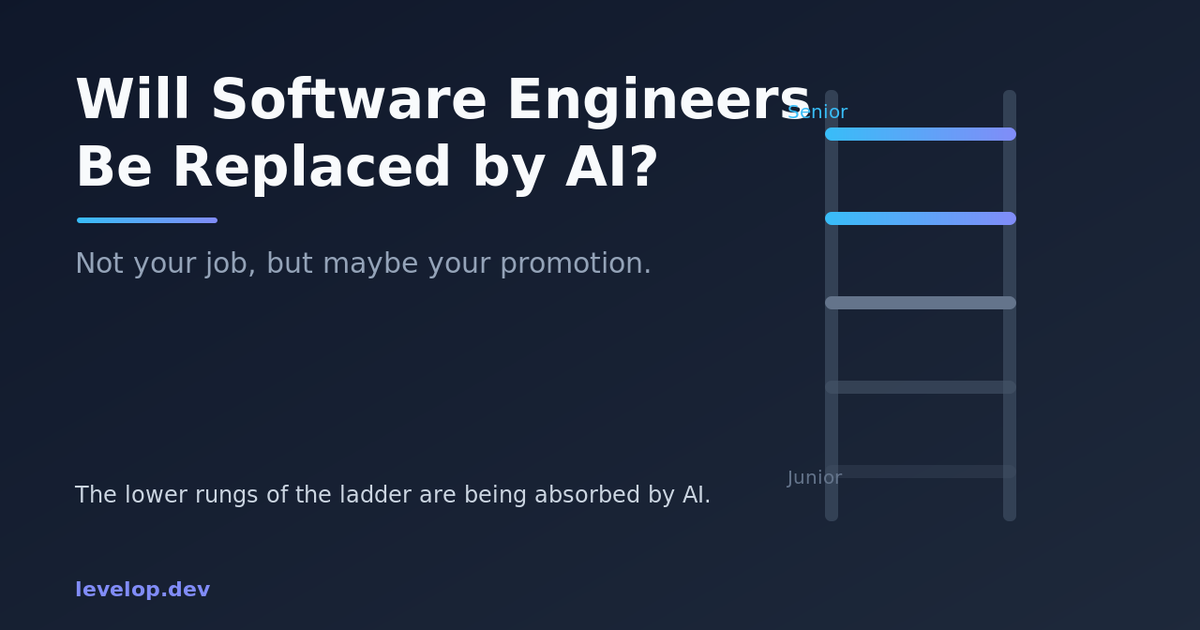
Will Software Engineers Be Replaced by AI?
Ask "will software engineers be replaced by AI" and you get two loud, wrong answers: the doomers who say coding is dead, and the cheerleaders who say nothing will change. The truer answer is quieter. AI is very unlikely to take your job in the next few years. But it is already reshaping who gets promoted, and that is the shift most engineers are not preparing for.
What the Data Actually Says
Start with the labor numbers, because vibes are a poor basis for career decisions. The U.S. Bureau of Labor Statistics projects software developer employment to grow much faster than average this decade. You can read the Occupational Outlook for software developers yourself. A field adding hundreds of thousands of roles is not on the edge of extinction.
Productivity research agrees. GitHub's controlled study found developers completed a coding task roughly 55 percent faster with its Copilot assistant. When a tool makes workers dramatically more productive, demand for that work usually rises. Cheaper software to build tends to mean more software gets built.
Even aggressive forecasts hedge. McKinsey's analysis of generative AI and the future of work estimates that many work activities could be automated, while carefully distinguishing activities from whole jobs. Software engineering bundles hundreds of activities, and AI is excellent at a subset and useless at the rest. So on the narrow question of whether AI will replace software engineers in the near term, the responsible answer is no.
Why Your Job Is Safer Than the Headlines
The "will software engineering be replaced by AI" narrative keeps overshooting reality for three structural reasons.
Software is mostly not typing. Writing code is a small slice of the job. The larger slice is deciding what to build, negotiating tradeoffs, and holding context that lives in a few humans' heads. AI agents generate plausible code and miss the surrounding judgment. An agent will happily ship a function that passes your tests and quietly violates a constraint you forgot to mention.
Accountability does not delegate. When a payment system double-charges customers, a company needs a named person who can fix it and stand behind the fix. You cannot put a model on an incident call and have it own the outcome.
Context is the moat. The hardest part of most work is the undocumented knowledge of why the system is the way it is. We covered this in our guide to context engineering best practices, and the short version is that feeding a model the right context is now a core skill precisely because the model has none of its own.
The Real Threat Is Your Promotion
Here is the part that gets missed. AI is not coming for the median engineer's job. It is coming for the work that used to be the on-ramp to the next level.
Junior engineers earn trust by grinding through well-scoped tickets, fixing bugs, and writing tests. That grind was never just output measured in lines of code. It was how you built judgment, and how your manager built the evidence to promote you. That exact tier of work is what AI does best. When an agent closes a scoped ticket in minutes, the proof-of-competence loop gets shorter and less visible. Engineers who keep doing the same volume of ticket-closing are not at risk of being fired. They are at risk of becoming invisible.
The rungs did not disappear. They moved up, and the bottom ones got slippery.
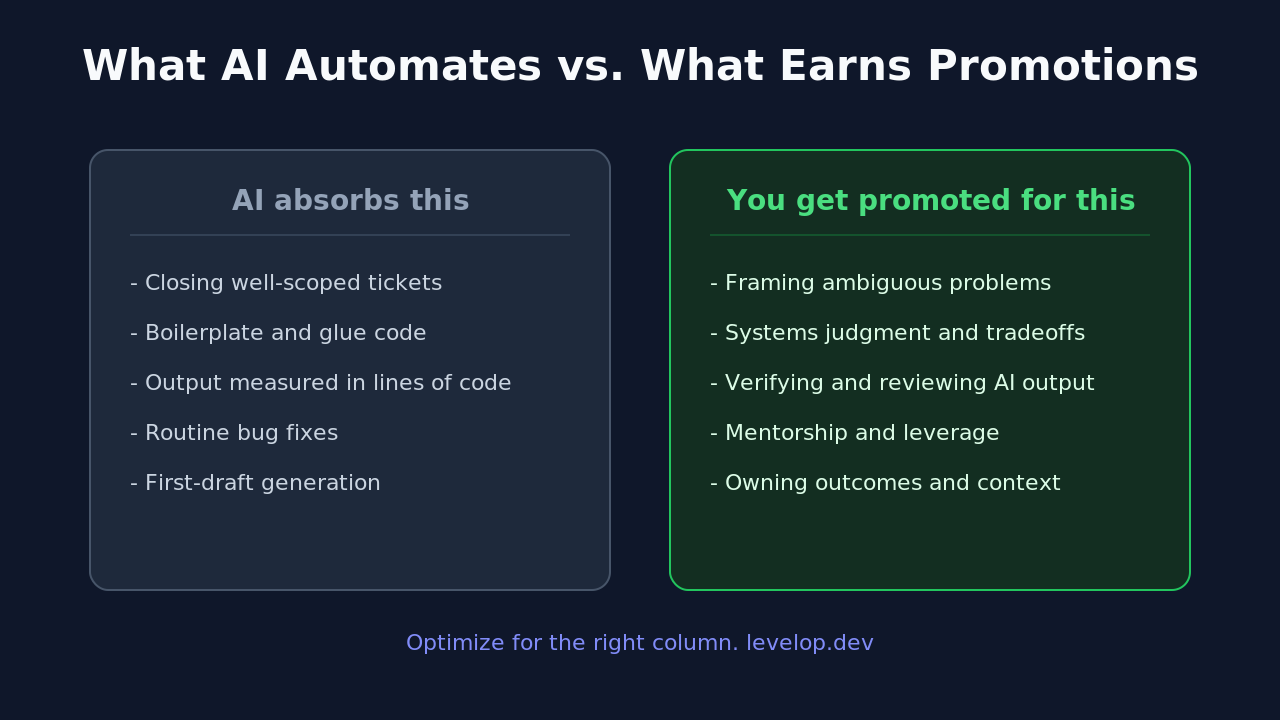
How AI Compresses the Ladder
Three forces squeeze the traditional path at once. Entry-level differentiation collapses: when everyone has an assistant that writes competent code, "writes competent code" stops separating people. Scope becomes the currency: the engineers pulling ahead take ambiguous, cross-cutting problems no agent can be handed. This is the theme from the 10x engineer myth, where the multiplier comes from judgment, not raw output. And managers recalibrate: once AI-assisted teams ship the old baseline faster, that baseline resets, so standing still feels like falling behind.
Put together, these forces do not threaten employment. They threaten mobility, which is a subtler and often more consequential risk.
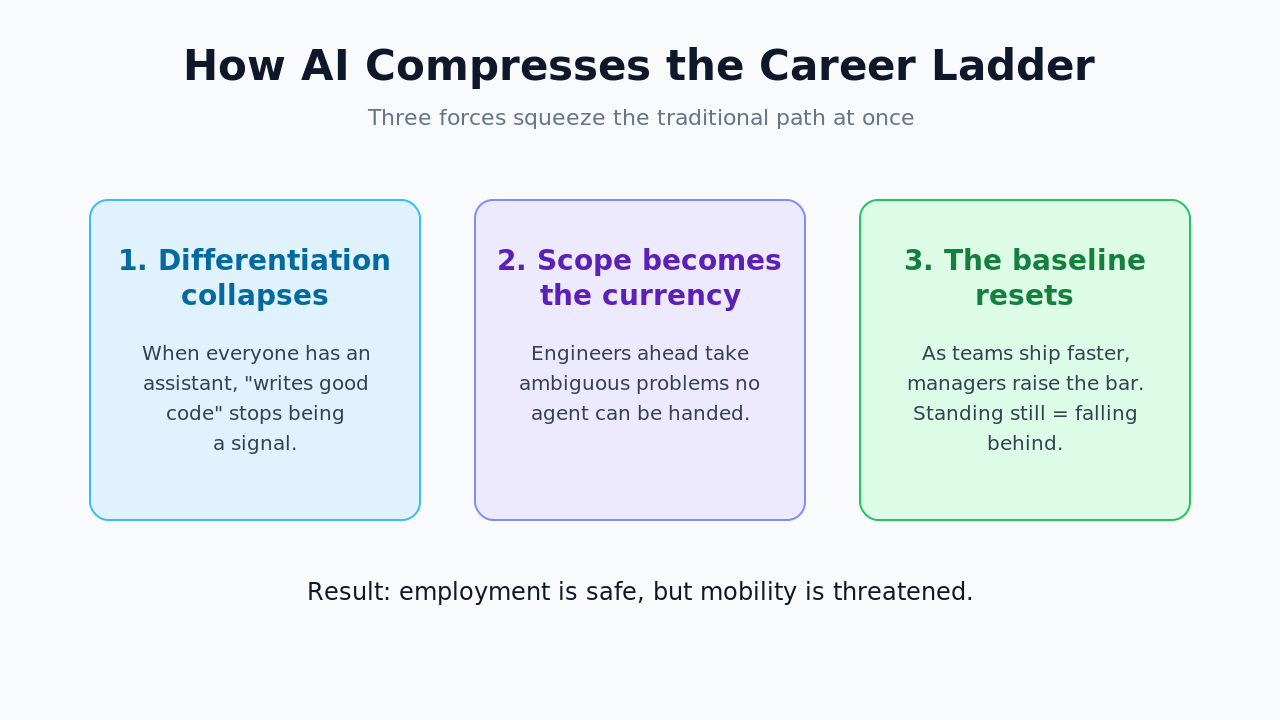
The Skills That Still Get You Promoted
If scoped output is being commoditized, invest in what AI cannot replicate. Problem framing: turning a vague business complaint into a defined technical problem is now more valuable than solving an already-defined one, because agents need a crisp problem before they are useful. Systems judgment: knowing when to add a cache versus fix the query is reasoning built from scars. Leverage and mentorship: reviewing an AI-heavy codebase for the failure modes juniors miss and teaching your team to prompt and verify are promotion-grade work, a lesson that ran through what building an AI mentor taught us. And verification: as generation gets cheap, spotting the one subtle bug in a hundred plausible lines gets expensive.
A Practical Playbook
Understanding the shift is useless without changing what you do on Monday.
Stop counting tickets closed and start counting decisions made, ambiguity resolved, and people leveled up. Make your judgment visible, because promotions run on evidence and AI is doing the visible typing. Write the design doc, comment on the tradeoff in review, and keep a running log of the calls you made.
# promotion-evidence.yml: a lightweight weekly log
decisions_owned:
  - "Chose eventual consistency for the cart service; documented the tradeoff"
leverage:
  - "Reviewed 4 AI-generated PRs, caught a race condition juniors missed"
Move up the abstraction stack deliberately: volunteer for the migration nobody wants to scope. Get fluent with AI tools, then get past them, since directing them well is table stakes now, not a differentiator. This is true even in the vibe coding era, where fast generation still needs someone accountable for the result. And have the promotion conversation early, so you know your manager's new bar before your review, not during it.
Where This Leaves the Profession
The likely future is not that AI replaces software engineers. It is a profession that keeps growing while quietly raising the bar for advancement. Figures like Bill Gates have publicly argued that AI will not replace software engineers wholesale, and the near-term data supports that caution against doom. But "your job is safe" and "your career is on track" are different statements, and the gap is where you should pay attention. The engineers who thrive will let AI absorb the commoditized work and reinvest the freed time into judgment, scope, and leverage. Browse the Levelop blog or start at levelop.dev for more.
Frequently Asked Questions
Will AI replace software engineers entirely?
Not on any timeline the current evidence supports. Employment projections show strong growth, and productivity studies suggest AI makes engineers faster rather than redundant. It automates specific tasks, not the accountability, judgment, and context ownership that define the role.
Will software engineers be replaced by AI for entry-level roles first?
Entry-level roles face the most disruption, but not through mass firings. The scoped work juniors used to prove themselves on is what AI does best, which makes a visible track record harder to build. New engineers should focus early on problem framing and verification.
Will AI replace software engineer jobs in the next five years?
The near-term data points to growth, not collapse. What changes is the definition of good performance. As AI-assisted teams ship faster, managers raise the baseline, so meeting the old bar reads as standing still.
If my job is safe, why worry at all?
Because job security and career mobility are different things. AI is absorbing the exact tier of work that used to earn promotions, so you can be employed and stuck at once. Protecting your trajectory means shifting toward judgment, scope, and leverage.
Will agentic AI replace software engineers as tools get more autonomous?
More autonomous AI agents raise what they can attempt, but they still need a human to frame the problem, own the outcome, and verify the result. Greater autonomy increases the value of engineers who can direct and audit these systems.