
What an AI Mentor Taught Me About How Engineers Learn to Code
I set out to build an AI mentor for coding interview prep, and I ended up rebuilding my entire model of how engineers learn to code. That was not the plan. The plan was a tidy little feature: a chat assistant powered by artificial intelligence that could explain a solution when a learner got stuck. What I got instead was a year of watching real engineers struggle, recover, and improve in ways that contradicted almost everything the standard prep advice assumes. This post is the honest version of that journey, the coding education lessons I did not expect, and what they mean if you are trying to get better at this yourself.
I am writing it as the founder of Levelop, but most of this is not about the product. It is about a stubborn gap between how we tell engineers to study and how learning actually happens in their heads. Building an AI mentor forced me to stare straight at that gap, because a mentor that gets the model wrong does not just underperform. It actively teaches the wrong habit.
Why I thought an AI mentor would be easy, and why I was wrong
My first mental model was embarrassingly simple. A learner hits a wall, the AI mentor explains the answer clearly, the learner reads the explanation, and the gap closes. Information in, understanding out. If that were true, every well-written textbook would already have solved coding education, and we would not have a multi-billion dollar industry built on grinding practice problems.
The first thing the early prototype taught me was that a clear explanation delivered at the wrong moment does almost nothing. I would watch a session replay where a learner was one nudge away from the insight, and the mentor would hand them the entire solution. The learner would nod, mark it understood, and then fail a nearly identical problem twenty minutes later. The explanation was correct. The timing destroyed its value. They had been robbed of the exact struggle that would have built the memory.
That single observation reframed the whole project. I had been treating learning as a delivery problem when it is really a timing and effort problem. The information was never the bottleneck. Every solution I could explain is already on the internet for free. What learners were missing was the structured, slightly uncomfortable process of arriving at the idea themselves.
Lesson one: struggle is the feature, not the bug
The most counterintuitive thing I learned is that productive difficulty is the entire point. There is a well-established idea in learning science called desirable difficulty, the finding that material learned with some effort sticks far better than material that arrives frictionlessly. I had read about it. I did not believe it in my gut until I watched the data from thousands of mentoring interactions.
When the AI mentor jumped in too early, retention cratered. When it held back and instead asked a question that pushed the learner to take one more step on their own, retention climbed. The learners who were mildly frustrated and then broke through outperformed the ones who got smooth, immediate help. Not by a little. The effect was large and consistent enough that we redesigned the mentor around it.
This is why I am allergic to the version of AI tutoring that races to remove all friction. A mentor that makes everything effortless feels great in the moment and teaches almost nothing. The goal is not to eliminate struggle. It is to keep the struggle inside the zone where the learner can still make progress, and to step in only when frustration is about to tip into giving up.
Lesson two: recognition is not understanding, and AI makes the difference brutal
I have written before about how memorizing solutions creates a fragile kind of competence, in the story of how four failed FAANG interviews led me to build a pattern-based platform. Building the AI mentor gave me a microscope on that exact failure mode.
The mentor logs let me see the difference between a learner who recognized a problem and one who understood it. The recognizer would solve a problem fast when it looked like one they had drilled, then stall completely on a variation that shared the same underlying technique but wore a different story. The understander was slower on the familiar case and dramatically more reliable on the unfamiliar one. Same study time. Completely different durability.
What surprised me was how confidently the recognizers misjudged themselves. They rated their own understanding high right before failing a disguised version of a problem they had just solved. The AI mentor became, almost by accident, a calibration tool. By asking a learner to explain why an approach worked before showing whether it passed, it exposed the gap between feeling ready and being ready.
The trap the mentor kept catching:

  Solve familiar problem  ->  feels easy  ->  "I understand this"  ->
  hit disguised variant   ->  freeze      ->  "where did that come from?"

The fix the mentor enforced:

  Before revealing pass/fail, ask: "Why does this technique apply here?"
  If the learner cannot answer, recognition is masquerading as understanding.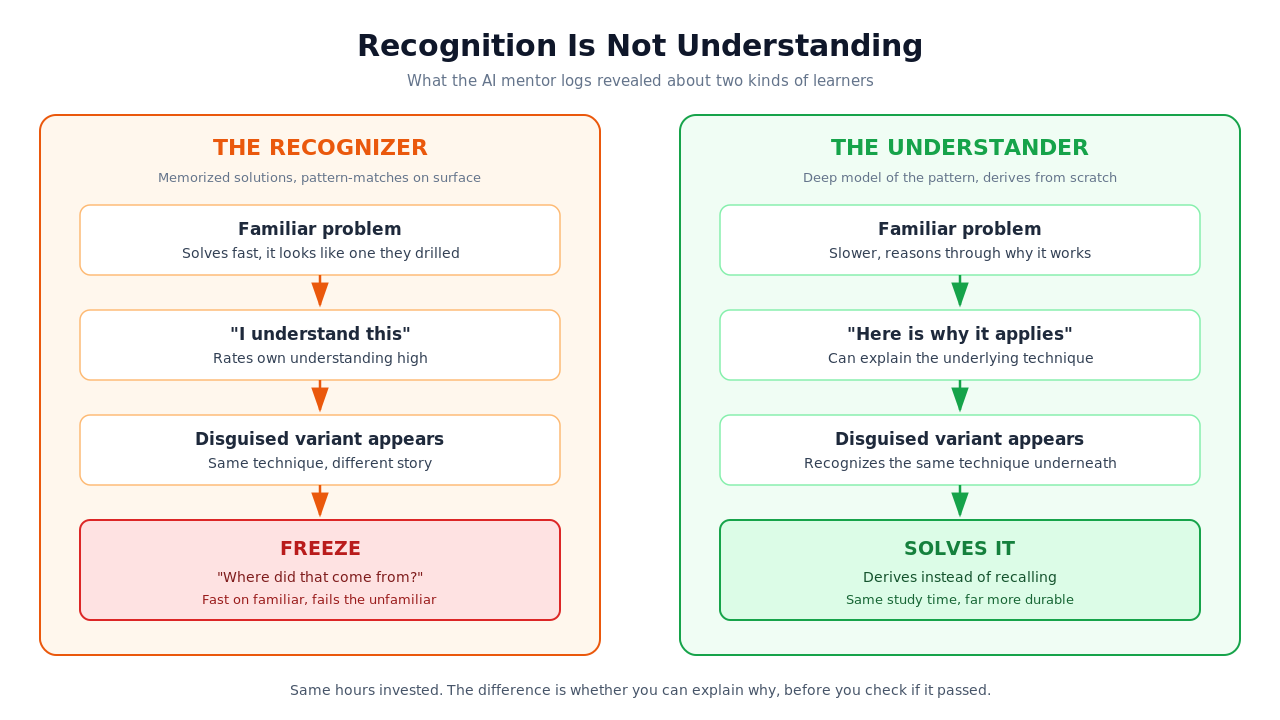
This connects directly to where interviews are heading. As more companies shift from "solve this problem" to asking you to explain existing code, the recognizers are in real trouble and the understanders are suddenly at an advantage. An AI mentor that trains explanation, not just output, happens to train exactly the skill the new format rewards. That alignment was luck more than foresight, but it confirmed the bet.
Lesson three: feedback on judgment beats feedback on correctness
Traditional practice gives you a binary verdict. Accepted or wrong answer. The AI mentor let me experiment with a richer kind of feedback, and the contrast was stark. Telling a learner that their solution was correct teaches them very little. Telling them that their correct solution reached for dynamic programming when a greedy approach was cleaner teaches them judgment, which is the thing that actually transfers.
I learned this lesson myself years ago writing up five greedy problems where I first reached for DP. The mentor scaled that experience. Instead of a checkmark, it could say something like, your approach works, but notice that the feasibility check here is monotonic, which is the tell for binary search on the answer. That kind of feedback reshapes how a person sees the next problem.
This is also where the AI part genuinely earns its place. A static explanation cannot react to the specific suboptimal choice a learner just made. A mentor that reads the actual attempt can point at the precise spot where the judgment went sideways. The teaching moment is not "here is the right answer," it is "here is why your reasonable instinct led you slightly astray, and how to recognize that situation next time."
Lesson four: the best mentor talks less than you expect
I came in assuming a great AI mentor would be eloquent, generating long, polished explanations. The data pushed me the other way. The most effective interactions were short. A single well-aimed question outperformed a paragraph of exposition almost every time.
There is a reason for this. A long explanation puts the learner in a passive, receptive mode. A pointed question puts them back in an active, generative mode, which is where learning happens. The mentor that asked "what is invariant as your window slides?" produced more durable understanding than the mentor that explained the entire sliding window pattern in full. The learner who answered their own question owned the idea. The learner who read the explanation borrowed it.
This was humbling because it meant the most impressive-looking output, the fluent multi-paragraph answer, was often the least useful one. I had to fight my own instinct, and the instinct that large language models have by default, to over-explain. Good mentoring is restraint. The model wants to talk. The learner needs to think.
The Socratic mode that came out of it
We ended up with a mentor that defaults to questions and escalates to explanation only when the learner is genuinely stuck. The progression looks like this in practice.
1. Nudge      A question that points at the gap without filling it.
              "What happens to your sum when the window grows?"

2. Hint       A narrower question or a small piece of the structure.
              "You are recomputing the sum each step. Can you avoid that?"

3. Explain    Only after real effort, the full reasoning, framed so the
              learner sees why their own path almost worked.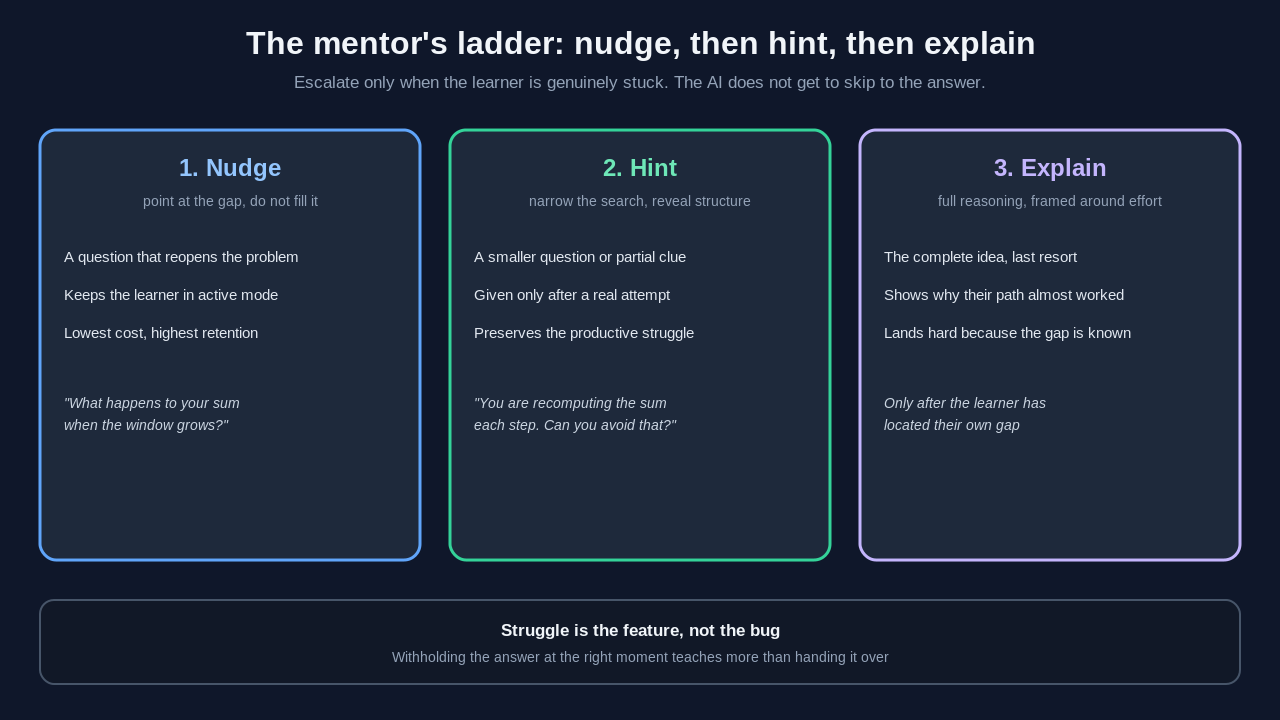
That ladder, nudge then hint then explain, mirrors how a good human mentor actually behaves. The expensive lesson was that the AI does not get to skip to step three just because it can.
Lesson five: understanding twelve things beats touching twelve hundred
The mentor data settled an argument I had been having with the entire industry. The engineers who improved fastest were not the ones who touched the most problems. They were the ones who built deep models of a small number of patterns and then practiced recognizing those patterns in disguise. This is the core thesis behind teaching dynamic programming as a state transition rather than a thing to memorize, and the mentor proved it out at scale.
When a learner truly understood a pattern, the mentor needed fewer and fewer interventions on new problems in that family. Understanding compounds. Each well-learned pattern made the next problem cheaper to crack, because the learner could derive rather than recall. Meanwhile the volume grinders kept needing the same level of help on every new problem, because they had no underlying model to generalize from. You can watch this same effect in how one template quietly solves a whole family of problems, which I broke down in the three DP problems I solved with the exact same template.
What this means for how you should study
You do not need an AI mentor to apply any of this. The whole point is that these are coding education lessons about how engineers learn, and you can run the loop by hand whether you are a beginner trying to learn to code or a senior engineer sharpening for interviews. Here is the practice that the mentor data convinced me actually matters.
Delay the answer on purpose
Before you look at any solution, write one sentence describing exactly where your reasoning stalls. Not "I do not get it," but "I cannot see how to update the state when the input has duplicates." Locating the precise gap is most of the learning, and it makes the eventual explanation land ten times harder.
Explain before you check
After you reach a solution, and before you confirm whether it is right, say out loud why your approach works. If you cannot articulate the reason, you have recognition without understanding, and a disguised version of the problem will catch you. This single habit is the heart of prepping for AI-era interviews, where the format increasingly rewards reasoning over recall.
Keep a pattern journal, not a problem count
Track the small set of patterns you can derive from scratch, with a plain-language note on why each works and the tell-tale sign that a problem wants it. A dozen solid entries carry more interview firepower than a thousand solved problems with no model underneath. This is the same shift that changed everything for me when I stopped counting green checkmarks, a story woven through the whole Levelop blog.
Ask for feedback on judgment, not just correctness
Whether your feedback comes from a mentor, a friend, or your own honest review, push past "did it pass." Ask whether a cleaner approach existed and why you missed it. Judgment is the durable skill, and it only grows when someone or something points at the specific choice you could have made better.
The part that goes beyond code
There is a wider lesson buried in all of this, and it is the one I keep coming back to. We have spent years assuming that coding education is an information problem, that if we just explain things clearly enough, people will learn. Building an AI mentor convinced me that information was never the scarce resource. Effort, timing, calibration, and judgment are the scarce resources, and a good mentor protects those rather than shortcutting them.
That is also why I am cautious about the rush to make learning frictionless with AI. The same tools that can hand a learner an instant answer can, used carelessly, hollow out the exact struggle that builds skill. The interview world is already wrestling with this, from how AI is breaking the coding interview to the complete software engineer interview process in 2026. The answer is not less AI in education. It is AI that understands learning well enough to know when not to help.
Building the mentor did not give me a clever product feature. It gave me a corrected belief. Engineers do not learn by being told. They learn by struggling productively, explaining their reasoning, getting feedback on their judgment, and building deep models of a small number of ideas. Every good thing the AI mentor does is in service of that, and every mistake it makes is some version of forgetting it. That, in the end, is the lesson I did not see coming and will not forget.
Frequently asked questions
What is an AI mentor for coding, and how is it different from a chatbot?
An AI mentor for coding is a system designed to develop a learner's skill over time, not just answer questions on demand. A generic chatbot optimizes for giving you a correct, complete answer as fast as possible. A real AI mentor optimizes for your long-term understanding, which often means withholding the full answer, asking a guiding question first, and giving feedback on your judgment rather than only on whether your code passed. The difference is the goal: immediate help versus durable learning.
What was the most surprising lesson from building an AI mentor?
That a clear explanation delivered at the wrong moment teaches almost nothing. I assumed learning was an information delivery problem, but the data showed that timing and effort matter far more than clarity. Learners who struggled productively before getting help retained the material far better than learners who got smooth, instant explanations. Productive difficulty turned out to be the feature, not a bug to be removed.
Do these coding education lessons apply if I am studying without any AI tool?
Yes, completely. The lessons are about how human learning works, so you can run the same loop by hand. Delay looking at the solution until you have written down exactly where your reasoning breaks, explain why your approach works before you check whether it is correct, keep a journal of patterns you can derive rather than a count of problems solved, and seek feedback on your judgment instead of just a pass or fail verdict. No software required.
Does using an AI mentor make engineers lazier or more dependent?
It can, if the tool is built to remove all friction. A mentor that races to hand you the answer hollows out the struggle that builds skill and creates dependence. A well-designed mentor does the opposite by protecting productive effort, defaulting to questions over explanations, and stepping in only when frustration is about to tip into quitting. The design choice, not the AI itself, decides whether the learner grows or atrophies.
Why does understanding a few patterns beat solving thousands of problems?
Because understanding generalizes and memorization does not. The mentor data showed that learners who built deep models of a small set of patterns needed steadily less help on new problems in that family, since they could derive solutions rather than recall them. Volume grinders needed the same level of help on every new problem because they had no underlying model to transfer. Depth compounds; breadth resets with each new problem.
Written by Avinash Tyagi, founder of Levelop.