
Job Search Strategies That Actually Get You Callbacks
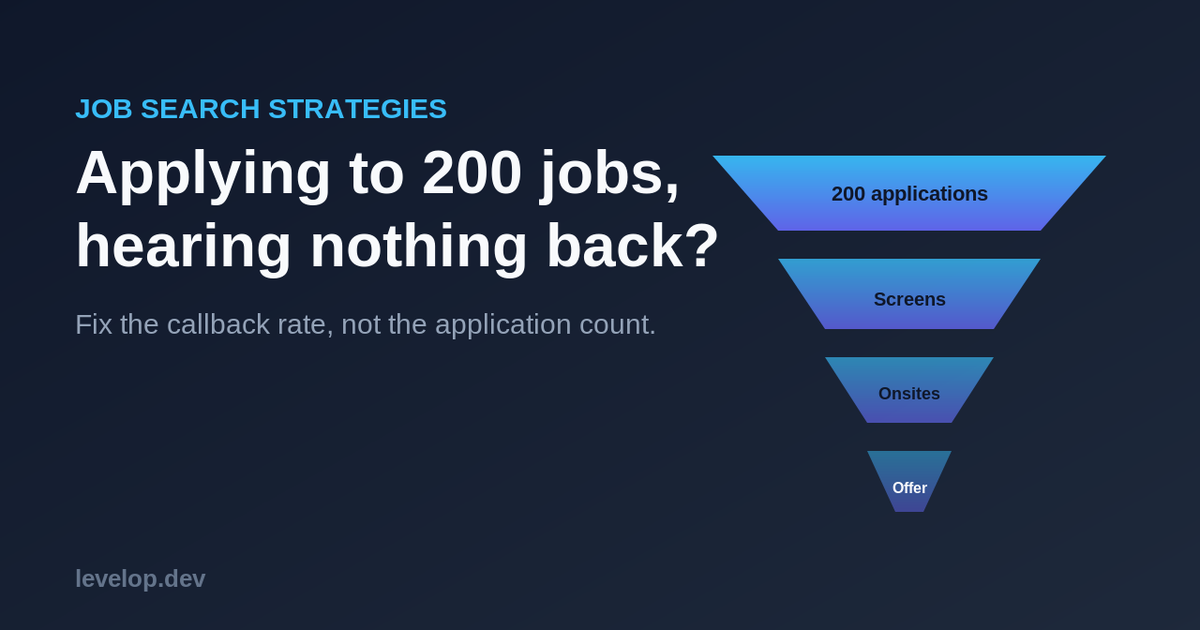
You sent out 200 applications. You tuned your resume, wrote cover letters, and clicked "Easy Apply" until your finger hurt. What came back? A wall of silence, or automated rejections that arrived faster than you could refresh your inbox. If that sounds familiar, the problem is almost never that you are unqualified. The problem is that the job search strategies most engineers use are built for a market that no longer exists.
The volume approach feels productive because it is measurable. But a high application count with a near-zero response rate is not effort paying off. It is a broken funnel, and pouring more applications into a broken funnel just gets you more silence. Here are the job search strategies that consistently move engineers from ignored to interviewing.
Why applying to 200 jobs produces nothing
Start with the math. A single job posting at a well-known company routinely pulls hundreds of applicants within 48 hours. Recruiters cannot read them all, so they lean on the applicant tracking system to filter and then skim the survivors for a few seconds each. Your application competes not on merit alone but on a stack of signals that decide whether a human ever sees it.
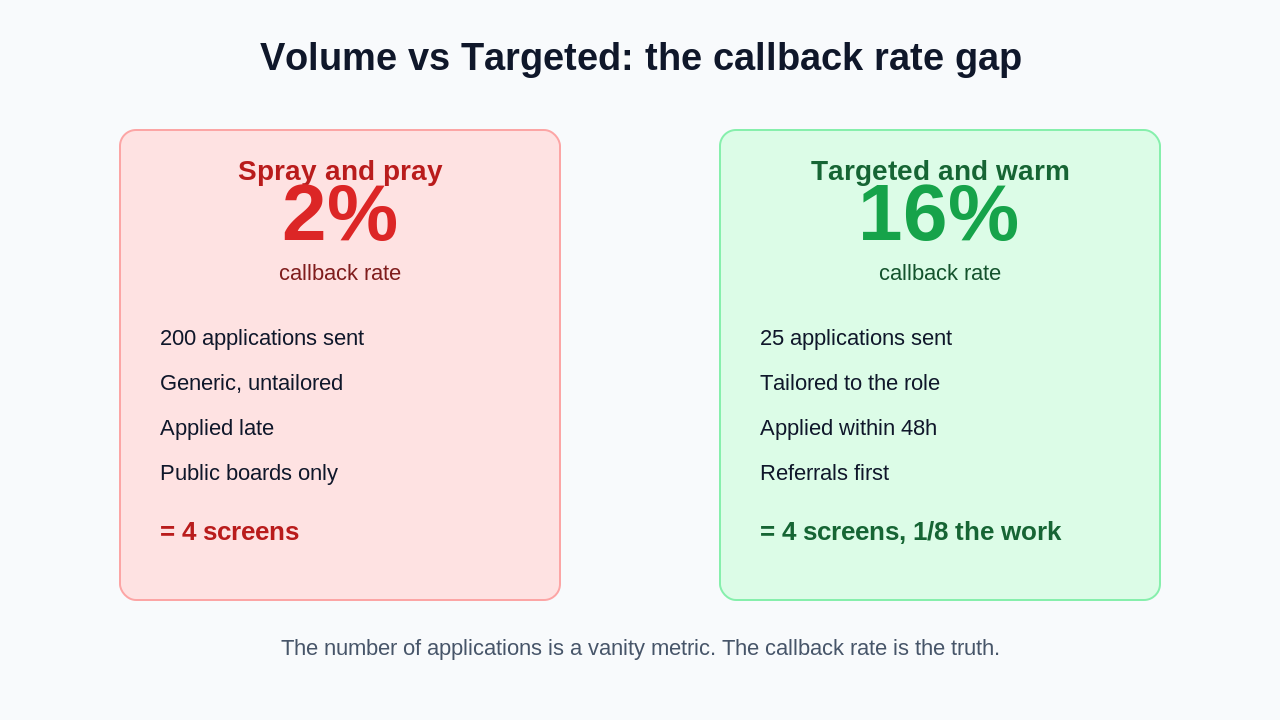
The callback rate is the metric that matters, and most job seekers never track it. It is the percentage of applications that lead to a real conversation with a recruiter or hiring manager. Send 200 applications and get 4 screens, and your rate is 2 percent. Get 4 screens from 25 targeted applications, and your rate is 16 percent for one eighth of the work. The number of applications is a vanity metric. The callback rate is the truth.
Three structural reasons explain the collapse. Timing: job postings decay fast, so applying in week three when a shortlist already exists makes you invisible. Targeting: when you apply to every job opening, you tailor nothing, and generic applications read as generic. The referral gap: a large share of hires come through referrals, so the roles you fight hardest for on public boards are the ones where an insider already has the inside track.
Track your funnel, then target
You cannot improve a number you do not measure. Set up a simple job application tracker and log every application: company, role, date, source (referral, company site, or job board), whether you tailored it, and the response. After twenty rows, patterns jump out. Referrals convert far better than cold boards. Early applications beat late ones. Tailored resumes get replies and copy-paste ones do not.
That diagnosis points to the fix: apply to fewer job openings, done properly. When you narrow to roles that match your background, your resume maps cleanly to the job description and survives the filter, your note can reference something specific, and you have time to find a warm path in. Tailoring does not mean rewriting from scratch. It means leading with the experience that matches the posting and mirroring its language where honest, because the first reader is a keyword filter and the second is a busy human scanning for the exact phrases they wrote.
Be ruthless about fit. A role that wants eight years of Go when you have two is a filter you will fail. Spend that energy where you are a plausible yes. If you want a structured way to gauge whether you are ready for the roles you chase, our complete coding interview preparation guide for 2026 walks through it before you invest weeks in a pipeline.
Referrals: the channel that converts
If one job search strategy outperforms every other, it is the referral. A referred application does not just skip the queue. It arrives with a human vouching for you, which lowers the perceived risk of talking to you and changes how fast it moves. Referrals are learnable, not just lucky. You do not need a huge network, only the one you already have.
Start with former colleagues and classmates. A short, specific message beats a vague ask. Do not say "let me know if you hear of anything." Say "I saw your team is hiring a backend engineer on payments, which maps to my last role, would you refer me or point me to the right person?" When you reach people you do not know well, treat it as relationship building. Engage with their work and build a little credibility before asking. Even career coaches will tell you the warm ask beats the cold one every time.
Do not neglect recruiters. When one reaches out or you land a screen, that first call sets the tone for the whole pipeline. Our breakdown of how to handle the recruiter call covers how to turn those thirty minutes into momentum instead of a dead end.
Timing and channel: apply early, apply narrow
Speed matters more than most people believe. Postings attract the bulk of their applicants in the first few days. Applying within 24 to 48 hours puts you in front of a recruiter while they are still building the pile, not sorting a finished one. Set alerts for the specific companies and roles you want so you hear about job openings early.
Channel choice matters just as much. Public job boards are the most crowded and least effective per application. Company career pages are better because they signal intent. Referrals and direct outreach to hiring managers are best. If you are early in your career, the market is not closed, but the channel mix differs. Our guide to work from home jobs for freshers shows where entry-level candidates find real traction. And because the job market has shifted rather than collapsed, the current software engineer job outlook backed by BLS data helps you aim at demand rather than the most saturated roles.
Diagnose where your funnel breaks
Once you track applications, you can pinpoint the failing stage, and each break has a different fix. Many applications and almost no responses means the break is at the resume or targeting stage; the fix is sharper targeting and a resume that leads with quantified impact. Screens that stall after the recruiter call mean the break is in your story or fit; being able to talk clearly about your experience, including how to talk about failure in an interview, is where strong candidates often lose momentum. Reaching technical rounds but not converting means the break is interview execution, which you fix with structured practice, not more applications.
Build a weekly system
Sustainable job search strategies are systems, not sprints. Spend the first block of your week on research, finding a small set of well-matched roles and the people connected to them. Spend the next on outreach, sending tailored applications and warm referral requests early in the week. Reserve time for interview preparation, because the whole point of a better funnel is to convert the conversations it produces. Cap applications per week and raise the bar on each one. To keep sharpening once callbacks start, the Levelop blog has guides across coding patterns, system design, and interview prep, and Levelop is built to coach you through these exact conversion points.
Frequently asked questions
How many jobs should I apply to in a week?
Fewer than you think, done better. Rather than a fixed number, aim for as many genuinely well-matched, tailored applications as you can complete properly, often five to fifteen a week. Quality, timing, and whether you have a referral matter far more than raw count.
What is a good callback rate for a software engineer job search?
There is no universal figure; it varies by seniority and market. Benchmark against yourself: measure your current rate, then improve it. Cold job-board applications often convert in the low single digits, while referred and tightly targeted applications convert many times higher.
Are referrals really better than applying online?
Yes, and it is not close. A referral moves your application out of the anonymous pile and attaches a trusted signal to it. Activating a handful of former colleagues with specific, respectful asks usually outperforms hundreds of cold applications.
Why am I not getting interviews even though I am qualified?
Being qualified is necessary but not sufficient. The break is usually at the top of the funnel: applications arriving too late, resumes that do not map to the job description, or reliance on crowded channels. Track your funnel, apply early, tailor each resume, and pursue referrals.
Sources and further reading
- U.S. Bureau of Labor Statistics, Occupational Outlook for Software Developers: https://www.bls.gov/ooh/computer-and-information-technology/software-developers.htm
- LinkedIn, guidance on referrals and networking in job search: https://www.linkedin.com/help/linkedin
- Harvard Business Review, research on job search and networking: https://hbr.org/topic/job-search