
How to Solve Coding Interview Problems When You Are Stuck
Every engineer knows the feeling. The interviewer finishes reading the prompt, you nod like you understand, and then thirty seconds later your mind is completely blank. The cursor blinks. The silence gets loud. You start to wonder if you even belong in the room.
Here is the truth almost nobody tells you: getting stuck is not the exception in a coding interview. It is the expected path. Interviewers deliberately pick problems you cannot pattern-match in five seconds, because they want to watch how you think when the answer is not obvious. Learning how to solve coding interview problems is far less about memorizing solutions and far more about having a reliable process for the moment you freeze.
This guide gives you that process: a 3-minute recovery protocol you can run the instant you feel stuck, a worked example that takes a blank mind to a working solution, and the habits that make being stuck a temporary state instead of a dead end.
Why getting stuck is not the failure signal you think it is
Candidates lose interviews not because they get stuck, but because of what they do next. They go silent. They guess randomly. They abandon a half-good idea because it did not feel perfect. The stuck moment itself is neutral. Your response to it is what gets scored.
Research on expert problem solving backs this up. In his classic book "How to Solve It," mathematician George Polya argued that solving hard problems is a matter of method, not raw talent, and that a structured sequence of questions can move almost anyone forward when intuition runs out. The same idea underpins modern interview frameworks used at companies like Google, which publish guidance encouraging candidates to think out loud and work through problems systematically rather than racing to code.
So the goal is not to never get stuck. The goal is to get unstuck on purpose, out loud, in a way the interviewer can follow. That is a learnable skill, and it starts with a protocol.
The 3-minute recovery protocol
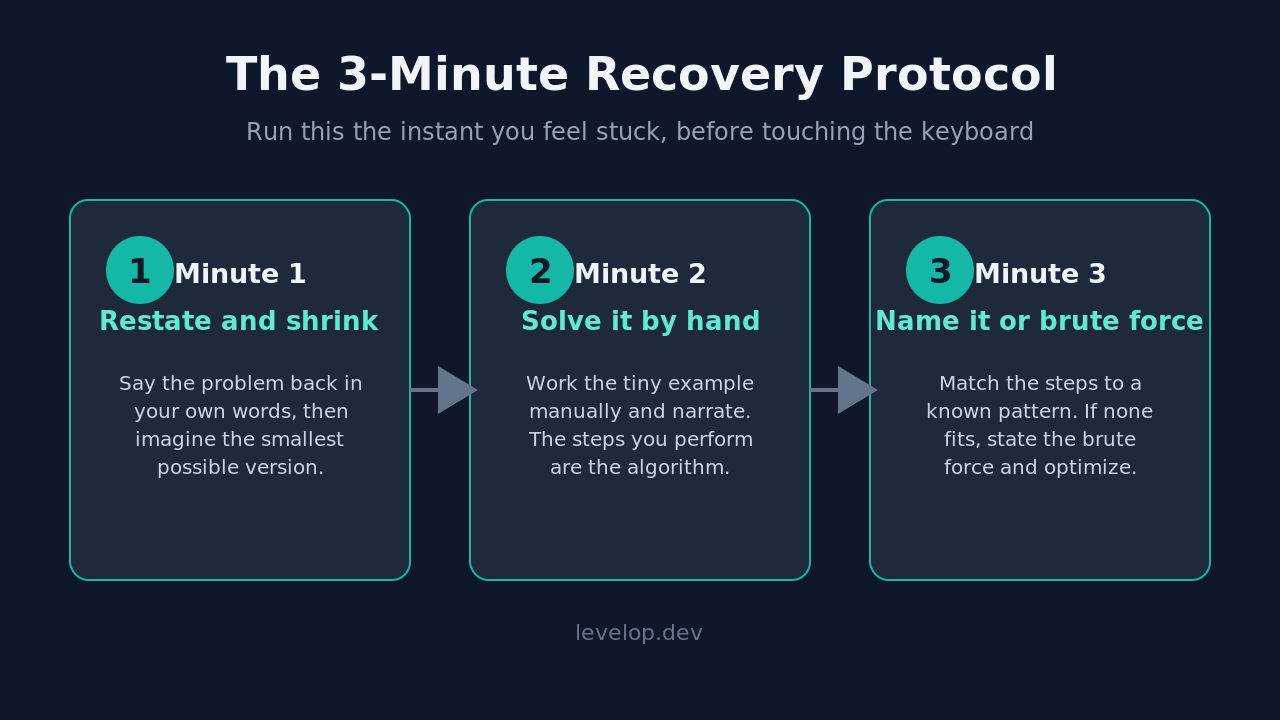
When you feel the panic rising, do not reach for the keyboard. Run this three-step protocol first. Each step takes roughly a minute, and by the end you almost always have a direction, even if it is not the optimal one yet.
Minute 1: Restate and shrink the problem
Say the problem back to the interviewer in your own words. This does two things at once. It confirms you understood the prompt, and it forces your brain to re-encode the problem in language you own rather than the phrasing you just heard.
Then shrink it. Ask yourself what the smallest possible version of this problem looks like. If the prompt is about finding pairs in an array of a million numbers, imagine an array of three numbers. Constraints that feel overwhelming at full scale often become obvious at size three.
Minute 2: Solve it by hand on a tiny example
Take your size-three example and solve it manually, narrating every step. Do not write code. Write the actual answer for the tiny case on the whiteboard or in the shared editor as plain notes.
When you solve a concrete instance by hand, you are reverse-engineering the algorithm. The steps your brain performs on the small case are the algorithm, you just have to notice them and write them down. This is the single most reliable technique for how to approach a coding interview problem you have never seen before.
Minute 3: Name the pattern, or fall back to brute force
Now look at the manual steps you just performed and ask: does this look like a pattern I know? Sorting, two pointers, a hash map lookup, breadth-first search, a sliding window, recursion with memoization. Coding interview problems overwhelmingly reduce to a small set of recurring patterns, which is exactly why we teach twelve patterns instead of grinding thousands of problems.
If no pattern jumps out, do not stall. State the brute-force solution instead. Brute force is not a weakness, it is a checkpoint. It proves you can solve the problem correctly, it gives you a baseline complexity to improve on, and it often reveals the bottleneck that points to the optimal approach.
A worked example: from stuck to solution
Suppose the interviewer asks: given an array of integers, return the indices of the two numbers that add up to a target. You blank. Here is the protocol in action.
Minute 1, restate and shrink: "So I need to find two positions in the array whose values sum to the target, and return those positions. Let me use a tiny example: nums equals two, seven, eleven and target equals nine." Already you have a concrete case.
Minute 2, solve by hand: "Two plus seven is nine, so the answer is indices zero and one. How did I find that? I looked at two, then asked: is there a seven somewhere? Seven equals target minus two. I searched the rest of the array for that complement."
Minute 3, name the pattern: "I was searching for a complement. Searching repeatedly is a hash map signal. If I store each number as I go, I can check for its complement in constant time." You just derived the optimal solution from a hand trace.
def two_sum(nums, target):
    # Map each value to its index as we scan once through the array.
    seen = {}
    for i, num in enumerate(nums):
        complement = target - num
        if complement in seen:
            return [seen[complement], i]
        seen[num] = i
    return []  # No valid pair found
Notice what happened. You did not recall this solution from memory. You reconstructed it from a three-number example in under three minutes. That is the entire point of the protocol: it converts a blank mind into a derivation you can narrate.
Frameworks that turn panic into process
If you want a repeatable scaffold, two well-known frameworks encode the same idea and are worth practicing until they are automatic.
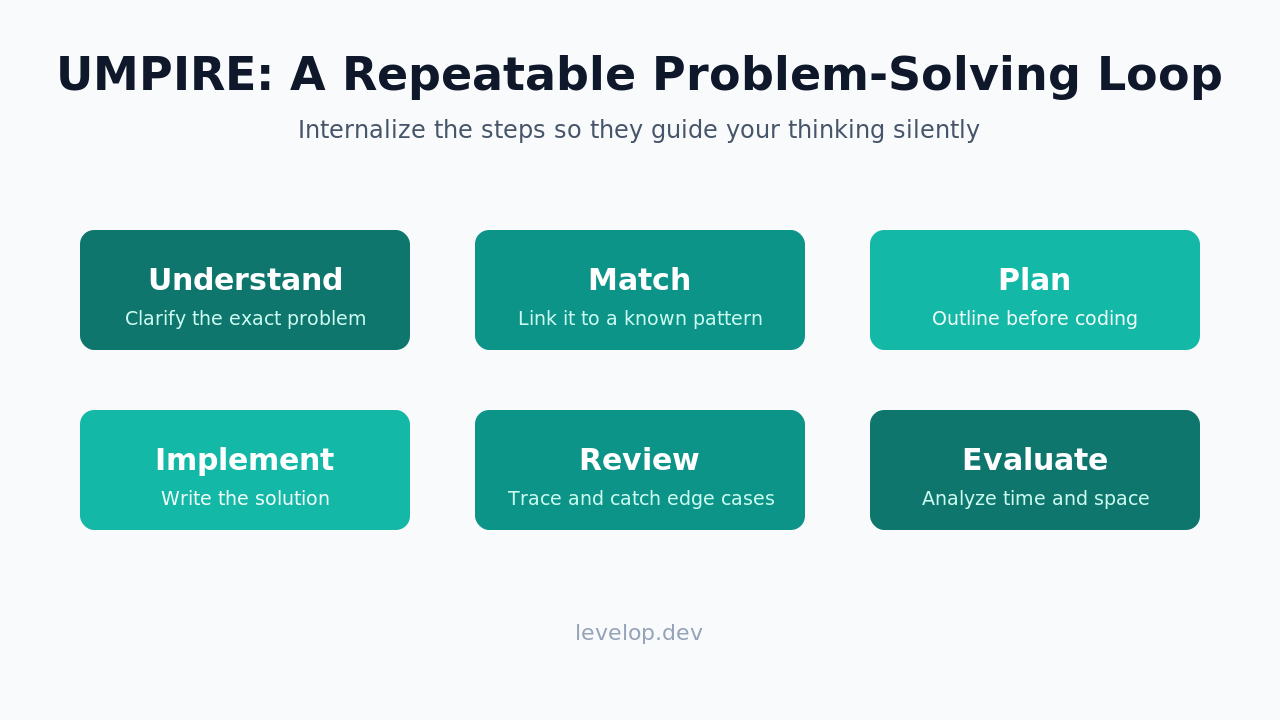
The UMPIRE method, popularized in interview prep communities, walks through Understand, Match, Plan, Implement, Review, and Evaluate. It keeps you from jumping to code before you understand the problem, which is the most common cause of getting stuck twice on the same question.
Polya's four steps, from the mathematics tradition, are even simpler: understand the problem, devise a plan, carry out the plan, and look back. The "look back" step matters more than people think, because reviewing your own solution out loud catches edge cases and demonstrates the senior-level rigor interviewers are screening for.
What to say out loud when you are stuck
Silence is the real killer in a coding interview. The interviewer cannot give you credit for thoughts they cannot hear, and they cannot nudge you toward the answer if they do not know where you are. When you are stuck during a coding interview, narrate honestly:
"Let me restate this to make sure I have it right."
"I am going to try a small example to see the structure."
"My first instinct is a brute-force double loop that is quadratic. Let me get that working, then look for a faster approach."
"I think there might be a hash map optimization here, but I want to confirm the brute force is correct first."
This running commentary is not filler. It is the actual deliverable of a coding interview. Companies are hiring for how you collaborate on hard problems, and thinking out loud is how they measure it. For a deeper treatment of this skill, our guide on communicating your thought process during a coding interview breaks down exactly what to say at each stage.
Common mistakes that keep you stuck
Even strong engineers sabotage themselves in predictable ways. Watch for these.
Jumping to code before understanding the problem. This is the number one cause of getting stuck, because you commit to an approach before you know what you are solving. Spend the first two minutes understanding, always.
Chasing the optimal solution first. Perfectionism freezes people. The candidate who writes a correct brute force in five minutes and then optimizes will out-score the one who stares at the ceiling hunting for the clever trick.
Going silent to think. Thinking is fine. Thinking silently for ninety seconds in an interview is not. Externalize your reasoning even when it feels incomplete.
Ignoring the examples. Interviewers often hand you a sample input and output for a reason. Trace through it by hand before writing anything.
Abandoning a working idea too early. A partial solution is a foundation, not a failure. Build on it rather than scrapping it for a fresh start you do not have time for.
How to build unstuck-ability before the interview
The protocol works in the room, but the real leverage is in preparation. You cannot install a calm, structured response to pressure on the day of the interview. You build it beforehand.
Practice out loud. Solve problems while narrating to a rubber duck, a friend, or a recording. The muscle of speaking while thinking is separate from the muscle of solving, and it atrophies if you only practice in silence.
Study patterns, not problems. Grinding hundreds of random problems teaches you those specific problems. Learning the underlying patterns teaches you how to solve coding interview problems you have never seen. This is why we built our practice approach around a focused set of patterns rather than an endless problem list. You can go deeper in our coding interview practice guide and the coding interview prep guide for 2026.
Time-box your practice. Give yourself the same thirty-minute window you will get in the real interview, and force the recovery protocol when you stall. Rehearsing the stuck-and-recover loop is exactly what makes it automatic. Our 30-minute pacing plan shows how to budget that time under realistic pressure.
Review every solution. After each practice problem, do a Polya-style look back. What was the pattern? Where did you get stuck, and which step of the protocol got you moving again? Over weeks, this builds a personal map of your failure modes and their fixes.
The mindset shift that matters most
Getting stuck is not a verdict on your ability. It is the normal texture of solving hard problems, and it is the precise moment your interviewer is most interested in you. When you treat the stuck moment as the start of a process rather than the end of your chances, everything changes. You restate, you shrink, you solve by hand, you name the pattern or fall back to brute force, and you narrate all of it out loud.
Master that loop and interviews stop being a memory test you might fail and become a thinking exercise you know how to run. That is the difference between candidates who crumble under a hard prompt and candidates who quietly turn it into an offer.
Ready to build the pattern recognition that makes getting unstuck automatic? Explore how Levelop trains engineers on the twelve core patterns and structured problem solving, and start turning stuck moments into solved problems.
Frequently asked questions
What should I do if I go completely blank in a coding interview?
Restate the problem in your own words and write down a tiny example, then solve that small case by hand while narrating. Re-encoding the prompt and working a concrete instance almost always surfaces a direction, and it buys you legitimate thinking time that interviewers respect rather than penalize.
Is it bad to give a brute-force solution first?
No. A correct brute-force solution is a strength, not a weakness. It proves you can solve the problem, establishes a complexity baseline to improve on, and often exposes the bottleneck that points to the optimal approach. State it clearly, then optimize from there. Correct and slow beats clever and broken.
How long should I stay stuck before asking for a hint?
Roughly two to three minutes of visible, narrated effort. If you have restated the problem, tried a small example, and still have no direction, it is fine to ask a targeted question. Asking a specific clarifying question after genuine effort reads as strong collaboration, not as giving up.
How do I stop panicking when I do not know the answer?
Replace the open-ended panic with a fixed procedure. Having a concrete protocol to run, restate, shrink, solve by hand, name the pattern, removes the what do I do now spiral because you always know the next move. Practicing the protocol under timed conditions beforehand is what makes it hold up under real pressure.
Should I keep talking even when I am not sure what to say?
Yes, but narrate your reasoning rather than filling silence with noise. Say what you are trying, what your current hypothesis is, and why. Interviewers score how you think through hard problems, and they can only score what they can hear. Thinking out loud is the actual deliverable of the interview.