
Coding Interview Practice: From Timeouts to 25-Minute Hards
Eighteen months ago I could not finish a medium LeetCode problem inside the 45 minutes a real interview gives you. I would read the prompt, freeze, try three ideas at once, and watch the timer run out with half a solution on the screen. Today I solve most hards in about 25 minutes, and mediums feel routine. Nothing about my raw intelligence changed in that window. What changed was how I practiced.
This post is the coding interview preparation system I wish someone had handed me on day one, the exact coding interview practice routine that turned my speed around. It is not a list of 500 problems to grind. It is a method for turning practice hours into interview speed, and it is the same approach we build into the way we teach at Levelop. If you have been solving problems for months and still feel slow under pressure, the problem is almost never the number of problems you have seen. It is the structure of your practice.
Why Grinding Problems Stops Working
Search how to prepare for coding interview rounds and you will find the same advice everywhere: solve more problems. So most people treat coding interview practice like flashcards. Solve a problem, check the answer, move to the next one, repeat until the count is high enough to feel safe.
The trouble is that speed and calm under pressure do not come from volume. They come from deliberate practice, the same principle that separates expert musicians and athletes from people who merely log hours. Psychologist Anders Ericsson spent decades showing that deliberate practice requires focused effort on your specific weaknesses, immediate feedback, and repetition at the edge of your ability, not comfortable repetition of things you already know.
When you grind random problems, you spend most of your time on patterns you have already internalized because those feel good. The medium that stumped you last week gets skipped because it is uncomfortable. So your weak spots stay weak, and the interview finds them every time.
Step 1: Practice Patterns, Not Problems
There are only about a dozen patterns that cover the overwhelming majority of interview questions. Two pointers, sliding window, binary search on the answer, BFS and DFS on graphs, backtracking, dynamic programming, heaps, union find, monotonic stack, and a handful more. Once you can name the pattern, the code writes itself. This is exactly why we teach 12 patterns instead of 2500 problems: the leverage is in the pattern, not the problem count.
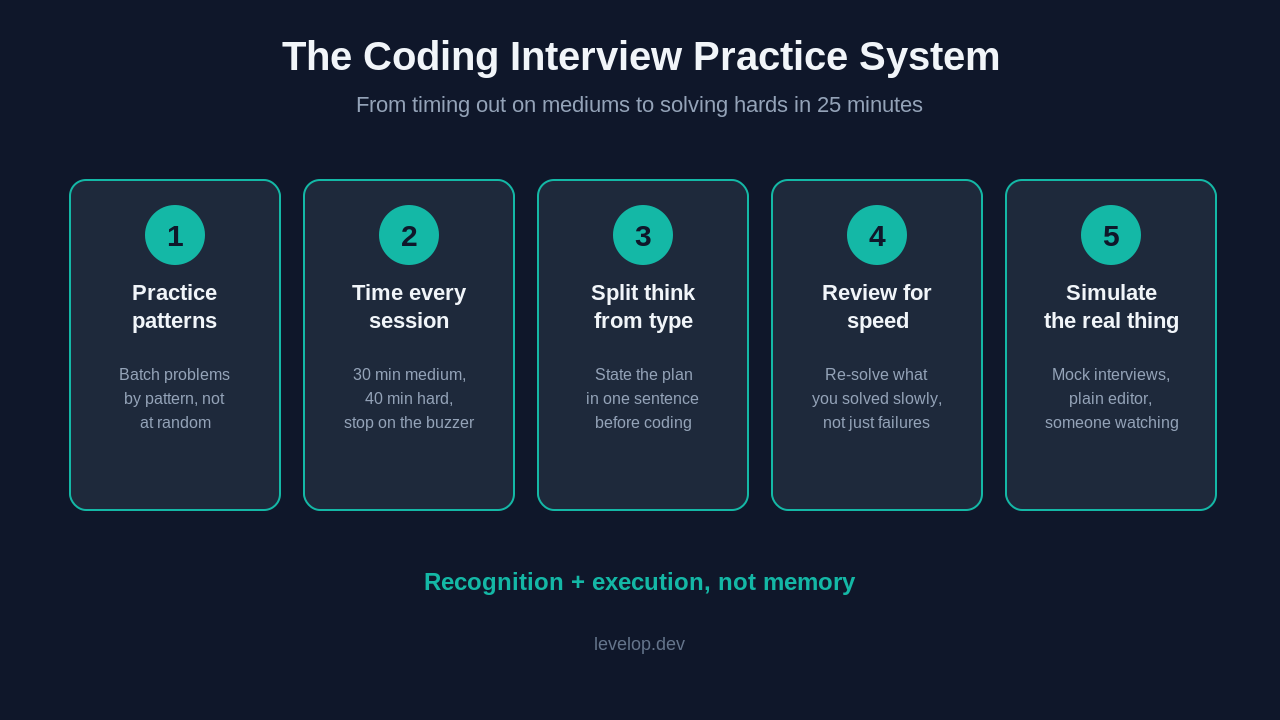
The practice change is simple. Instead of solving problems in random order, solve them in batches by pattern. Do eight sliding window problems back to back. By the fifth one, you stop deriving the technique from scratch and start recognizing the shape of it instantly. That instant recognition is what buys you time in a real interview.
Here is the sliding window template I drilled until it was muscle memory:
def sliding_window(nums, k):
    left = 0
    window_sum = 0
    best = float('-inf')
    for right in range(len(nums)):
        window_sum += nums[right]        # expand the window
        if right - left + 1 > k:         # window too big
            window_sum -= nums[left]     # shrink from the left
            left += 1
        if right - left + 1 == k:        # window is exactly right
            best = max(best, window_sum)
    return best
When I see a problem that mentions a contiguous subarray or substring with a constraint, my hand starts typing this skeleton before I have finished reading. That is the difference speed makes. I am not solving from zero. I am adapting a template I already own.
Step 2: Time Every Session Like It Is Real
The single biggest change to my coding interview practice was adding a clock. For months I had practiced with no time pressure, telling myself I would speed up later. Later never came, because untimed practice trains a completely different skill than the one the interview tests.
I started giving myself 30 minutes per medium and 40 per hard, matching real interview constraints. When the timer ended, I stopped, even mid-solution. Then I studied what went wrong. Did I spend twelve minutes stuck on the approach? Did I know the pattern but fumble the implementation? Timed practice makes your bottleneck visible in a way that untimed practice hides. For a full breakdown of how to spend those minutes during the interview itself, we wrote a 30-minute pacing plan that maps out exactly where each minute should go.
Step 3: Separate Thinking Time From Typing Time
One reason people time out is that they blur two very different activities. Figuring out the approach and writing the code are separate skills, and blending them is where minutes disappear. In my timed sessions I forced a hard split. The first block was for thinking only, no typing. I talked through the approach out loud, named the pattern, sketched the data structures, and only started coding once I could state the plan in one sentence.
This split does two things. It stops you from writing code you will delete two minutes later, and it rehearses the exact skill interviewers grade you on, which is communicating your thought process before you touch the keyboard. An interviewer who can follow your reasoning will give you hints when you stall. An interviewer watching you type in silence cannot help you at all.
Here is the one-sentence plan format I use before writing a single line:
Pattern: <name the pattern>
Data structure: <what I'll store and why>
Loop invariant: <what stays true each iteration>
Edge cases: <empty input, single element, duplicates>
If I cannot fill in all four lines, I am not ready to code yet, and forcing myself to code anyway is how sessions run long.
Step 4: Review Solved Problems, Not Just Failed Ones
Most people only revisit problems they got wrong. That is half the value. The problems you solved but solved slowly are a goldmine, because they show you patterns you know but execute inefficiently. I built a weekly review where I re-solved every problem I had finished that week, but this time optimizing for speed rather than correctness.
The second pass is almost always dramatically faster, and that speed is the whole point. The interview does not reward you for eventually solving a problem. It rewards you for solving it inside the window with time left to test your code. Re-solving known problems is how you push a 35-minute solve down to a 20-minute solve.
Step 5: Simulate the Real Environment
The final piece of my coding interview practice was ruthless simulation. A real technical interview is not a solo session in your favorite editor. They happen in a plain shared document, with someone watching, and with the pressure of a stranger judging you. So I practiced that way. I used a bare text editor with no autocomplete. I explained my approach out loud to an empty room. I ran mock interviews with friends who played the interviewer and stayed silent while I struggled.
The first mock coding interview was humbling. I was noticeably slower with someone watching, even on problems I had solved cleanly the day before. That gap between solo speed and observed speed is exactly what you want to close before the real thing, and the only way to close it is to practice under observation. If you want a structured warmup before you begin, our coding interview prep guide lays out a full timeline from first problem to interview day.
A Realistic Weekly Practice Plan
Here is roughly how I structured a week once the system clicked. Adjust the numbers to your available time, but keep the proportions.
Monday    Pattern drilling: 6-8 problems, one pattern, timed
Tuesday   Pattern drilling: a second pattern, timed
Wednesday Mixed timed set: 3 random problems, full interview timing
Thursday  Speed review: re-solve Monday and Tuesday problems faster
Friday    Mock coding interview: 1-2 problems, someone watching, out loud
Weekend   Rest or light reading, review your practice log
Notice how little of this week is spent seeing brand new problems. Two days of new material, then three days of extracting more value from what you already touched. That ratio is the opposite of how most people practice, and it is why most people plateau.
What Actually Changed My Speed
Looking back, the jump from timing out to 25-minute hards came down to a mindset shift. I stopped measuring my coding interview practice by how many problems I had seen and started measuring it by how fast I could recognize and execute a pattern. Volume made me feel productive. Structure made me fast.
If you take one thing from this, let it be this: your practice should be uncomfortable in a specific way. It should target the exact pattern you fumble, under the exact time pressure you fear, in the exact plain environment you dread. Comfortable practice feels good and changes nothing. The uncomfortable kind is where the speed lives.
We built Levelop around this idea, teaching a small set of patterns deeply and drilling recognition under time pressure rather than pushing an endless problem count. However you practice, structure your hours around recognition and speed, and the timeouts will stop.
Frequently Asked Questions
How many hours of coding interview practice do I need?
Quality matters far more than raw hours. Most people who practice deliberately, meaning timed, pattern-focused, and reviewed, see real gains in six to eight weeks of consistent daily sessions of about ninety minutes. Grinding four hours a day of random problems often produces slower improvement because the practice is not targeted.
Should I practice easy, medium, or hard problems?
Spend most of your time on mediums, because that is the level most interviews actually test. Use easy problems to warm up and to learn a new pattern cleanly, and use hards to stress-test patterns you already know. If you can solve mediums quickly and calmly, most interviews are within reach.
How do I stop timing out during coding interviews?
Add a clock to every practice session and separate your thinking time from your typing time. Timing out usually comes from starting to code before the approach is clear. Force yourself to state the full plan in one sentence before you type, and practice that split until it is automatic.
Is LeetCode enough for coding interview practice?
LeetCode is a strong problem source, but a problem bank is not a practice system. You still need to organize problems by pattern, time yourself, review solved problems for speed, and simulate the observed environment. The platform gives you the raw material, not the method.
How important are mock interviews?
Very important, and most people underuse them. Solo speed and observed speed are different skills, and the only way to close the gap is to practice with someone watching. Start mock interviews weeks before your real one, not days before, so your nervous system has time to adjust.