
Coding Interview Tips: The 30-Minute Minute-by-Minute Plan
Back with another one in the series where I break down the parts of engineering interviews that tripped me up. This time it is not an algorithm. It is the clock.
Most coding interview tips focus on what to study. Patterns, data structures, the list of two thousand problems everyone tells you to grind. That advice is fine, but it skips the thing that actually sank me the first few times.
I knew the material and still ran out of time. I would spend twelve minutes reading the prompt, freeze, then rush the code with four minutes left and never get to test it. The problem was never knowledge. It was pacing.
So this post is about coding interview time management. A single 45-minute coding round usually gives you about 30 minutes of real problem-solving once you subtract intros and questions at the end. Here is how to spend those 30 minutes so you never get caught coding a solution you have not thought through.
Why the clock is the real interviewer
The interviewer is not just checking whether you can produce a correct function. They are watching how you move through ambiguity, how you communicate, and whether you can manage yourself under pressure. A candidate who calmly narrates a decent solution almost always beats one who silently produces a perfect one at minute 44.
The reason pacing matters so much is that every phase of the interview feeds the next. Skip clarifying the problem and you code the wrong thing. Skip the brute force and you jump to an optimization you cannot justify. Skip testing and you hand over code with an off-by-one error the interviewer spots in two seconds. Time pressure turns small skips into a chain reaction.
The fix is boring but reliable: give each phase a budget and stick to it. Once you have run the same 30-minute structure a dozen times in practice, it stops feeling like a constraint and starts feeling like a rhythm.
The 30-minute anatomy
Here is the budget I now use for a standard single-question coding round. Adjust the numbers to your own speed, but keep the shape.
- Minutes 0 to 5: understand and clarify the problem.
- Minutes 5 to 10: state a brute-force approach out loud.
- Minutes 10 to 15: find the optimization and commit to it.
- Minutes 15 to 25: write the code.
- Minutes 25 to 30: test, trace, and handle edge cases.
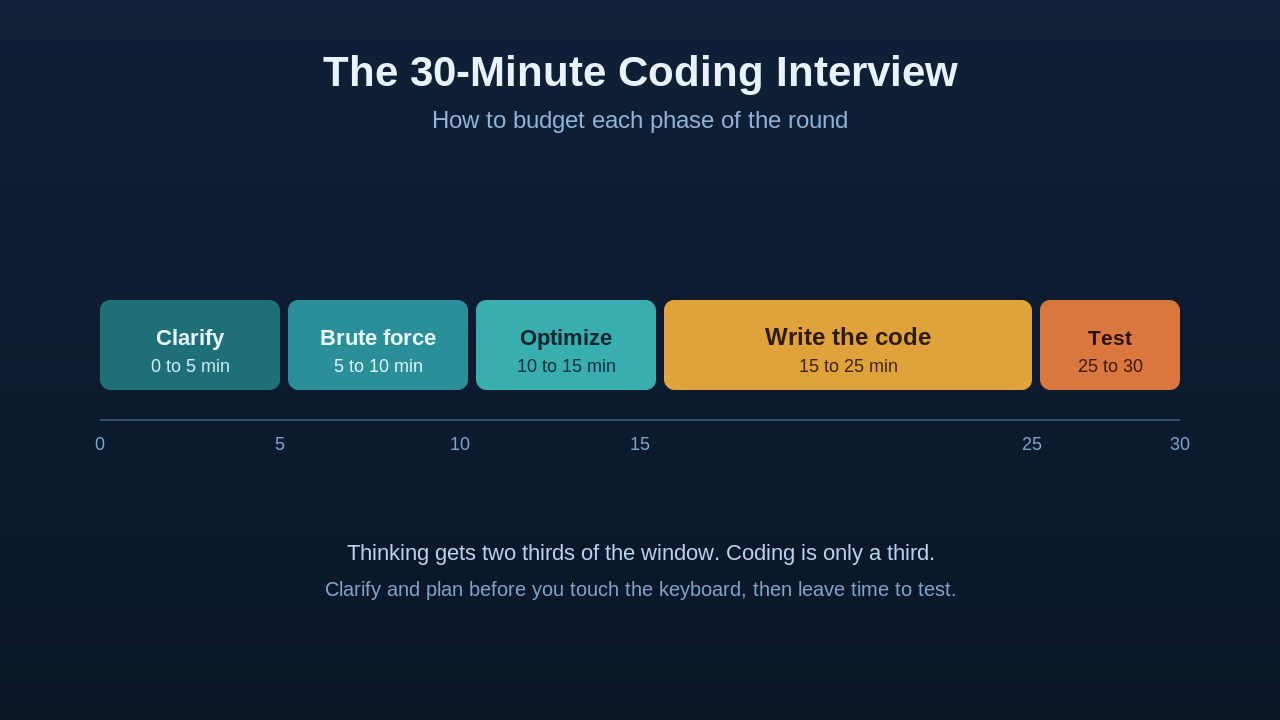
Notice that actual coding is only a third of the window. Beginners flip this ratio, spending twenty minutes typing and five minutes thinking. The strongest coding interview preparation you can do is to invert that instinct.
Minutes 0 to 5: clarify before you touch the keyboard
Do not start solving. Start understanding. Read the prompt out loud, then restate it in your own words and ask the interviewer to confirm. This single habit catches more mistakes than any pattern you will memorize.
Ask about the shape of the input. Can the array be empty? Are the numbers sorted? Can there be duplicates or negatives? What is the expected size, ten elements or ten million? Size hints at the target complexity. If the interviewer says the input can be a billion items, they are quietly telling you an O(n squared) solution will not cut it.
Write two or three concrete examples by hand, including one tiny edge case. These examples become your test cases later, so you are doing double duty. When you can predict the output for your own examples, you actually understand the problem.
Minutes 5 to 10: brute force, out loud
Your first solution should be intentionally naive. Say it plainly: 'The simplest thing that works is to check every pair, which is O(n squared). Let me start there and improve it.' This does three things. It proves you can solve the problem at all, it gives you a correctness baseline, and it usually reveals the redundant work that the optimal solution removes.
Resist the urge to stay silent while a clever trick forms in your head. The interviewer cannot score thoughts they cannot hear. Narrating the brute force is one of those coding interview tips that feels awkward the first time and pays off every time after. If you go blank at the optimal step, you still have a working approach on the board and partial credit in hand.
Minutes 10 to 15: optimize and commit
Now improve the brute force. Ask yourself the standard questions. Am I recomputing something I could store? A hash map often turns O(n squared) into O(n). Would sorting help? Is there a two-pointer or sliding-window shape here? Does the problem have overlapping subproblems that point to dynamic programming?
The trap in this phase is analysis paralysis. You find one optimization, then start doubting it and hunting for a better one, and suddenly it is minute 20 and you have not written a line. Set a rule: once you have an approach that hits a reasonable complexity, state the time and space cost, get a nod from the interviewer, and commit. A good solution you finish beats a perfect one you never write.
If you want a deeper library of these reusable shapes, I wrote about why we teach a small set of patterns rather than an endless problem list in why Levelop teaches 12 patterns instead of 2500 problems.
Minutes 15 to 25: write the code
With the approach locked, coding should be the calmest part. You are transcribing a plan, not inventing one. Keep narrating, but lighter now: 'I will iterate once, store seen values in a map, and check the complement.'
A few habits that save time here. Name variables so you do not confuse yourself under pressure. Write the main loop first and fill helper details after. Do not silently refactor three times. If you spot a cleaner structure, say so before you rewrite, so the interviewer follows your reasoning.
def two_sum(nums, target):
    # map value -> index, filled as we scan
    seen = {}
    for i, n in enumerate(nums):
        complement = target - n
        if complement in seen:
            return [seen[complement], i]
        seen[n] = i
    return []  # no pair found
That is the whole point of the earlier phases. Because you clarified the input and chose the map approach out loud, the code above writes itself in two minutes and you still have eight left for the part most people skip.
Minutes 25 to 30: test like the interviewer will
Never announce 'done' and lean back. Walk your code line by line with a real example, playing the interviewer. Trace the two or three examples you wrote in minute 3, then deliberately try to break it. Empty input. A single element. Duplicates. The value that lands exactly on a boundary.
If you find a bug, narrate the fix instead of silently editing. 'My loop misses the last index, let me adjust the range.' Catching your own bug is a strong signal. It shows you test your work, which is exactly what the interviewer wants to see in a teammate.
What to do when you are completely stuck
Pacing helps most when things go wrong. If you hit a wall and three minutes pass with no progress, switch modes on purpose. Go back to a concrete example and solve it by hand, slowly, watching what your brain does that your code does not. The manual steps are usually the algorithm.
If that fails, say what you know out loud. 'I know I need to avoid the repeated scan, and a hash map usually does that, but I am not seeing the key yet.' Interviewers often nudge you when you externalize the blocker, and a nudge you earned by thinking out loud is not a penalty. Silence is the real killer.
Adjust the plan for the round you are in
Not every round is a clean 30 minutes on one problem. A recruiter phone screen might hand you a single easy question in 20 minutes, while an onsite loop can stack two mediums into 45. The five phases still apply, you just scale the budget. For a shorter slot, compress the optimization phase and get to code faster, because the interviewer usually cares more about a clean working answer than a perfect one. For a longer slot with two problems, treat each as its own mini 20-minute cycle so a slow first problem does not eat into the second.
The other variable is difficulty. On an easy problem, do not pad. Clarify quickly, state the approach, code it, and spend the saved minutes on thorough testing and a short complexity discussion. On a hard problem, spend more of your budget in the clarify and brute-force phases, because the whole game is finding the insight, and rushing to code before you have it is exactly how people freeze.
This is where general coding interview preparation pays off. If you have practiced the common patterns, you recognize the shape of a problem during the clarify phase and your optimization step takes two minutes instead of ten. Learning how to prepare for a coding interview is really about building enough pattern recognition that the clock stops being the enemy. The pacing plan is the frame, and your preparation is what fills it in.
Common mistakes I made
The first time, I treated the interview like a race and started coding at minute two. I wrote fast, wrong code and spent the rest of the time debugging something I never understood. The clock ran out mid-fix.
The second time, I over-corrected. I found a decent solution at minute nine, then kept searching for something more elegant and talked myself out of three working approaches. I coded nothing until minute 22 and never tested it. Same failure, opposite cause.
What finally worked was the fixed budget. Not because it is optimal for every problem, but because it removes the decision of when to move on. The timer decides, so I do not spend willpower on it. That freed up the attention I had been wasting on panic.
How to practice the clock
Studying patterns and studying pacing are different skills, and most people only train the first. When you practice, set a real 30-minute timer and force yourself through all five phases even on easy problems. Do mock interviews where someone watches you talk, because narrating changes everything. Record yourself once and you will hear every place you went silent.
If you are still building the underlying toolkit, the pacing plan sits on top of solid fundamentals. Our full walkthrough of coding interview preparation in 2026 covers the patterns to learn first, and the piece on how to communicate your thought process goes deeper on the narration habit that ties all five phases together. For a neutral complexity reference while you practice, the Big-O cheat sheet is worth bookmarking.
Frequently asked questions
How long is a typical coding interview?
Most on-site and virtual coding rounds run 45 minutes to an hour. After introductions and time for your questions at the end, you usually get about 30 minutes of active problem-solving. Plan your pacing around that 30-minute core rather than the full slot.
Should I really spend five minutes before writing any code?
Yes. Clarifying the input and writing a couple of examples up front is the highest-return five minutes in the interview. It stops you from solving the wrong problem, and your examples double as test cases at the end.
What if I finish early?
Use the extra time to test more aggressively, analyze time and space complexity, and mention how you would extend the solution for a larger input or a follow-up constraint. Finishing early is a chance to show depth, not a reason to stop talking.
Is it bad to give the brute-force solution first?
No. Stating an O(n squared) baseline out loud is a strength, not a weakness. It proves you can solve the problem, gives you a correctness check, and makes the optimization easier to explain. Just do not stop there if you can improve it.
How do I get better at coding interview time management?
Practice with a timer and treat pacing as its own skill. Run mock interviews, narrate everything, and rehearse the five-phase budget until it is automatic. Knowing the pattern is not enough if the clock still rattles you.
I have been working through timed problems on Levelop, and the pacing habit above came out of failing enough timed rounds to finally take the clock seriously.