
Behavioral Interviews Aren't Soft: They're the Round That Eliminates Senior Candidates
Most engineers treat the behavioral interview as the easy round. You show up, tell a few stories about projects you shipped, stay friendly, and wait for the "real" test in the coding and system design loops. That framing is exactly why strong engineers get downleveled or rejected after acing the technical bar.
For senior and staff candidates, the behavioral round is not a warm-up. It is often the single round with the most veto power. A hiring committee can look at a clean coding score and still decline the offer because the behavioral signal said "this person operates one level below where we are hiring." The technical rounds prove you can do the work. The behavioral round decides how much scope you can be trusted with, and at senior levels scope is the entire question.
This post breaks down the behavioral interview questions that decide senior offers, why behavioral interviews eliminate senior candidates, what interviewers are actually scoring, and how to structure answers that read at the level you are targeting. If you want the broader picture of how hiring is shifting, our take on how AI is breaking the coding interview pairs well with everything here.
Why "soft" is the wrong word for this round
Calling behavioral interviews "soft skills" rounds is a marketing accident that has cost a lot of people their target level. The label implies the round measures friendliness or communication polish. It does not. It measures decisions: how you scoped ambiguous problems, how you handled conflict with real stakes, how you made calls under uncertainty, and what happened as a result.
Those are not soft signals. They are the exact behaviors that separate a mid-level engineer who executes well-defined tasks from a senior engineer who defines the tasks in the first place. According to guidance from the Tech Interview Handbook, behavioral interviews assess judgment, collaboration, and leadership, and the weight on these signals climbs with every level. The higher you interview, the more the behavioral round carries.
There is also a volume shift worth noticing. Industry write-ups in 2026 estimate that companies now spend a majority of interview time on behavioral and experience-based questions rather than pure algorithms, precisely because these are the human judgment signals that generative AI cannot fake for a candidate. When a whiteboard can be assisted by a model, the story of how you actually led a migration becomes more valuable, not less.
What interviewers are actually scoring
Interviewers are not grading your storytelling for entertainment. They are collecting evidence against a rubric, and then writing that evidence into a packet the hiring manager and committee read. When you understand the rubric, the round stops feeling random.
Scope and impact, not effort
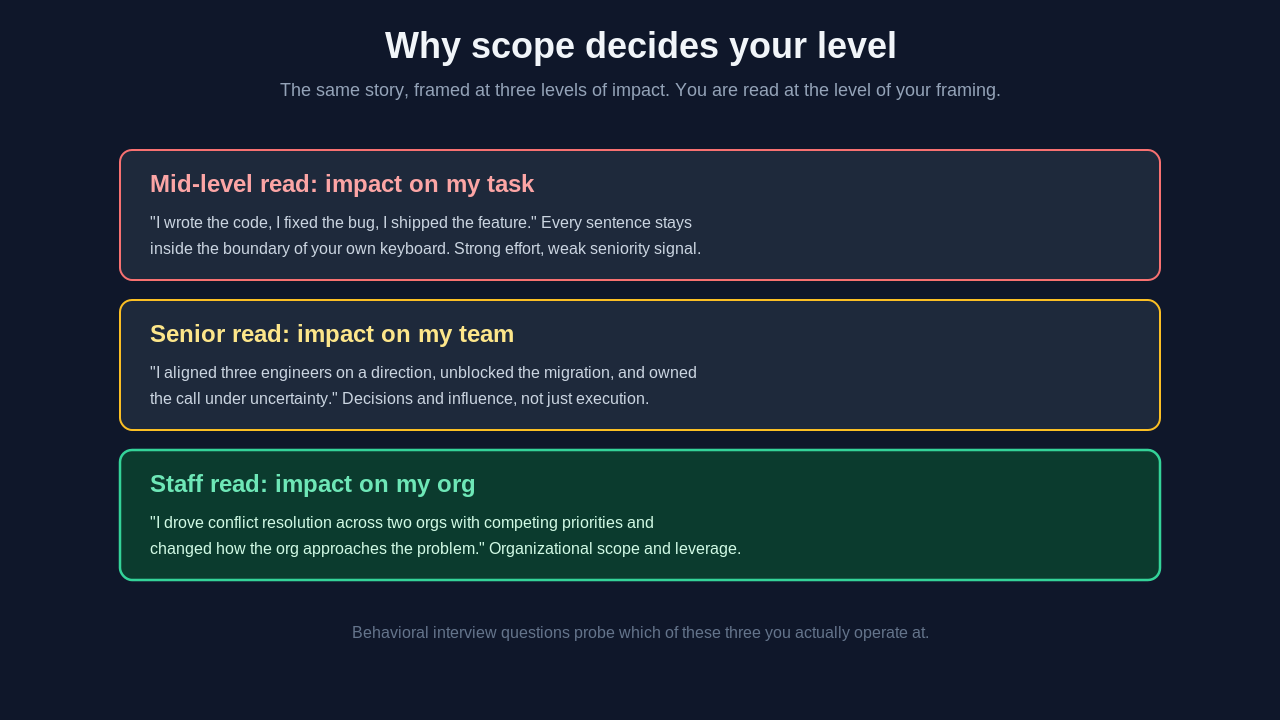
The most common reason senior candidates get downleveled is scope. A candidate describes a project they clearly worked hard on, but every sentence is about their own tasks: the code they wrote, the bug they fixed, the feature they shipped. That is a strong mid-level answer. It is a weak senior answer.
At senior and staff levels, interviewers look for organizational impact. As interviewing.io's breakdown of how Meta evaluates behavioral interviews makes clear, the bar shifts from "impact on my task" to "impact on my team" to "impact on my org" as you move up the ladder. If your stories never leave the boundary of your own keyboard, you will get read at the level of your stories, not the level of your title.
Leadership signal without a manager title
You do not need to have managed people to show leadership signal. What committees want is evidence that you moved outcomes through other team members: you drove conflict resolution across a cross-team disagreement, you influenced a technical direction that was not yours to mandate, you unblocked a stalled initiative by building alignment. A staff engineer who cannot describe resolving cross-team conflict is missing the exact signal the level requires.
Ownership of failure
Senior candidates often sanitize their failure stories until nothing is left. They pick a "failure" that was really a success, or they blame external factors. Interviewers read this instantly. The strongest failure stories name a real decision that went wrong, own the candidate's specific contribution to it, and then show what changed afterward. Growth is the signal, and you cannot show growth without first showing a genuine mistake.
Signal density and communication
There is a real communication component, but it is not about charm. It is about signal density. Senior interviewers ask sharp follow-ups and will interrupt. If you take four minutes to reach the point, you may never reach it, because the interviewer redirected you first. Answers that front-load the decision and the result, then support with detail on demand, score far better than a slow chronological build.
The STAR method, and why senior candidates outgrow it
If you have prepared for any behavioral interview, you know the STAR method: Situation, Task, Action, Result. It is the industry standard structure for any software developer, and for good reason. It forces you to set context, state your specific responsibility, describe what you did, and quantify what happened. If you are not using a structure at all, STAR is the fastest fix available.
Here is the plain version:
STAR structure for a behavioral answer

S - Situation:  One or two sentences of context. Where, when, what was at stake.
T - Task:       Your specific responsibility. What were YOU on the hook for?
A - Action:     The decisions and steps you personally drove. Use "I", not "we".
R - Result:     The measurable outcome. Numbers, scope, business impact.
The problem is that STAR alone stops at the result, and for senior roles the result is not the last thing interviewers want. They want to know what you learned and how it changed the way you operate. This is why guidance for 2026 increasingly pushes senior candidates toward STAR-L, which adds a Learnings step. Some writers have gone as far as declaring the death of the pure STAR method for experienced candidates, arguing that a result without reflection reads as junior.
STAR-L, the version that scores at senior level
STAR-L for senior and staff candidates

S - Situation
T - Task
A - Action     (emphasize influence across people and teams, not just code)
R - Result     (org-level or team-level impact, quantified)
L - Learnings  (how this changed your engineering judgment going forward)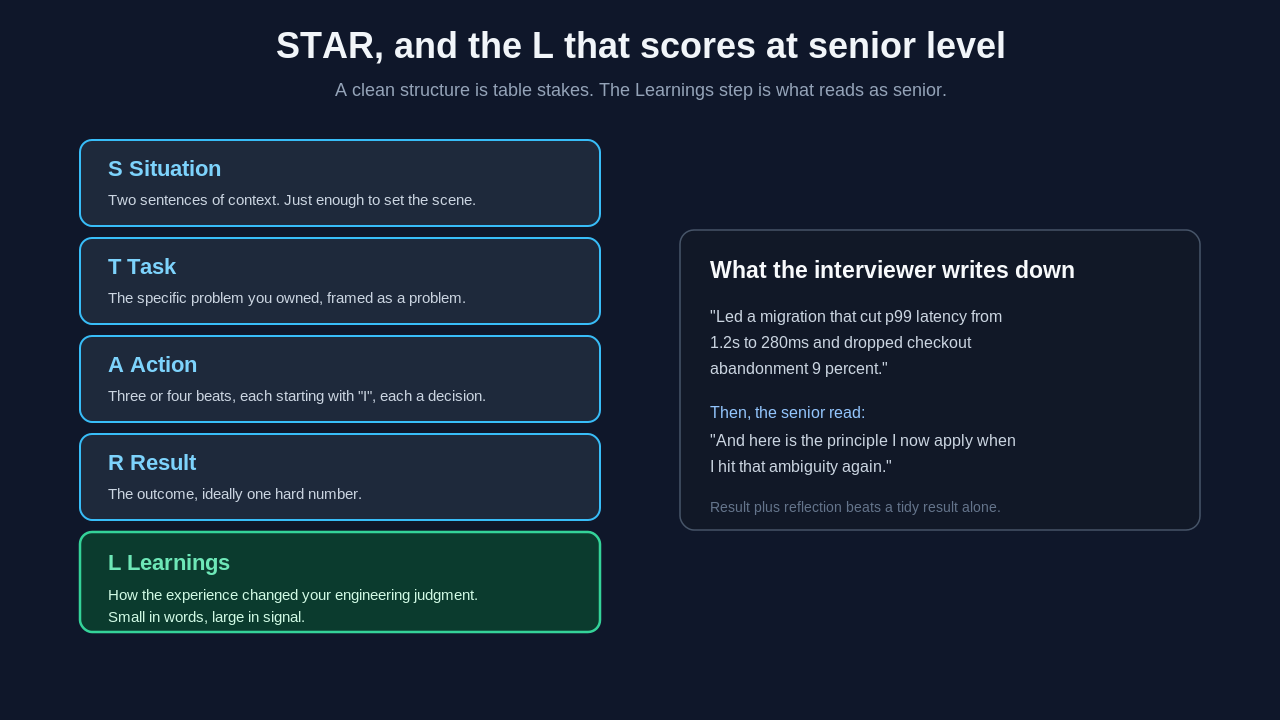
The Learnings step is small in word count and large in signal. It converts a story about something you did into evidence of how you think. A candidate who ends with "and here is the principle I now apply when I hit that situation again" sounds like someone who has operated at scale and reflected on it. That is the senior read.
The specific traps that sink senior candidates
Knowing the rubric is not enough. The failures are patterned, and the same handful of mistakes account for most senior downlevels. If you want a broader map of interview missteps, our guide to preparing for AI-era interviews and the skills that cannot be faked covers the mindset side; below are the behavioral-specific traps.
Trap 1: The "we" trap
Senior engineers who lead teams naturally speak in "we." It feels humble and accurate. In a behavioral interview it is a scoring problem, because the interviewer cannot separate your contribution from the group's. If every action is "we decided" and "we built," the packet has no individual signal to grade. Say "we" for context, then switch hard to "I" for the decisions you personally owned.
Trap 2: Choosing the safe story over the big story
When given a choice, candidates pick the story they can tell cleanly rather than the one with the largest scope. This is backwards. Between a tidy small project and a messy large one, the large one almost always demonstrates more senior signal, even if it does not map perfectly to the literal question. Interviewers care about the scope evidence more than a perfect topical match.
Trap 3: Verbosity that buries the signal
There is a lot to cover and limited time, so time management matters and candidates over-explain the setup and run out of runway before the result. The fix is inversion: state the outcome and your key decision first, then provide context. If the interviewer wants more setup, they will ask. You are optimizing for the case where you get interrupted, because at senior level you will be.
Trap 4: Failure stories with no real failure
A failure story where nothing actually failed is a red flag. It signals either a lack of self-awareness or an unwillingness to be candid, and both are disqualifying at senior level. Pick a real one, own your part, and land on the learning.
Trap 5: No evidence of influence without authority
The single most senior signal is moving an outcome you had no formal authority to mandate. Many candidates have done this and never think to tell the story, because it felt like "just convincing people." That is exactly the story. Convincing a skeptical team to adopt a direction, aligning two orgs with competing priorities, or killing a project that should not ship are all high-value influence narratives.
How to prepare in the two weeks before the loop
Preparation for behavioral rounds is unglamorous and highly effective, which is the opposite of how most people treat it. Here is a compact plan.
First, build the story bank. List every meaningful project from the last few years and, for each, write the STAR-L skeleton. Aim for six to twelve stories that collectively cover conflict, failure, ambiguity, leadership, technical judgment, and cross-team influence. Reuse is fine; a single strong project can answer several different prompts from different angles.
Second, level-check every story. For each one, ask: does the Action show me making decisions, or just executing someone else's? Does the Result describe team or org impact, or only my personal output? If a story reads mid-level, either reframe it around the decisions you drove or replace it with a bigger one.
Third, practice out loud, on a timer, with interruptions. Behavioral answers degrade badly when spoken for the first time in the room. Have someone interrupt you with follow-ups so you rehearse the recovery, not just the monologue. Running mock interviews with a study partner, or even an AI acting as an interviewer, builds the muscle for handling redirects. Our walkthrough on using AI as an interview study partner shows how to set that up without letting it write your stories for you.
Fourth, map stories to the company's values. Amazon has Leadership Principles, and other companies have their own competency rubrics. Pre-tag which of your stories hits which principle so you are never scrambling to match a story to the value the interviewer is probing.
The mindset shift that fixes most of this
If you internalize one idea, make it this: the behavioral interview is a leveling exam disguised as a friendly chat. Every story you tell is evidence for a specific claim about the scope you can own. When you stop trying to be likable and start trying to be legible as a senior operator, your answers change. You lead with decisions, you quantify impact, you own failures, and you show what you learned.
That shift is also why the round eliminates so many strong engineers. They prepared hard for the technical loops and walked into the behavioral round with a handful of vague stories, assuming warmth would carry them. Warmth is table stakes. Evidence of scope is the score. The candidates who treat this round with the same rigor they bring to a system design problem are the ones who get the level they came for.
Levelop is built around exactly this kind of deliberate, evidence-based practice. If you are working toward a senior or staff loop, browse the rest of our interview preparation writing on the Levelop blog and start building your story bank today.
Frequently asked questions
Are behavioral interviews really as important as coding interviews for senior roles?
For senior and staff roles, they are frequently more important. Coding rounds tend to be pass or fail signals, while behavioral rounds carry heavy leveling weight and veto power. A strong coding score with a weak behavioral signal commonly results in a downlevel or a no-hire, because the behavioral round is where committees decide how much scope you can own.
What is the difference between the STAR method and STAR-L?
STAR is Situation, Task, Action, Result. STAR-L adds a Learnings step at the end, where you explain how the experience changed your engineering judgment. The Learnings step matters most for senior candidates, because it converts a story about what you did into evidence of how you think, which is the signal committees weigh at higher levels.
How many stories should I prepare for a behavioral loop?
Aim for six to twelve adaptable stories that collectively cover conflict, failure, ambiguity, leadership, technical judgment, and cross-team influence. You do not need a unique story per question. A single strong, large-scope project can answer several prompts when framed around different decisions, so depth of a few stories beats a long list of shallow ones.
Why do senior engineers get downleveled in behavioral interviews?
The most common cause is scope. Candidates describe hard work but frame every action around their own individual tasks rather than team or organizational impact. When the stories sound mid-level, the candidate gets read at mid-level regardless of title. Other frequent causes are the we trap, sanitized failure stories, and no evidence of influence without formal authority.
Can I use AI to prepare for behavioral interviews?
Yes, as a practice partner and a critic, not as a scriptwriter. AI is useful for generating follow-up questions, timing your answers, and pressure-testing whether a story reads at your target level. It should not write your stories, because interviewers probe for authenticity and specific detail that only your real experience can supply. Use it to rehearse recovery from interruptions and to check the seniority of your framing.
Sources and further reading
- Tech Interview Handbook, Behavioral interviews for software engineers, techinterviewhandbook.org.
- interviewing.io, How Meta evaluates software engineering behavioral interviews, interviewing.io.
- Tech Interview Handbook, Behavioral interviews for senior candidates, techinterviewhandbook.org.
- Design Gurus, The death of the STAR method, designgurus.substack.com.
- Engineering Leadership, How to nail big tech behavioral interviews as a senior engineer, newsletter.eng-leadership.com.