
AI Mock Interview Tools: Which Ones Actually Prepare You (An Honest 2026 Review)
Back with another one in the series where I break down the things I keep getting asked about. This time it is not an algorithm but a question I get almost every week from people prepping for a job interview: which of these AI mock interview tools is actually worth my time?
I run Levelop, so I watch a lot of engineers prepare, and I have tried most of these tools myself to give the people who ask me an honest answer. What I found is that the category called ai mock interview tools is really four or five different products wearing the same label, and some of them are not preparing you for anything. A few are quietly doing the opposite. So here is my honest take on what each type actually does, who it helps, and where it wastes your time.
The confusion I kept running into
When someone searches for an ai mock interview, they usually want one thing: practice sessions with something that talks back and tells them where they are weak. The problem is that the search results are a pile of tools doing wildly different jobs. One sits invisibly on your screen during a live interview and feeds you answers, another runs a scripted mock interview ai that asks role specific questions and scores your filler words, another matches you with a stranger for a peer mock, and another is a speaking coach that never touches technical questions. Once I sorted them by what they actually do, the which-one-is-best question mostly answered itself, because it depends entirely on which job you need done.
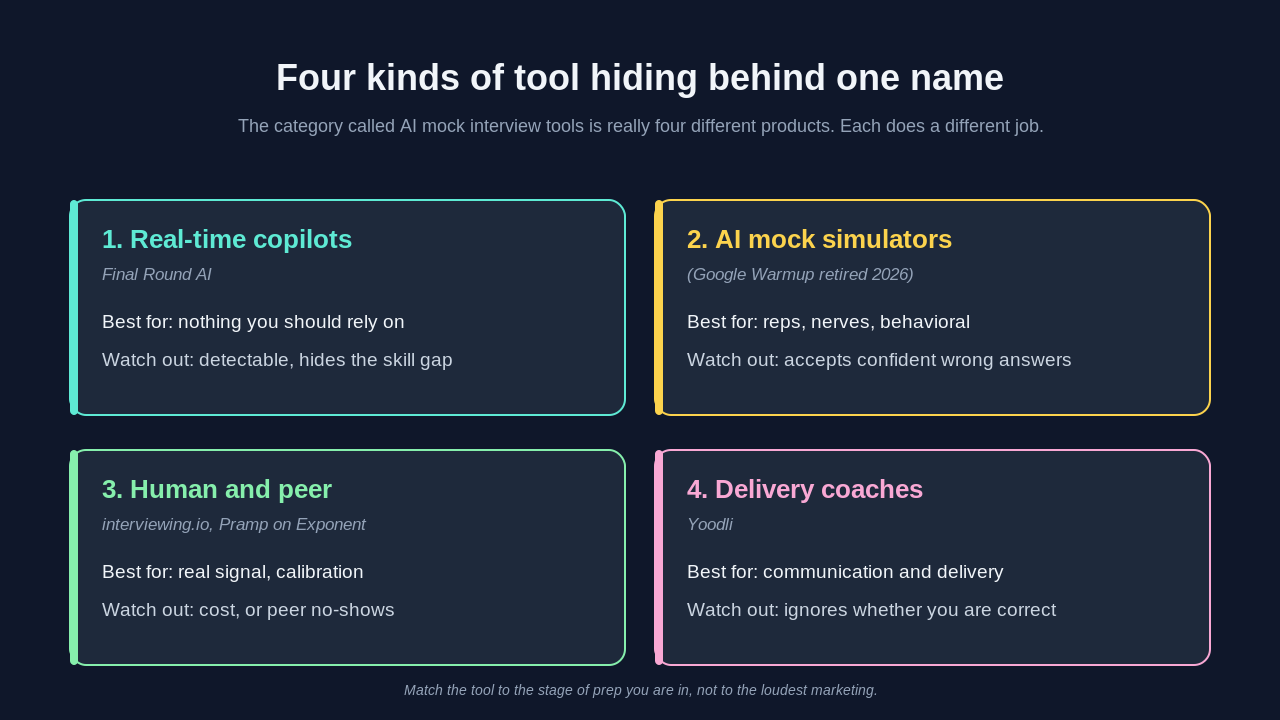
The four kinds of tool hiding behind one name
1. Real-time interview copilots (be careful with these)
Final Round AI is the loudest example, with over 10 million users and a real-time Interview Copilot that listens to your live interview and suggests answers on screen, with a stealth mode that runs in the background during a screen share across technical questions, coding and behavioral questions. Let me be direct: a final round ai mock interview copilot is not a preparation tool, it is a live-assist tool that helps you get through an interview you are not ready for by reading answers off your screen. It also offers a genuine practice mode with post-interview feedback, and that part is fine, but the headline stealth feature solves the wrong problem.
I will skip the ethics lecture and make the practical case instead. If you lean on a copilot to pass a screen, you still cannot do the job on day one, the onsite will expose the gap, and more companies now run proctored or in-person rounds specifically because these tools exist. The interview is a proxy for whether you can do the work, so beating the proxy without the skill just moves the failure a few weeks later, when it costs far more.
2. AI mock simulators (useful, with a ceiling)
This is the category most people picture when they imagine an ai mock interview: a bot that asks questions, lets you answer by voice or text, and gives you ai generated feedback afterward. Google Interview Warmup was the famous free one, though it is worth knowing that Google quietly retired Interview Warmup in April 2026 and now points people to Gemini, so if you are still searching for it, it is gone.
The newer AI simulators are genuinely useful for reps and nerves, and they are excellent for behavioral questions. You get to say your tell me about a time you had conflict answer out loud ten times while the real time feedback flags when you ramble, use filler words, or never actually answer, and the best ones give ai feedback on answer quality plus a short list of areas for improvement. Where they hit a ceiling is depth, because an AI simulator will happily accept a technically wrong answer delivered confidently, since it grades delivery and structure rather than correctness. That makes them a great warmup and a poor final judge, and no simulator is yet a fully realistic interview.
3. Human and peer platforms (still the highest signal)
The tools that are not AI at all still change outcomes the most. interviewing.io connects you with real engineers, many from senior FAANG roles, for anonymous mock interviews, and at roughly 225 dollars a session it is a late-stage calibration tool you reach for when you are close to ready and want a brutal, accurate read from a real interviewer. Pramp is the free peer option, acquired by Exponent in 2024 so new sessions run on the Exponent platform, and its free peer mocks make pramp ai mock interviews a common starting point early in prep. The honest caveat is that peer quality is a coin flip: roughly one in five sessions ends in a no-show, and many that happen are a wash because your partner is as lost as you are, so you need enough mock interviews practice for the good sessions to average out.
4. Delivery coaches (the piece everyone forgets)
Tools like Yoodli ignore your algorithm entirely and instead analyze how you speak, measuring pacing, filler words, and whether you sound like you know what you are talking about. This seems like a soft add-on until you bomb a round because you could not narrate your thinking rather than because your solution was wrong. Communication is graded in every real interview, so a delivery coach is a cheap, low-stakes way to fix the part of your interview performance that has nothing to do with what you know.
What actually prepares you
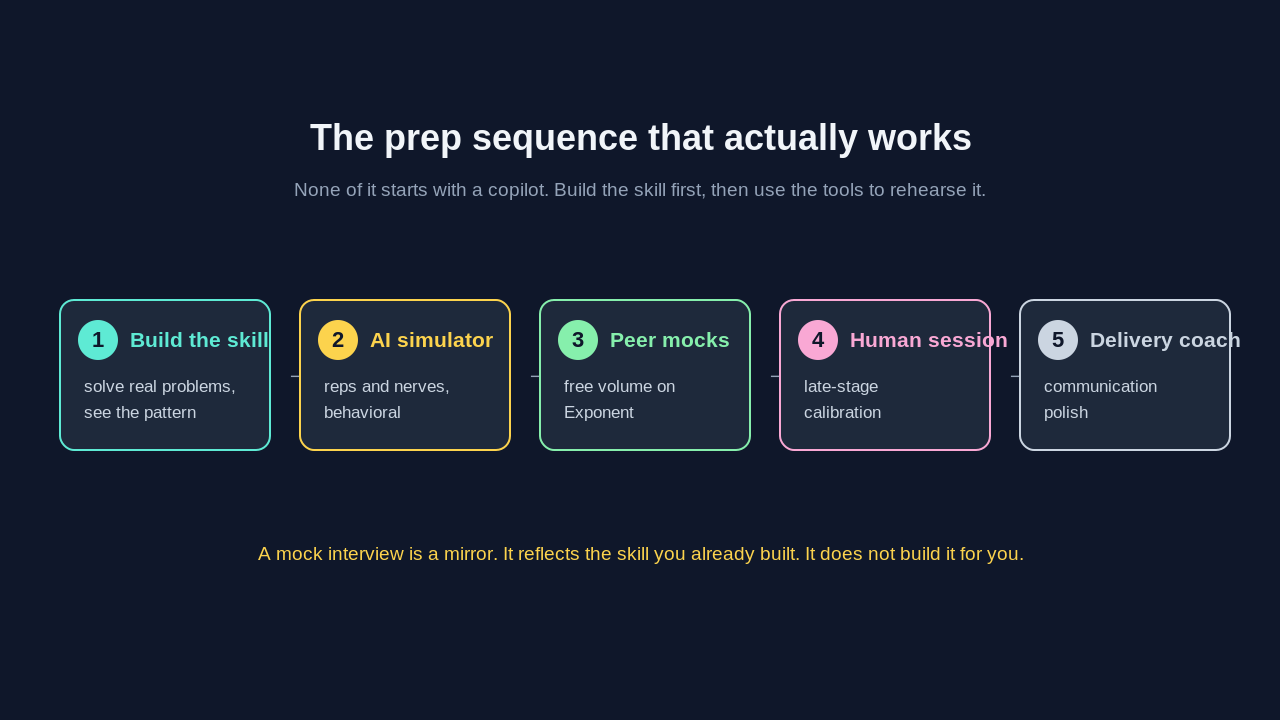
Here is the thing I had to learn the slow way: none of these tools build the underlying skill, they only rehearse it, and that is useful only if the skill already exists. An ai mock interview is a mirror, so if you walk in without the pattern recognition that comes from solving enough problems to see the structure underneath them, the tool just reflects an unprepared person back at you with nicer formatting. The people who get the most out of these tools already did the work and use the tool to pressure-test it under time and nerves.
So the sequence that works is boring. Build the skill first by solving real problems until you can spot the pattern in a new one, then run an AI simulator for behavioral questions and nerves, use free peer mock interviews practice on Exponent for volume, spend on one or two interviewing.io sessions near the end for an honest read, and keep a delivery coach running in the background the whole time. Reaching for a copilot instead of doing that first step is the tell that someone is trying to skip the only part that matters.
The free tool that beats most paid ones
The most underrated ai mock interview free option is the general-purpose LLM you already pay for, because Claude or ChatGPT can be told exactly how hard to push, unlike the dedicated apps that are tuned to be relentlessly encouraging. Here is the prompt I hand people to turn a general model into an interviewer that applies pressure instead of praise.
You are a senior engineer running a 45-minute interview for a mid-level
software role. Interview me on {topic}. Rules:
1. Ask ONE question at a time. Wait for my full answer.
2. Do NOT give me the answer or hints unless I say I am stuck.
3. When I answer, push back: ask why, ask about edge cases, ask what
   breaks at 10x scale.
4. If my answer is wrong or hand-wavy, say so plainly.
5. At the end, score me 1-10 on correctness, communication, and
   follow-ups, and give two areas for improvement.
Start with the first question. Do not preamble.
The value lives in rules 3 and 4, because every dedicated tool I tried was too nice, and this one is not, since you told it not to be. It produces technical questions with real bite and honest ai feedback on answer quality. Pair it with a scoring rubric you track between practice sessions so you can tell whether you are improving or just repeating the same session with new words.
{
  "date": "2026-07-02",
  "topic": "system design: rate limiter",
  "scores": { "correctness": 6, "communication": 8, "followups": 5 },
  "areas_for_improvement": [
    "Jumped to a solution before clarifying requirements",
    "Could not explain token bucket vs sliding window"
  ]
}
The mistakes I see people make
I made most of these before I figured out the pattern. I treated the tool as the prep instead of the rehearsal, running twenty mock sessions with almost no real problem solving and then wondering why I plateaued, when the mocks were only reflecting a gap I never closed. I also optimized for the tool score instead of the interviewer judgment, learning to sound great while staying wrong, which is the worst possible combination in a real onsite where someone pushes back. And I leaned on one kind of tool at a time, so peer mocks gave me variance with no calibration while paid human sessions were too expensive to do enough reps, when the tools are meant to be complementary.
What I would actually do
If I were prepping today, none of it would start with a copilot. I would build real pattern recognition on actual problems, then layer the tools on top in the order above, and use a general LLM with that interviewer prompt as my daily driver because it is free and I control the difficulty. The best ai mock interview tools 2026 has to offer are genuinely good at rehearsal but not at building the thing you are rehearsing, and keeping that line clear is the difference between real value and a false sense of readiness.
Frequently asked questions
What is the best AI mock interview tool in 2026?
There is no single best one because they do different jobs. For honest human feedback interviewing.io has the highest signal, for free peer practice Pramp on Exponent is the common starting point, and for daily rehearsal a general LLM like Claude or ChatGPT with a strict interviewer prompt beats most dedicated apps. Match the tool to your stage of prep.
Are AI interview copilots like Final Round AI worth it?
Their genuine practice mode is fine, but the headline stealth copilot that feeds you answers during a live interview is not preparation, it is a way to pass a checkpoint you are not ready for. These tools are increasingly detectable, and the skill gap they hide surfaces on the job, so I would not build a prep plan around one.
Is Google Interview Warmup still available?
No. Google retired Interview Warmup in April 2026 and now directs job seekers toward Gemini, so if you want a free simulator, a general LLM or one of the newer free AI mock tools fills the same role.
Do AI mock interviews help with coding interviews?
For reps, nerves, and communication yes, but for correctness no, because an AI simulator will accept a wrong answer delivered confidently since it grades structure and delivery rather than whether your algorithm is right. Use it to rehearse specific interview questions and fix how you communicate, not as the judge of whether your solution works.
Are free AI mock interview tools good enough, or do I need to pay?
For most of your prep free is enough, since peer platforms and a general LLM cover the bulk of the reps, and the one place paying is worth it is late-stage calibration from a real senior engineer, which is what a paid interviewing.io session gives you.
Where this comes from
I think about this a lot because it is the exact problem Levelop exists to solve, since these tools rehearse interview performance while the harder part, building the pattern recognition the rehearsal is supposed to reflect, is what we focus on. For more on how prep is shifting, I wrote about how AI is changing the coding interview and the skills that cannot be faked, with more on the Levelop blog.
References
- Final Round AI, Interview Copilot product pages, finalroundai.com.
- interviewing.io, mock interviews with senior engineers, interviewing.io.
- Exponent, Pramp peer mock interview practice, tryexponent.com/practice.
- Google, Interview Warmup archived notice, grow.google.
- Yoodli, AI speech and communication coaching, yoodli.ai.