
AI Interview Practice Tools: A Smarter Prep Workflow
Back with another one in the series where I break down the parts of interview prep that I got wrong before I got them right. This one is about tooling, specifically the wave of AI interview practice tools that showed up over the last two years and how I actually fit them into a study routine instead of collecting tabs.
I resisted these tools for a long time. My prep looked like everyone else's in 2022: a problem list, a timer, and a lot of staring at editorials I did not fully understand. When the AI tools arrived I assumed they were a shortcut, and I distrust shortcuts for interviews because the interview itself has no shortcut. What changed my mind was not the tools getting smarter. It was realizing I had been using them at the wrong step of my own process.
The gap: I was using AI to get answers, not to build a workflow
Here is the specific thing that tripped me up. The first time I opened one of these assistants, I pasted a problem and asked for the solution. It gave me a clean, correct answer in seconds. I felt productive. Two weeks later I sat down to a mock and could not reproduce any of it under pressure. I had outsourced the exact muscle the interview tests: generating the approach myself, out loud, while someone watches.
That is the trap with AI tools for interview prep. Used as an answer machine, they make you feel prepared while quietly making you worse. The value is not in the answer. It is in everything around the answer: the hint at the right moment, the follow up question you did not think to ask, the honest read on whether your explanation actually made sense. Once I moved the AI out of the give me the solution seat and into the coach me through my own attempt seat, the whole thing clicked.
What "AI interview practice tools" actually means now
The category is broader than most people assume. When I say ai interview practice tools I am really talking about four different jobs, and most products only do one or two of them well.
The first job is problem generation and selection. Instead of grinding a fixed list, you describe your target company and weak areas, and an AI powered tool proposes a focused set of interview questions matched to that role. The second job is live coaching during a problem: hints that escalate slowly, so you get unstuck without getting the answer handed to you. The third job is mock interviews practice, where a voice or chat agent plays the interviewer, asks clarifying questions, and pushes back on your complexity claims. The fourth job is feedback and review, turning a messy session into a short list of what to fix.
Some products brand these as an AI interview assistant, others as an AI interview tool or an interview warmup, but the labels matter less than which of the four jobs each one actually does. A role specific practice interviewing session for a backend job interview looks nothing like a generic warmup, and knowing which job you are trying to do is half the battle. I wasted a month treating a mock interview tool like a study aid. If you want a clear-eyed comparison of the mock category specifically, I wrote a separate honest review of AI mock interview tools that goes tool by tool.
The workflow that finally worked for me
I stopped thinking about tools and started thinking about a loop. Every problem I practice now moves through four passes, and AI plays a different role in each one. The point of the loop is that the AI never does the part I need to own.
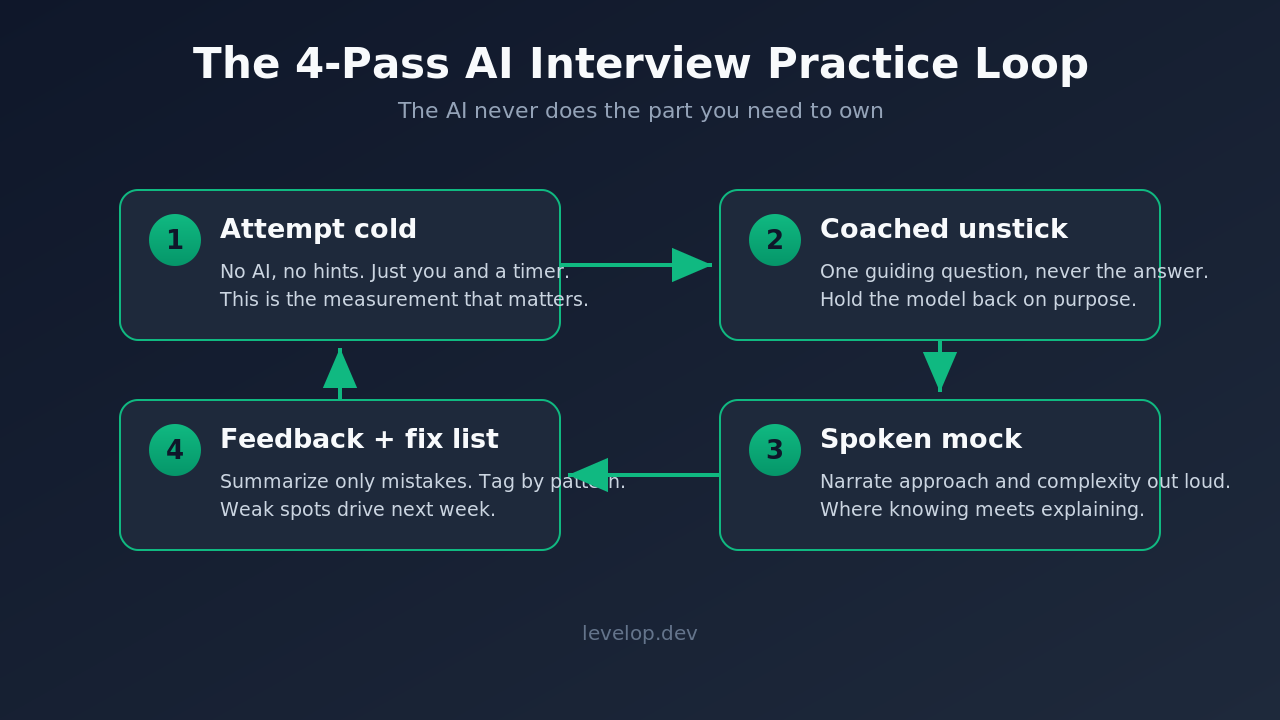
Pass 1: Attempt cold, no help
I read the problem and try it with zero assistance. No AI, no hints, no editorial. I set a timer for the amount of time I would actually have in a real screen. This pass is sacred. If I let the tool in here, I am cheating the one measurement that matters, which is what I can do alone.
If I solve it, great, I still do the remaining passes to sharpen. If I get stuck, I note the exact moment I got stuck and what I was thinking. That note is the most useful artifact in the whole loop.
Pass 2: Coached unstick, not solved
Now I bring in the AI, but with a strict rule I put in the prompt itself. I tell it: do not give me the solution or the key idea, ask me one question that moves me toward it. This is where using ai for interview preparation stops being lazy and starts being deliberate. A good coaching prompt turns the assistant into a Socratic partner.
Here is the actual system-style prompt I keep in a snippet and reuse:
You are my coding interview coach. I will describe a problem and my current
attempt. Rules:
1. Never state the full approach or the final answer.
2. Respond with at most ONE guiding question or ONE small hint.
3. If I am on a wrong track, ask a question that exposes the flaw.
4. Only after I produce a working approach, critique my time and space complexity.
Wait for my problem before responding.
That prompt is boring on purpose. The constraint is the feature. Without it the model will happily dump the whole solution, because that is what it is optimized to do. This is the single most important habit in how to use ai for coding interviews: you have to actively hold the model back.
Pass 3: Explain out loud to the interviewer agent
Once I have a working approach, I switch tools or modes and do a spoken mock. The agent plays interviewer. It asks me to state my approach before I code, questions my edge cases, and challenges my complexity. Doing ai coding interview practice this way surfaces the thing that kills real interviews: I know the answer but I cannot narrate it cleanly.
The first few times I did this I was shocked at how much worse my talking was than my thinking. That gap is invisible when you practice silently. It is the entire reason spoken mocks exist.
Pass 4: Feedback and a fix list
After the session, I ask the tool to summarize only my mistakes and turn them into a short, specific list. Not "communicate better," but "you started coding before stating the brute force" or "you claimed O(n) but the sort makes it O(n log n)." I paste those items into my notes tagged by pattern. Over a few weeks the tags reveal my real weak spots better than any practice count.
A concrete example: two-sum under interview conditions
Let me walk one problem through the loop so it is not abstract. Take a classic: return indices of two numbers that add to a target.
Pass 1, cold: I try it. I reach for the brute force double loop, then remember the hashmap trick, and write it. I note that I hesitated on whether to store the value or the index. That hesitation is my artifact.
Pass 2, coached: I tell the coach I am unsure about the hashmap contents. Following its rules, it does not tell me. It asks, "When you find the complement later, what do you actually need to return?" That question answers itself: I need the index, so I store value to index. One question, unstuck, and I owned the insight.
Pass 3, spoken: The interviewer agent asks me to state complexity before I run anything. I say O(n) time, O(n) space, and explain the single pass. It pushes: "What if the array is sorted, does that change your options?" Now I am discussing a two pointer alternative, which is exactly the kind of follow up a real interviewer throws.
def two_sum(nums, target):
    seen = {}                      # value -> index
    for i, x in enumerate(nums):
        need = target - x
        if need in seen:
            return [seen[need], i]
        seen[x] = i
    return []
Pass 4, review: The fix list says one thing: "State the brute force before jumping to the optimal, interviewers want to see the progression." Small note, real gain. That single habit has helped me in more live interviews than any new algorithm.
Where AI tools genuinely beat solo grinding
I was a skeptic, so let me be fair about what actually improved. Availability is the obvious one: a patient mock partner at 6 a.m. is worth a lot when scheduling humans is hard. But three less obvious wins mattered more to me.
Interview preparation with ai gave me reps on the narration skill, which the old solo method never touched. It also gave me faster feedback loops, since I no longer waited days for a peer to review a recording. And it exposed my blind spots through questioning rather than through failure in a real interview, which is a much cheaper place to fail. Repeated mock interviews practice also helped me build confidence, so by the time I sat across from real hiring managers the interview process felt familiar instead of terrifying.
None of that replaces fundamentals. You still have to know the core patterns cold, and you still need the skills that cannot be faked under pressure. The tools sharpen judgment you already have. They do not manufacture it. Research on deliberate practice has said this for decades: gains come from focused effort at the edge of your ability with immediate feedback, which is exactly the loop above, just with a faster feedback partner. The idea traces back to work summarized well by Anders Ericsson's research on expert performance.
Common mistakes I made so you do not have to
I made every one of these, so I am naming them plainly.
I let the model solve Pass 1. This is the cardinal sin. It feels efficient and it rots your independent problem solving. Guard Pass 1 with your life.
I trusted complexity claims blindly. Early on the assistant told me a solution was O(n) when the sort inside it made it O(n log n). AI tools are confidently wrong sometimes, especially on subtle analysis. Verify the reasoning, do not just accept the label.
I skipped the spoken pass because it was uncomfortable. That discomfort was the signal. The thing you avoid in practice is the thing that breaks in the interview.
I collected tools instead of building a routine. Five open tabs is not a workflow. One loop you actually repeat beats a drawer full of shiny assistants. If you want a broader take on assembling a personal toolset, my post on using AI to prep, Claude and ChatGPT as a study partner goes deeper on the study-partner side.
What to practice next
If you want to build this loop, start small and specific.
Pick five problems in one pattern, like sliding window, and run all four passes on each. Doing one pattern deeply teaches the loop faster than scattering across topics. Next, write your own coaching prompt and tune it until the model reliably refuses to hand you answers. That prompt is a reusable asset you will keep for months. After that, add a weekly spoken mock on a fresh problem you have never seen, since cold narration is the rarest and most valuable rep. Finally, review your tagged fix list every Sunday and let it choose next week's focus, so your weak spots drive the plan instead of a generic list.
The measure of progress is not problems solved. It is how often Pass 1 succeeds without help, because that is the number the real interview reports back to you.
Frequently asked questions
Are AI interview practice tools worth it, or are they a crutch?
They are worth it when used as a coach and a mock partner, and they become a crutch the moment they solve problems for you. The deciding factor is whether you protect a cold, unassisted attempt on every problem. Keep that first pass sacred and the tools accelerate you. Skip it and they quietly erode the exact skill the interview tests.
Can I use ChatGPT or Claude for interview prep, or do I need a dedicated tool?
A general assistant works well for the coaching and review passes if you give it a strict prompt that forbids full solutions. Dedicated tools tend to win on the spoken mock, because voice interviewing, timing, and structured feedback are hard to replicate in a chat window. Many people run a hybrid: a general model for coaching, a purpose-built tool for realistic mocks.
Does practicing with AI actually help in a real interview with a human?
Yes, provided you include spoken mocks. The skill that transfers most is narration, stating your approach and complexity clearly before and while you code. AI mocks give you cheap, frequent reps on that narration, which is usually the weakest and least-practiced part of most candidates' preparation.
Will using AI for interview preparation get flagged as cheating?
Practicing with AI is preparation, not cheating. The concern only appears when candidates use tools live during an actual interview, which is a different and clearly prohibited thing. Using AI to train your independent ability beforehand is exactly what these tools are for, and it leaves you better able to perform without them when it counts.
How much of my prep time should involve AI tools?
A useful split is roughly a quarter of your time on unassisted cold attempts, a quarter on AI-coached unsticks, a quarter on spoken mocks, and a quarter on review and targeted drills. The exact ratio matters less than the rule that no session is fully AI-assisted. Every session should contain some minutes where you are entirely on your own.
I have been building and testing this loop while working through problems on Levelop, and it is the closest I have come to prep that feels like the real thing instead of a rehearsal of the answer key. For more write-ups in this series, the full Levelop blog collects them.