

How to Evaluate a Job Offer: A 7-Day Framework for Engineers
You spent months grinding through the interview process, and the offer letter is finally in your inbox. The number looks good, and your instinct is to reply "yes" before they change their mind. Slow down. Knowing how to evaluate a job offer is a separate skill from passing the interview, and it quietly decides your next two to four years of daily life, learning, and earning.
Most engineers evaluate a software engineer job offer on a single dimension: base salary. That is like judging a system by its request latency and ignoring throughput, reliability, and cost. A good decision looks at the whole system. This guide gives you a concrete 7-day framework to evaluate a job offer, benchmark the number, negotiate without burning the relationship, and decide with confidence instead of anxiety.
Why evaluating a job offer deserves more than a gut check
A job offer is a multi-year contract dressed up as a one-page PDF. A role that pays 10 percent less but doubles your rate of learning can be worth far more over the long term than a slightly higher salary at a place where you stagnate. Conversely, a shiny title at a company burning cash can vanish in a layoff before your first equity cliff.
Offers arrive with artificial urgency. Recruiters say "we need an answer by Friday" because pressure works in their favor, not yours. A framework protects you from that. When you know exactly what you are measuring and in what order, a tight deadline stops feeling like a threat. Seven days is usually realistic: most companies grant a week, and asking signals seriousness, not disinterest. With only two or three days, compress the framework but keep the order of operations.
The 7-day framework at a glance
Here is the full sequence. Each day has one job, so you are never trying to weigh compensation, culture, and risk all at once.
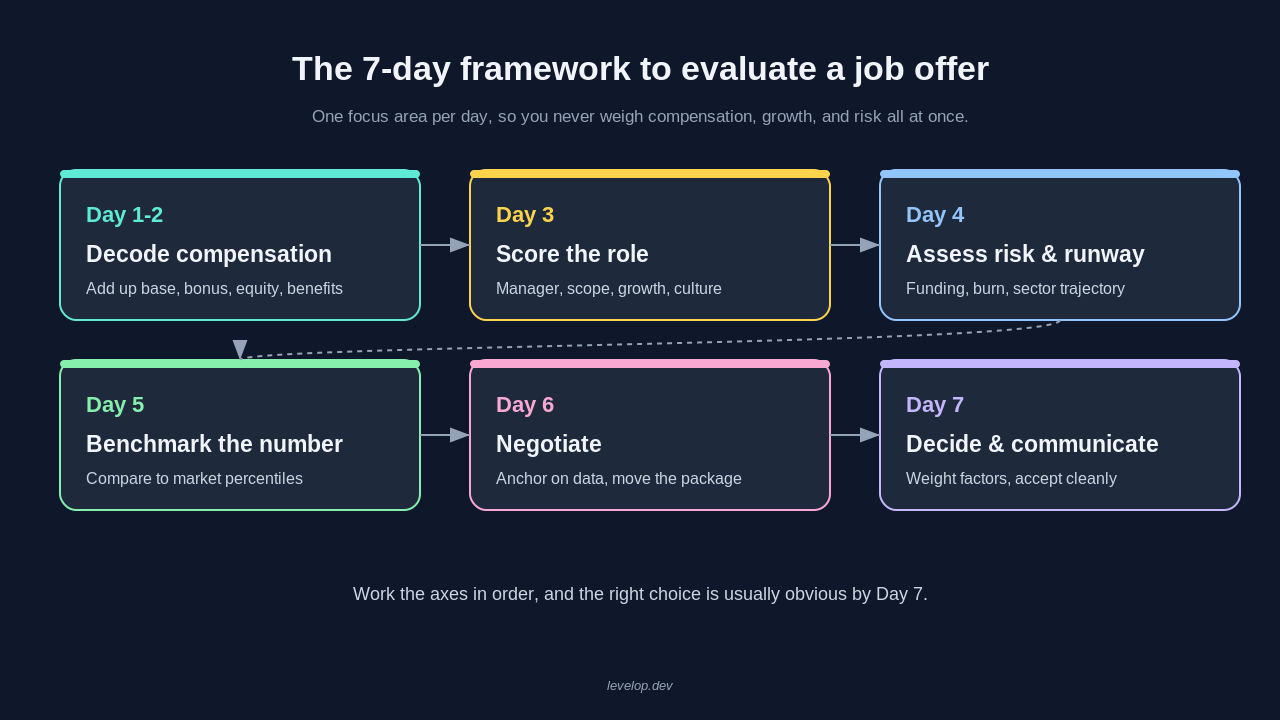
Day 1 and 2: Decode the full compensation package
Base salary is the number recruiters lead with because it is easiest to compare and cheapest to inflate. Real compensation is a stack, and you cannot evaluate a job offer until you have added up the entire benefits package and seen how each layer pays out.
The layers people miss
Write down every component: base salary, target bonus, signing bonus, equity (and its vesting schedule), retirement plan match, health insurance contributions, paid time off, tuition reimbursement, and any stipends. Then translate each into an annualized number you can compare across offers.
Equity is where most engineers get confused. At a public company, restricted stock units (RSUs) have a clear dollar value but vest over four years, and refreshers matter as much as the initial grant. At a private startup, stock options are a lottery ticket: ask for the share count, total shares outstanding, the most recent preferred price, and the strike price before assigning any value.
Here is a simple way to normalize an offer into an annual number so two offers become comparable:
# offer_value.py: normalize a tech offer to annual comp (first-year and 4-year average)
def annual_comp(base, target_bonus_pct, signing_bonus, equity_total, vest_years=4):
    bonus = base * (target_bonus_pct / 100)
    equity_per_year = equity_total / vest_years
    # signing bonus only counts in year one
    year_one = base + bonus + signing_bonus + equity_per_year
    steady_state = base + bonus + equity_per_year
    return {"year_one": round(year_one), "steady_state": round(steady_state)}

offer_a = annual_comp(base=160000, target_bonus_pct=15, signing_bonus=20000, equity_total=200000)
print(offer_a)  # {'year_one': 274000, 'steady_state': 254000}
Running both offers through the same function is more honest than eyeballing base salaries: a lower base with strong equity and bonus can beat a higher base with neither. For a deeper breakdown of the parts beyond base, see our guide on how to evaluate a tech compensation package beyond the base salary.
Day 3: Score the role beyond the money
With the numbers settled, spend a full day on everything money cannot buy back later. These factors predict whether you grow or stall, and growth determines your compensation two offers from now.
Four things matter most. First, the manager: you are interviewing them as much as they interviewed you, because a good manager accelerates careers and a bad one ends them. Second, scope: will you own meaningful systems or maintain someone else's? Third, engineering maturity: do they test, review code, and ship safely, or is every deploy a prayer? Fourth, technology and domain: will these skills still be valuable in three years?
Beyond those four, weigh the day-to-day realities that shape your quality of life: company culture, work life balance, whether work from home is supported, the work schedule, and the job title you will carry into your next role. These rarely show up on the offer letter, but they define how the job actually feels.
Score each factor one to five and write one sentence of evidence for each. Evidence forces honesty: "strong manager, five" means nothing, but "she described exactly how she got two reports promoted last year" is a real signal.
Day 4: Assess risk and runway
Compensation and growth assume the company still exists and still employs you. Day 4 tests that assumption. A seed-stage startup, a Series C scale-up, and a public giant carry wildly different risk, and the right choice depends on your own runway and risk tolerance, not on which is objectively "better."
For a startup, ask about the last funding round, amount raised, monthly burn, and runway in months. A company with nine months of runway and no clear path to revenue is a very different bet from one with three years in the bank. It is a fair question, and evasive answers are themselves an answer.
For any company, look at the trajectory of the team and sector; a stable but shrinking business can be riskier than a volatile but growing one. The U.S. Bureau of Labor Statistics projects software developer employment to grow much faster than average through the early 2030s, but sector demand does not protect a mismanaged company. Weigh the macro tailwind against the company's health, covered in our overview of the software engineer career outlook.
Day 5: Benchmark the number
Now that you know the full package, find out whether it is fair. Benchmarking turns "this feels low" into "the 50th percentile for this level in this city is X, and I am at the 30th." Data changes a negotiation from emotional to factual.
Pull comparable data from multiple sources. Sites like levels.fyi aggregate self-reported total compensation by company, level, and location, far more useful than base-salary averages. Cross-reference with public salary bands and your own network. The goal is a defensible range, not a single magic number.
Map your offer against that range and note the gap. At the 75th percentile, the lever is smaller and you push on non-cash terms; at the 25th with a competing signal, you have a data-backed case for a raise. Knowing exactly where you stand is the whole point of learning how to evaluate a job offer before you respond.
Day 6: How to negotiate a job offer without burning the bridge
Almost every engineer leaves money on the table because negotiating feels confrontational. It is not: a well-run negotiation is collaborative, and recruiters expect it. By this stage of the hiring process, the people extending the offer already want you, and asking for a fair number rarely makes them rescind it. Harvard Business School's Deepak Malhotra has shown the biggest mistake candidates make is not negotiating at all.
The mechanics are simple. Be specific, be grateful, and anchor on data, not feelings. Ask for a concrete number or component rather than "can you do better." Put the ask in writing so it is easy to forward to a hiring manager or approver. Here is a template that keeps the tone warm while being direct:
Subject: Re: Offer for Senior Software Engineer

Hi [Recruiter],

Thank you again for the offer. I'm genuinely excited about the team and
the work on [specific project]. I've done my homework on compensation for
this level and location, and based on that data I was hoping we could get
the base to $[target] and revisit the equity grant.

If we can close that gap, I'm ready to sign. Happy to hop on a call to
make this easy on your end.

Best,
[Your name]
Negotiate the whole package, not just base. Signing bonuses and equity are often easier to move than base because they do not reset internal pay bands. If the base is fixed, ask for a larger sign-on, an earlier compensation review, or extra vacation. For the exact language, our post on the salary negotiation script that got a 35 percent higher offer walks through it, and if this is your first time, start with negotiating your first salary with zero leverage.
Day 7: Make the decision and communicate it
By the final day, the question should I accept the job offer should almost answer itself. You have a normalized compensation picture, a scored role, a risk read, a benchmark, and hopefully an improved offer. Decision day is about synthesis, not more analysis. Past a point, more data does not improve the choice, it just delays it.
A clean way to decide is to weight your factors before you look at the offers, then apply the weights. Deciding what matters most while you are attached to a specific number is how people rationalize bad choices.
# decide.py: weight the factors you set BEFORE seeing final numbers
weights = {"total_comp": 0.30, "growth": 0.30, "manager": 0.20, "risk": 0.10, "wlb": 0.10}
scores = {"total_comp": 4, "growth": 5, "manager": 4, "risk": 3, "wlb": 4}  # 1-5

final = sum(weights[k] * scores[k] for k in weights)
print(round(final, 2))  # 4.1 out of 5 -> a strong yes
Once you decide, communicate quickly and cleanly. Accept in writing, confirm the start date, and decline any other offer graciously. The engineering world is small, and the recruiter you decline warmly today may recruit you in three years. Getting the decision right sets up your first weeks at the new job.
Common mistakes when evaluating a job offer
A few traps catch even experienced engineers. Anchoring entirely on base salary and ignoring equity and bonus is the most common. Accepting under artificial time pressure is second: a real employer gives you a reasonable window. Skipping the benchmark and negotiating on vibes is third, because without data you either under-ask or over-ask. And forgetting that the manager and scope, not the logo, drive your growth is the quiet one that costs the most over a decade.
The fix for all four is the same: run the framework. When you evaluate a job offer against a consistent set of axes, in a deliberate order, the right choice usually becomes obvious by Day 7.
Frequently asked questions
How long do I have to evaluate a job offer?
Most companies expect a decision within one to two weeks and will grant that if you ask politely. A week is enough to run this framework. If a recruiter demands an answer in 24 hours with no flexibility, treat the urgency itself as a small negative signal.
Should I always negotiate a job offer?
Almost always, yes, as long as you do it respectfully and back it with data. Recruiters expect a counter, and the downside is minimal when your ask is reasonable. The exception is when the offer is already above your benchmarked range and you would happily sign as-is.
How do I evaluate a startup offer versus a big tech offer?
Compare them on risk-adjusted terms. Big tech offers more predictable total compensation and clearer equity value; startups offer higher upside, faster scope, and higher risk. Ask about funding, runway, and burn, then decide based on your own financial cushion and appetite for variance.
What if I have only one offer and no leverage?
You still have leverage: they chose you and would prefer not to restart the search. Anchor on market data instead of a competing offer, and negotiate non-cash terms like a signing bonus or an early review if the base will not move. Never invent a competing offer to bluff with.
Is a higher salary always the better choice?
No. A role that grows your skills and pairs you with a strong manager can be worth more over a career than a marginally higher salary at a place where you stagnate. Weigh total compensation against growth, risk, and quality of life before you decide.
Start with a framework, not a gut feeling
Learning how to evaluate a job offer is one of the highest-leverage career skills you will build, because you use it at every job change. The 7-day framework keeps you from defaulting to the salary number, protects you from manufactured urgency, and turns a stressful decision into a systematic one.
At Levelop we help engineers prepare for interviews and navigate the whole journey, from the first coding round to the final offer. Explore more career and interview guides on the Levelop blog, and the next time an offer lands in your inbox, run the framework before you run to reply.