
Prompt Engineering for Developers: The New Literacy
There was a stretch in the 2000s when "knows how to Google" was a real, if unspoken, hiring signal. Two engineers with the same degree could have wildly different output, and a big part of the gap came down to who could turn a vague problem into the right search query. Nobody put "advanced Googling" on a resume, but everyone knew it mattered.
We are living through the same shift again, except the tool is a large language model and the skill is prompt engineering for developers. The engineer who cannot prompt well in 2026 looks a lot like the engineer who could not search well in 2008: still capable, but quietly slower than the person next to them who learned to drive the new tool. This is not a hype piece about AI replacing programmers. The developers who thrive are the ones who treat the model as an instrument they have to learn to play.
Why prompt engineering for developers is now a core skill
The reason prompting matters is simple: the model does not read your mind, it reads your words. Two engineers can point the same coding assistant at the same bug and get very different results, and the difference is almost never the model. It is the prompt.
Give a model a lazy request like "fix this function" and you get a plausible guess. Give it the function, the error message, the input that triggers it, the framework version, and a sentence on the correct behavior, and you get something you can merge. That gap compounds. Over a quarter, it is the difference between someone who looks like a strong senior and someone who looks stuck, even with identical underlying ability. Anthropic, OpenAI, and Google have all published prompting guides precisely because model behavior is so sensitive to input.
What good prompting actually looks like
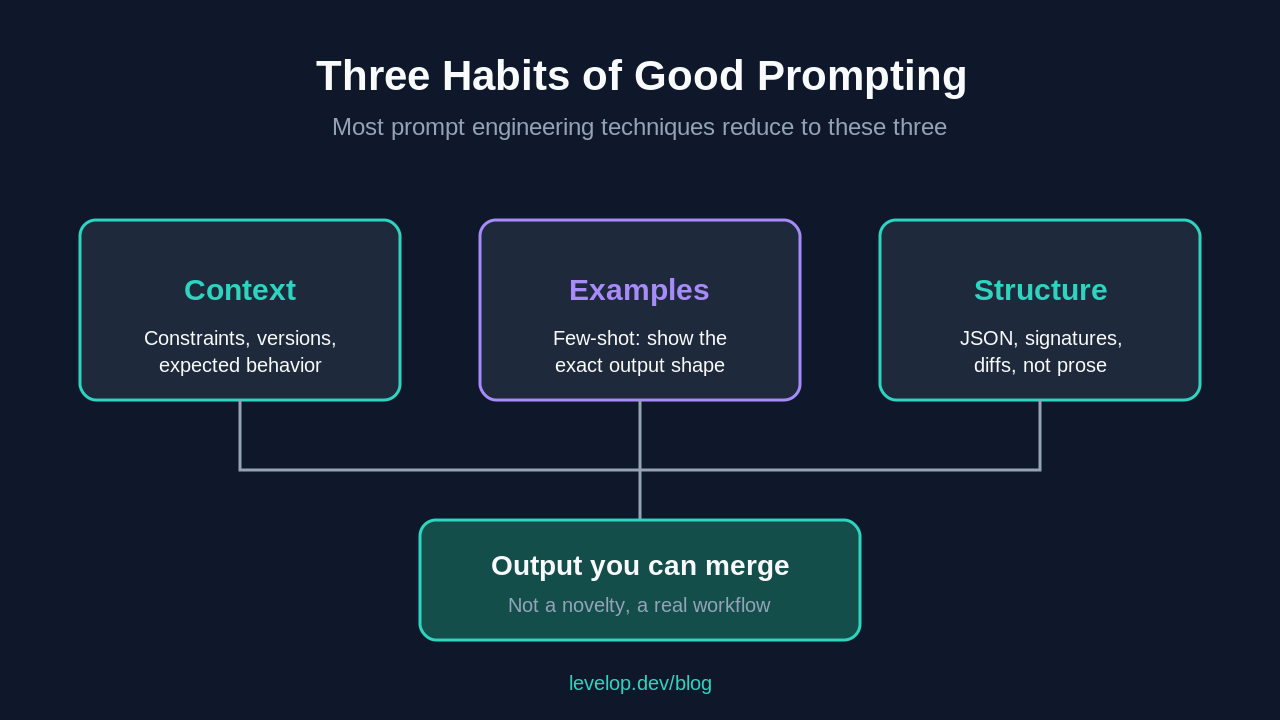
Prompting well is less about magic phrases and more about three habits: giving context, showing examples, and asking for structure. Most prompt engineering techniques worth knowing reduce to these three.
Give the model context and constraints
The single biggest upgrade most developers can make is to stop sending one-line requests. Compare these two prompts for the same task.
Weak prompt:
Write a function to validate emails.

Strong prompt:
Write a Python 3.11 function that validates email addresses for a signup form.
- Standard library only, no external packages
- Return a tuple of (is_valid: bool, reason: str)
- Reject addresses over 254 characters (RFC 5321 limit)
Include a short docstring and three example calls.
The weak prompt forces the model to invent every decision you did not make, and it usually invents the wrong ones. The strong prompt front-loads the decisions a reviewer would otherwise send back in a pull request comment.
Show, do not just tell
Models are pattern matchers, so a single example is often worth a paragraph of instructions. This is called few-shot prompting. Show one log line converted to the exact JSON shape you want, then ask for the next one, and the model stops guessing whether a field should be a string or an integer. You showed it, so it copies it.
Ask for structured output
If you plan to feed the answer into other code, say so and specify the format. The model happily returns natural language when you do not ask for structure, so ask for JSON with named fields, a specific function signature, or a diff. Specific requests produce something your pipeline can consume directly, which is the difference between using a model as a novelty and wiring it into real workflows.
The skills gap nobody is measuring
Most teams have no idea how wide their internal prompting gap already is, because nobody measures it. Code review catches bad code, but no review step catches an engineer wasting two hours on a task a better prompt would have finished in fifteen minutes. The strongest prompt engineers on a team are not the loudest about it. They are the ones who always seem to have a working draft ready.
The trap for individuals is assuming that because the model sometimes produces great output on a lazy prompt, prompting is not a real skill. That is survivorship bias. You remember the times a one-liner worked and forget the many times you re-rolled the same weak prompt hoping for a better result.
How to get better at prompt engineering for developers
This skill is learnable, fast, and mostly free to practice, because you already have the raw material: your daily work.
Treat prompts like code. When a prompt produces something useful, save it. When it fails, change one variable at a time the way you would debug a function, instead of re-rolling and hoping. Over a few weeks you will notice you keep reaching for the same shapes, so collect them into a small prompt library, which is to prompting what a snippets file is to coding.
Break big tasks into a short conversation. Each turn builds step by step on a verified previous one, and each carefully crafted prompt in the chain does one job and hands off cleanly to the next. Finally, read the vendor guides once. The OpenAI prompt engineering guide, Anthropic's documentation, and Google's prompting guidance converge on the same fundamentals and take an afternoon to absorb.
The engineer who cannot prompt is not going to be fired for it. They are simply going to be out-shipped, review cycle after review cycle, by the colleague who took the new literacy seriously. If you want a structured way to build these habits alongside the interview and system design skills that still matter, that is the skills-first approach we focus on at Levelop, and we write about the changing engineering job on the Levelop blog.
Frequently asked questions
Is prompt engineering for developers a real skill or just hype?
It is a real, measurable skill. The same model produces very different results depending on the quality of the input, and that variance is controlled by the prompt. Developers who give clear context, use examples, and specify output formats get more usable results with less rework.
Do I need a course to learn prompt engineering?
No. The fastest path is to practice on your daily work, save the prompts that work, and read the official guides from OpenAI, Anthropic, and Google once. Courses like the DeepLearning.AI ChatGPT prompt engineering for developers course help structure the basics, but most of the skill comes from deliberate iteration on real tasks.
How is this different from prompt engineering for software engineers generally?
The core principles are the same, but software development applies them to code-specific tasks: refactoring, debugging, writing tests, and explaining stack traces. Prompt engineering for software engineers leans heavily on giving the model relevant code context and validating results, since a wrong answer in code fails loudly rather than reading awkwardly.
Will better AI models make prompt engineering skills obsolete?
Unlikely. Models are getting better at handling weak prompts, which raises the floor, but the gap between average and excellent prompting is widening because skilled users extract more from every improvement. Better tools amplify skill differences rather than erase them.
What is the single biggest prompting mistake developers make?
Sending one-line requests with no context. Fix this function forces the model to invent every decision you did not specify. Adding the error message, the triggering input, the relevant versions, and a sentence on the correct behavior turns a plausible guess into something you can merge.