
Platform Engineering vs DevOps in 2026
I've been writing about system design and infrastructure patterns as part of my ongoing series on things I had to learn the hard way. This one has been brewing for a while because I kept running into the same debate at work and in online communities: is platform engineering replacing DevOps, or are we just rebranding the same thing? The devops vs platform engineering debate shows up everywhere now.
After spending time in both worlds and watching how our team's approach evolved over the past year, I think the answer is more nuanced than either side admits. Here's what I've learned.
The DevOps Promise and Where It Hit a Wall
DevOps changed everything when it first took hold. The idea was simple and powerful: tear down the wall between development and operations. No more throwing code over the fence to an ops team and hoping for the best. You build it, you run it.
And it worked. CI/CD pipelines became standard, transforming the entire software delivery lifecycle. Infrastructure as code replaced manual server provisioning. Teams that adopted DevOps shipped faster and broke things less often. For a while, it felt like the industry had solved the collaboration problem.
Then things got complicated.
Microservices meant that instead of deploying one application, teams were deploying dozens. Kubernetes added a whole new layer of operational complexity. Multi-cloud strategies multiplied the number of tools and configurations. Observability stacks grew from a single monitoring dashboard to a constellation of tracing, logging, and metrics tools.
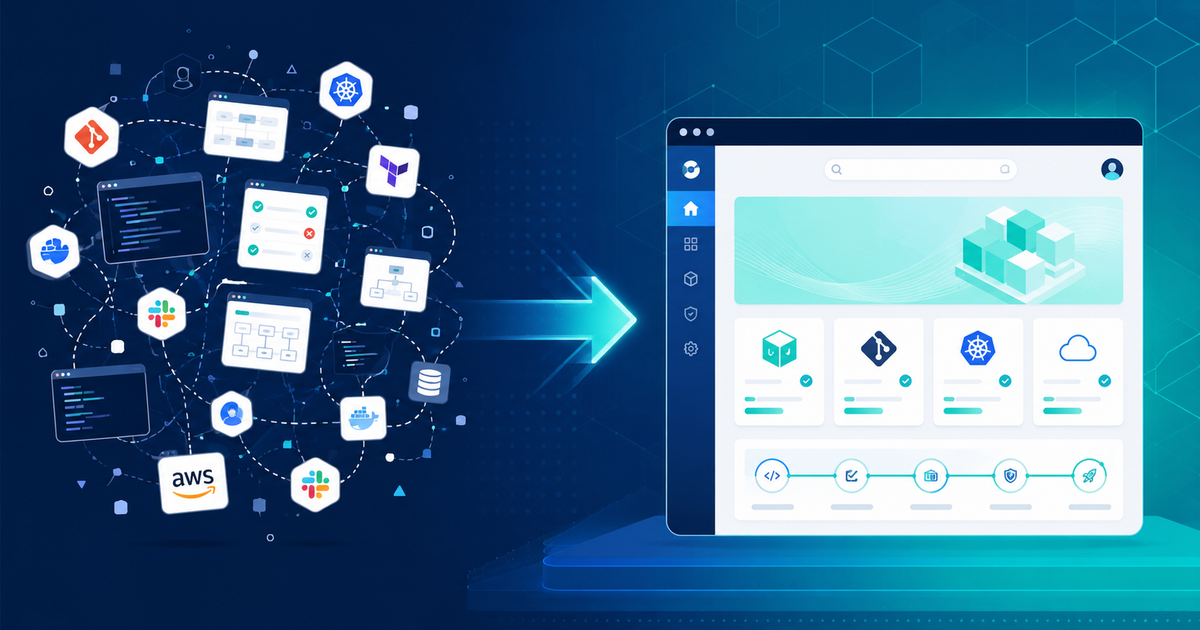
The cognitive load on individual developers became enormous, slowing the entire development process. I remember a quarter where I spent more time wrestling with Terraform configs and debugging Helm charts than writing actual application code. And I wasn't alone. Every team was independently solving the same infrastructure problems, building slightly different CI/CD pipelines, and maintaining their own deployment scripts. We were all following the DevOps playbook, but the playbook assumed a level of infrastructure simplicity that just didn't exist anymore.
That's the gap platform engineering stepped into.
What Platform Engineering Actually Is
Platform engineering is the discipline of building and maintaining Internal Developer Platforms (IDPs). Instead of every team managing their own infrastructure and tooling, a dedicated platform team creates reusable tools, workflows, and self-service environments.
Think of it this way. In a DevOps world, you hand each team a toolbox and say "build whatever you need." In a platform engineering world, you build a workshop with pre-configured workstations and say "here's everything set up, just start creating."
The core concept is the "golden path." It's a pre-paved road for common workflows (deploying a service, spinning up a database, setting up monitoring) that developers can follow without needing deep infrastructure expertise. They can step off the golden path if they need to, but most of the time they don't have to.
What platform engineering is NOT: it's not just a rebranding of DevOps. It's not creating a new silo where a platform team gatekeeps infrastructure. And it's not just writing Terraform modules and calling it a day. A good platform also standardizes security and compliance requirements across teams. The key difference is the product mindset. Platform teams treat developers as their customers and the platform as their product.
I wrote a deeper breakdown of the fundamentals in my earlier post on what platform engineering is and why it's the biggest shift since DevOps. If you're new to the concept, that's a good starting point.
Platform Engineering vs DevOps: The Real Differences
When you look at the devops vs platform engineering question closely, the comparison gets muddied because people frame it as a competition. It's not. They operate at different layers. But there are real, practical differences worth understanding.
Philosophy: Culture vs Product
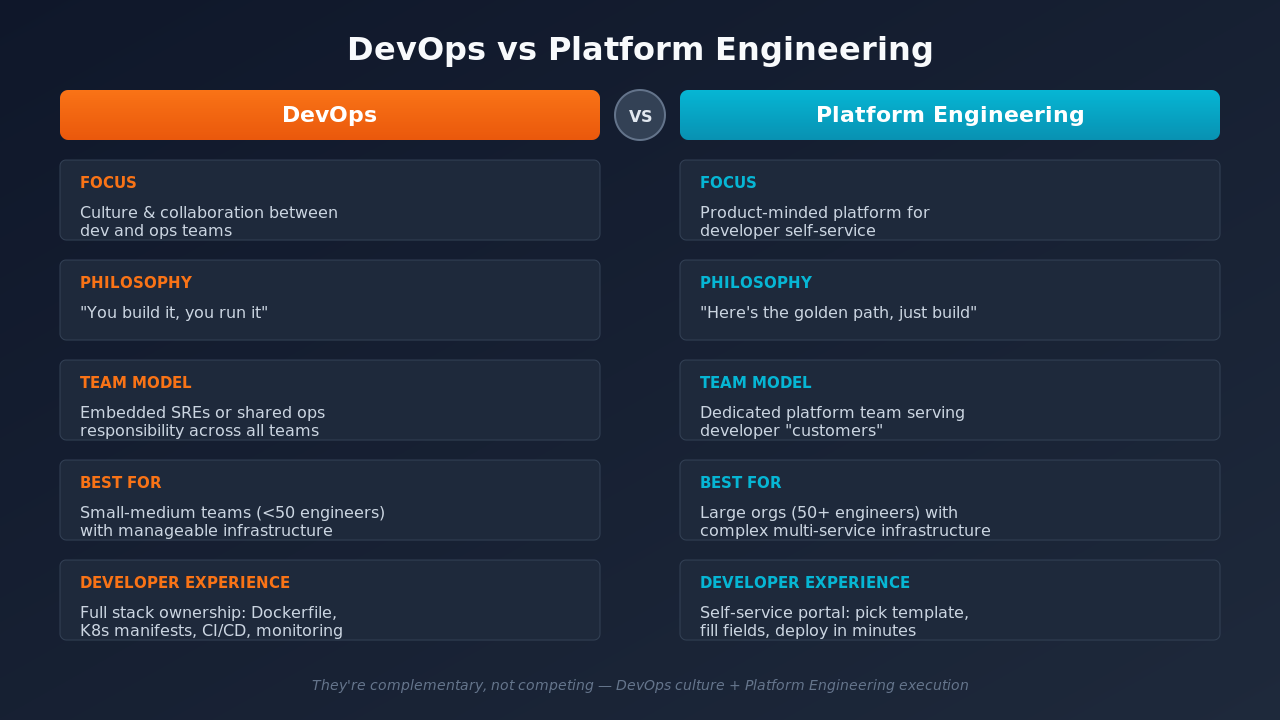
DevOps is fundamentally a cultural movement. It's about breaking down organizational silos, fostering collaboration between dev and ops, and creating shared ownership of the software lifecycle. The principles (automate everything, measure everything, share responsibility) are timeless.
Platform engineering is a product discipline. It takes those DevOps principles and implements them through a concrete, maintained product: the Internal Developer Platform. The focus shifts from "everyone should understand infrastructure" to "we should make infrastructure so easy that understanding it becomes optional for most developers."
Team Structure and Ownership
In a traditional DevOps setup, you might have embedded SREs in each team, or you might expect every developer to handle their own infrastructure needs. The "you build it, you run it" philosophy distributes operational responsibility across all engineering teams.
Platform engineering centralizes the infrastructure expertise in a dedicated team. That team builds self-service capabilities so other teams can move fast without needing to become infrastructure experts. The platform team doesn't own deployments for other teams. They own the tools and paths that make software delivery easy and consistent.
Developer Experience
This is where the difference becomes tangible. In a DevOps-centric org, a developer who needs to deploy a new service might need to write a Dockerfile, create Kubernetes manifests, set up a CI/CD pipeline, configure monitoring, wire up alerts, and manage secrets. That's a lot of context-switching away from the actual business logic.
In a platform engineering org, that same developer opens a self-service portal, selects a service template, fills in a few fields, and the platform handles the rest. The underlying infrastructure is the same, but the developer experience is radically different.
Where Each Approach Fits
DevOps works well when your engineering org is relatively small (under 50 people), your infrastructure is manageable (a monolith or a handful of services), and your developers actively want exposure to operations. There's real value in engineers understanding the full stack.
Platform engineering becomes essential when you cross certain complexity thresholds. If your engineers spend more than 30% of their time on non-differentiated operational work, if every team builds their own CI/CD pipeline slightly differently, if onboarding a new developer takes more than a week, or if your Kubernetes clusters have become tribal knowledge, you're past the point where pure DevOps scales comfortably.
The 2026 Landscape: What the Data Shows
The shift isn't just theoretical anymore. Gartner predicted that 80% of large software engineering organizations would have dedicated platform engineering teams by 2026, up from 45% in 2022. The latest enterprise surveys show that prediction was roughly on track, with 78% of enterprise DevOps teams now reporting a dedicated platform engineering function.
But there's an important caveat that the headlines miss. Adoption and maturity are very different things. Only about 25% of organizations with platform engineering teams rate their platform as "mature." The majority are still in early stages where the platform covers basic CI/CD and deployment but lacks self-service infrastructure, comprehensive observability, or integrated developer workflows.
The AI angle is accelerating things though. Over 60% of platform engineering teams are building or planning AI-assisted features. Think intelligent deployment recommendations, automated incident triage, AI-powered code review, and natural language interfaces for infrastructure provisioning. This is where the next wave of productivity gains is coming from.
Why This Isn't "DevOps Is Dead"
I want to push back on the "DevOps is dead" narrative because I think it causes real harm to teams making organizational decisions.
DevOps isn't dead. DevOps principles live inside platform engineering. The cultural foundation of shared ownership, breaking down silos, automation-first thinking, and measuring what matters is still critical. Platform engineering is the implementation layer for DevOps culture at scale. It's what DevOps looks like when your organization grows beyond the point where cultural practices alone can manage infrastructure complexity.
I've seen companies try to skip the DevOps cultural transformation and jump straight to platform engineering. It doesn't work well. You end up with a platform team that nobody trusts, builds tools nobody uses, and operates as the exact kind of silo that DevOps was supposed to eliminate. The culture has to come first. The platform is the tool that scales that culture.
How to Decide What Your Team Needs
If you're trying to figure out whether your organization needs to invest in platform engineering, here's the framework I'd use.
Start with cognitive load. Survey your developers. Ask them what percentage of their time goes to infrastructure versus product work. If that number is consistently above 30%, your development process has a platform engineering problem whether you call it that or not.
Look for duplication. If three teams are maintaining three different CI/CD pipelines that do basically the same thing, that's wasted effort a platform could consolidate.
Check onboarding time. How long does it take a new engineer to deploy their first change to production? If it's more than a day or two, your developer experience needs investment.
Assess your infrastructure complexity. If you're running Kubernetes, multi-cloud, or more than 20 microservices, the operational surface area probably justifies dedicated platform investment.
For most organizations in 2026, the answer isn't either/or. The hybrid approach works best: maintain the DevOps culture of shared responsibility and collaboration, but build platform engineering capabilities to reduce cognitive load on product teams. Start with the highest-impact golden path (usually deployment), treat it as a product with internal customers, and iterate based on developer feedback.
Building Your First Internal Developer Platform
If you're convinced you need to start, here's the practical path.
First, survey developer pain points. Don't assume you know what developers struggle with. Ask them. The top friction points are almost always: deployment complexity, environment setup, and observability configuration.
Second, pick your first golden path. Deployment is usually the highest-impact starting point because every team touches it every day. Build a standardized deployment pipeline that works out of the box for 80% of cases.
Third, choose your platform engineering tools. The landscape in 2026 is maturing quickly. Backstage (by Spotify) remains the most popular developer portal framework. Humanitec provides a platform orchestrator. Port offers a no-code internal developer portal. Kratix handles platform-as-a-product patterns on Kubernetes.
Fourth, measure what matters. Track deployment frequency, change lead time, onboarding time, and developer satisfaction (through regular surveys). These tell you whether your platform is actually reducing cognitive load or just adding another tool to the pile.
Frequently asked questions
Is DevOps being replaced by platform engineering?
No. Platform engineering evolved from DevOps, it didn't replace it. DevOps is the cultural foundation of collaboration between development and operations. Platform engineering is the product-oriented discipline that implements those principles at scale through Internal Developer Platforms. Most organizations in 2026 practice both: DevOps culture with platform engineering execution.
What is an Internal Developer Platform (IDP)?
An Internal Developer Platform is a self-service layer built on top of your existing infrastructure. It provides developers with golden paths for common workflows like deploying services, provisioning databases, and setting up monitoring. The goal is to reduce cognitive load by abstracting infrastructure complexity while still allowing teams to customize when needed.
Do I need platform engineering if I already have DevOps?
It depends on your scale and complexity. If your engineering organization is under 50 people with relatively simple infrastructure, strong DevOps practices may be sufficient. Once you cross certain complexity thresholds (many microservices, multi-cloud, developers spending significant time on ops work), platform engineering helps scale those DevOps principles without burning out your teams.
What tools do platform engineering teams use in 2026?
The most common platform engineering tools include Backstage for developer portals, Humanitec and Kratix for platform orchestration, Port for no-code internal platforms, ArgoCD and Flux for GitOps deployment, and Crossplane for infrastructure abstraction. Many teams also integrate AI assistants for deployment recommendations and incident triage.
How do I transition from DevOps to platform engineering?
Start by measuring developer cognitive load and identifying the most common infrastructure pain points. Form a small platform team (2-3 engineers to start) and have them build a golden path for your most painful workflow, usually deployment. Treat the platform as a product: interview your developer customers, iterate based on feedback, and measure adoption. Don't try to build everything at once. Grow the platform organically based on demonstrated value.
Wrapping Up
The platform engineering vs devops conversation is really about how organizations evolve. DevOps gave us the cultural playbook for better software delivery. Platform engineering gives us the tools to run that playbook at scale. Neither makes the other obsolete.
If you're feeling the weight of infrastructure complexity on your team, the signal is clear. Measure your cognitive load, find the highest-friction workflows, and start paving golden paths. Your developers will thank you.
I've been exploring these infrastructure and system design patterns on Levelop, where I break down the concepts that keep coming up in real engineering work.