
What Is Platform Engineering? A Developer's Guide to the Biggest Shift Since DevOps
I've been breaking down system design and software architecture concepts in this series, and this one keeps coming up in every architecture discussion I'm part of. Platform engineering. If you've been in software for more than a year, you've probably noticed DevOps teams quietly rebranding. New job titles showing up on LinkedIn. Conference talks shifting from "shift left" to "golden paths." Something is happening, and it's bigger than a name change.
The Problem That Created Platform Engineering
Here's what actually happened. DevOps told every developer: "You build it, you run it." Great philosophy. Terrible at scale.
When your company has 10 engineers, everyone can learn Kubernetes, set up their own CI/CD pipelines, configure monitoring, manage secrets, and still ship features. When you hit 200 engineers across 40 teams, that model breaks. Not because DevOps was wrong, but because the cognitive load becomes unsustainable.
I saw this firsthand. Teams were spending 30 to 40 percent of their time on infrastructure plumbing instead of building features. Every team had slightly different Terraform configs. Three different ways to deploy to staging. Nobody could onboard a new engineer in under two weeks because there was too much tribal knowledge baked into the toolchain.
Gartner predicted that by 2026, 80 percent of large software engineering organizations would establish platform engineering teams. They made that prediction in 2022 when adoption was around 45 percent. Looking at the landscape now, they were right.
So What Is Platform Engineering, Actually?
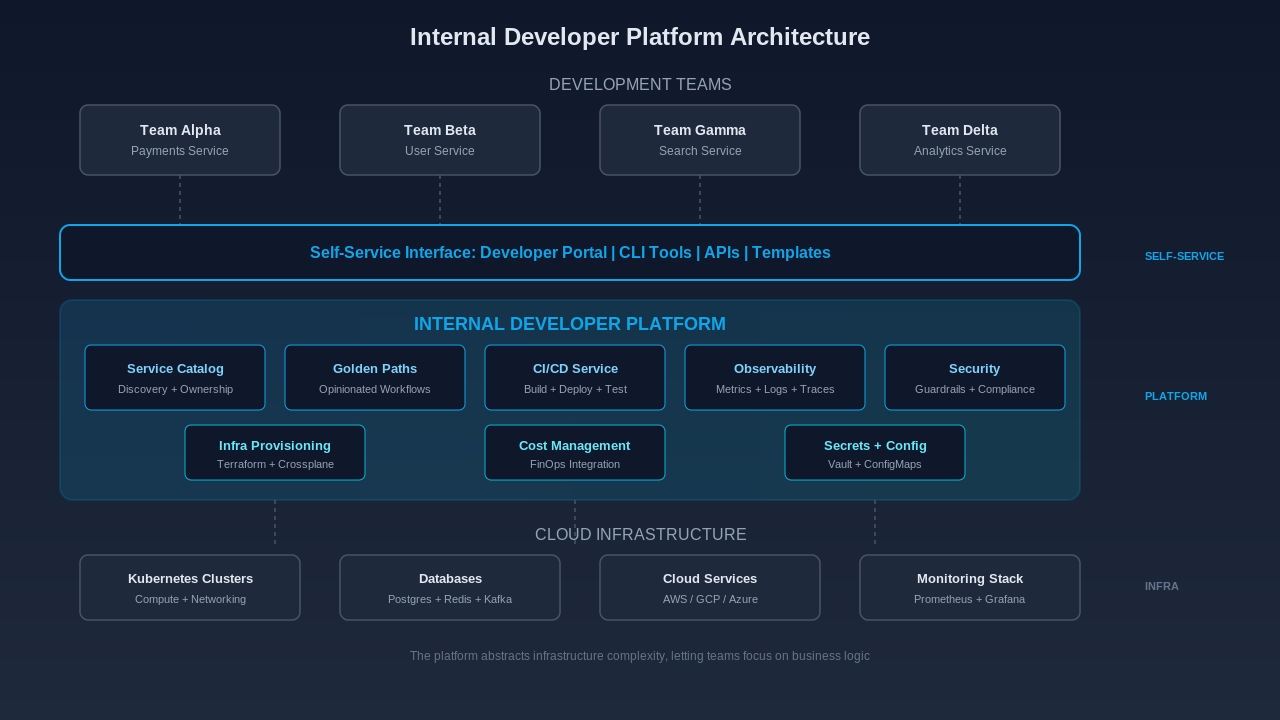
Platform engineering is the discipline of building and maintaining an Internal Developer Platform (IDP) that provides self-service capabilities to software development teams. The goal is to reduce cognitive load on developers by abstracting away infrastructure complexity behind well-designed interfaces.
Think of it this way. If DevOps was a philosophy ("dev and ops should collaborate"), platform engineering is the product that makes that philosophy work at scale. The platform team builds a curated set of tools, templates, and workflows. Development teams consume them through self-service portals, CLI tools, or APIs. Nobody files a ticket to create a database. Nobody waits three days for a staging environment.
The key mental model comes from Team Topologies (the book by Matthew Skelton and Manuel Pais). Platform teams operate as "enabling teams" that reduce the cognitive load on "stream-aligned teams" (your feature teams). The platform is a product, and the developers are its users.
The Core Components of an Internal Developer Platform
An IDP isn't one tool. It's a composition of capabilities that work together. Here's what most production IDPs include:
Service Catalog
A centralized registry of every service, API, library, and data pipeline in your organization. Developers can search, discover ownership, check documentation, and understand dependencies without asking anyone. Spotify built Backstage for exactly this problem. When they hit 2,000 backend services across 280 engineering teams, tribal knowledge stopped working. The service catalog became the source of truth.
Golden Paths
These are pre-paved, opinionated workflows for common tasks. Need a new microservice? The golden path gives you a production-ready scaffold with CI/CD, monitoring, logging, and security policies already configured. You run one command or click one button.
The key insight about golden paths: they're opinionated but not mandatory. Teams can deviate when they have good reason. But 80 percent of the time, the golden path is exactly what they need, and they save hours of setup.
Self-Service Infrastructure
Developers request compute, databases, message queues, and other resources through the platform. Behind the scenes, the platform handles provisioning, networking, security groups, and compliance checks. The developer gets a connection string and moves on.
This isn't just about speed. It's about consistency. When every Postgres database gets provisioned through the same workflow, you get consistent backup policies, monitoring, and access controls for free.
Developer Portal
The user interface that ties everything together. Most teams use Backstage (open source, created by Spotify) or commercial alternatives like Port or Humanitec. The portal is where developers go to create services, check deployment status, view documentation, and access platform capabilities.
Guardrails, Not Gates
Traditional ops teams acted as gatekeepers. You submit a request, they approve it (eventually). Platform engineering flips this to guardrails. The platform encodes policies (security, compliance, cost) into the self-service workflows. If your request meets the policies, it goes through automatically. If it doesn't, you get immediate feedback about what to fix.
This is where FinOps integration is happening in 2026. Teams see the cost of their infrastructure choices before they deploy, not after the monthly invoice.
Platform Engineering vs DevOps: The Real Difference
This is the question everyone asks, and most answers get it wrong. Platform engineering doesn't replace DevOps. It operationalizes it.
DevOps gave us the principles: shared ownership, automation, feedback loops, continuous improvement. Platform engineering gives us the implementation: a product team that builds the tools and workflows that make those principles achievable at scale.
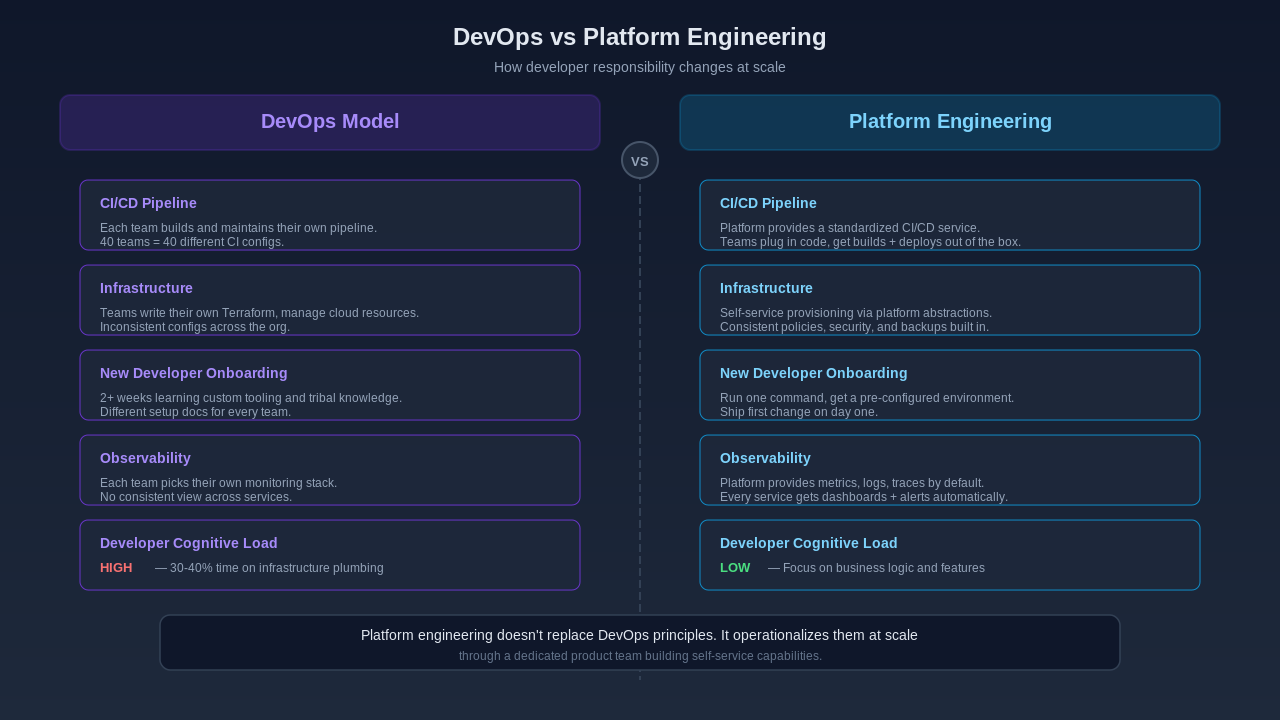
Where teams get confused is thinking platform engineering means centralizing everything again. It doesn't. It means centralizing the undifferentiated heavy lifting (infrastructure provisioning, CI/CD, observability setup) while keeping teams autonomous in their domain decisions (architecture, technology choices within guardrails, feature prioritization).
When a new developer joins in a DevOps-only organization, they spend their first two weeks learning the team's custom Terraform setup, figuring out how the CI pipeline works, getting access to various cloud accounts, and understanding the deployment process. In a platform engineering organization, they run a single onboarding command, get a pre-configured development environment, and ship their first change on day one.
What a Platform Team Actually Looks Like
A platform team is a product team. Full stop. They have a product manager (or someone playing that role). They have a backlog. They do user research (interviewing development teams about their pain points). They measure success by developer satisfaction and time-to-production, not by uptime alone.
The typical platform team in 2026 includes infrastructure engineers who build the underlying provisioning, networking, and compute layer. Developer experience (DevEx) engineers who build the portal, CLI tools, templates, and self-service workflows. And site reliability engineers who ensure the platform itself is reliable.
Most organizations start with 3 to 5 people and scale based on the number of stream-aligned teams they support. A common ratio is one platform engineer for every 8 to 10 development teams.
Real-World Examples
Spotify started all of this by open-sourcing Backstage in 2020. Their internal version manages 2,000+ backend services, 300 websites, and 4,000 data pipelines. In 2026, they've evolved Backstage into an agent-first platform, with AI assistants that reduced developer overhead by roughly 47 percent.
Netflix built their platform around "paved roads" (their term for golden paths). Their internal tooling lets engineers go from idea to production deployment in minutes for standard workloads. But they never force anyone onto the paved road. If a team needs something custom, they can build it.
Uber invested heavily in platform engineering to support their 4,000+ microservices. Their platform handles build, deploy, and observability for every service, with self-service capabilities that let new engineers ship code on their first day.
Mercado Libre (Latin America's largest e-commerce company) runs over 20,000 microservices. Their platform team built Fury, an internal platform that handles everything from service creation to production monitoring. Their deployment frequency went from a few times per week to thousands of deployments per day.
The pattern across all these companies is the same. They hit a scale where manual infrastructure management became the bottleneck, and they solved it by treating infrastructure as a product rather than a project.
What a Golden Path Looks Like in Practice
To make this concrete, here's what a golden path for creating a new service might look like. The developer runs a single CLI command:
platform create service --name order-processor --type grpc --language goBehind the scenes, the platform scaffolds everything:
# platform-manifest.yaml (auto-generated)
service:
  name: order-processor
  type: grpc
  language: go
  team: payments
  tier: critical

infrastructure:
  compute:
    type: kubernetes
    replicas: 3
    cpu: "500m"
    memory: "512Mi"
  database:
    type: postgres
    version: "16"
    backup: daily
  observability:
    metrics: prometheus
    tracing: opentelemetry
    logging: structured-json
    alerts:
      - type: error-rate
        threshold: 1%
      - type: latency-p99
        threshold: 500ms

ci-cd:
  pipeline: standard-grpc
  stages: [lint, test, security-scan, build, deploy-staging, integration-test, deploy-prod]
  auto-deploy-staging: true
  prod-requires-approval: true
The developer didn't write any of that configuration. The platform generated it based on organizational defaults, the service type, and the team's tier. Within minutes, they have a repository with a working service skeleton, a fully configured CI/CD pipeline, a database provisioned in staging, monitoring dashboards, and an entry in the service catalog.
Getting Started (Without Over-Engineering It)
If you're a developer or team lead thinking about platform engineering, here's the practical path forward.
Start with pain. Survey your development teams. Where do they spend the most time on undifferentiated work? The answer is your starting point. For most teams, it's environment provisioning or CI/CD setup.
Build for the 80 percent. Don't try to handle every edge case. Build golden paths that cover the most common workflows. A service template that handles the standard case is infinitely more valuable than a flexible system that handles everything but requires a PhD to operate.
Treat it like a product. Measure adoption. Collect feedback. Iterate. If developers aren't using the platform, the platform has a product problem, not a people problem.
Don't buy before you build understanding. Tools like Backstage, Port, and Humanitec are powerful. But adopting one before you understand your teams' actual workflows is a recipe for expensive shelfware.
Measure what matters. Track four metrics: time from commit to production (deployment frequency), time for a new engineer to ship their first change (onboarding time), percentage of teams using the golden paths (adoption rate), and developer satisfaction score from periodic surveys (NPS).
Common Mistakes I've Seen
The "build everything" trap. Some platform teams try to build a complete IDP from scratch. They spend 18 months building before anyone uses it. By the time it launches, requirements have shifted. Start small, ship incrementally, get feedback.
Ignoring developer experience. The platform works perfectly from a technical standpoint. But the CLI is confusing, the docs are out of date, and the portal requires five clicks to do anything. Developers go back to doing things manually. DevEx isn't a nice-to-have. It's the thing that determines whether your platform gets adopted.
Treating the platform as infrastructure, not a product. If your platform team doesn't talk to developers regularly, doesn't measure satisfaction, and doesn't have a roadmap based on user needs, you're building infrastructure, not a platform.
What Comes Next
Platform engineering is evolving fast. In 2026, the biggest shift is AI integration. 73 percent of platform teams have integrated AI assistants into at least one developer workflow. AI code review bots, automated incident responders, and intelligent service scaffolding are becoming standard platform features.
The other trend is composability. Rather than monolithic IDPs, teams are building platforms from composable modules. A Backstage frontend with custom plugins. A Crossplane backend for infrastructure. Argo for deployments. The platform becomes an orchestration layer that ties best-of-breed tools into a coherent experience.
Security is also becoming a first-class platform capability, not an afterthought. Platform teams are embedding security scanning, dependency auditing, and compliance checks directly into golden paths. When a developer creates a service through the platform, it automatically gets container image scanning, SAST/DAST integration, secrets management, and network policies.
FinOps integration is another area seeing rapid growth. Platform teams are embedding cost visibility into the developer workflow. Before you provision a database, the platform shows you the estimated monthly cost. This turns cost management from a surprise invoice at the end of the month into a real-time decision point.
I've been digging into these architecture concepts on Levelop, and platform engineering keeps showing up as the connective tissue between system design theory and real-world engineering practice.
Frequently asked questions
What is platform engineering in simple terms?
Platform engineering is the practice of building internal tools, templates, and self-service workflows that help development teams ship software faster without dealing with infrastructure complexity. Instead of every team managing their own CI/CD, databases, and deployments, a dedicated platform team builds a standardized set of capabilities that all teams can use through self-service portals or CLI tools.
Is platform engineering replacing DevOps?
No. Platform engineering operationalizes DevOps principles at scale. DevOps gave us the philosophy of shared ownership and collaboration between development and operations. Platform engineering gives us the actual product (the Internal Developer Platform) that makes those principles work when you have hundreds of developers.
What skills do you need for platform engineering?
Platform engineers typically need strong infrastructure skills (Kubernetes, cloud platforms, Terraform/Pulumi), software engineering fundamentals (you're building a product, not just running scripts), and product thinking (understanding user needs, measuring adoption, iterating based on feedback). Experience with tools like Backstage, Argo CD, and Crossplane is increasingly common in job listings.
How is platform engineering different from SRE?
Site Reliability Engineering (SRE) focuses on the reliability and performance of production systems. Platform engineering focuses on building internal tools and workflows that improve developer productivity. SRE serves the end user by keeping systems reliable. Platform engineering serves the developer by making their workflow efficient. Many organizations have both SRE and platform engineering teams working together.
What are the best platform engineering tools in 2026?
The most widely adopted tools include Backstage (open-source developer portal by Spotify), Port (commercial IDP with a strong no-code interface), Humanitec (score-based platform orchestrator), Crossplane (Kubernetes-native infrastructure provisioning), and Argo CD (GitOps continuous delivery). The right choice depends on your team size, existing toolchain, and whether you prefer open-source or managed solutions.