

Amazon Coding Interview Prep 2026: Leadership Principles in Your Algorithm Explanation
Most guides treat the Amazon coding interview as two separate tests bolted together. First you solve the algorithm. Then, in some other room on some other day, you answer behavioral questions about the Leadership Principles. Prepare for each in its own silo, the thinking goes, and you are covered.
That framing quietly costs strong engineers their offers. At Amazon, the Leadership Principles are not confined to the behavioral loop. They are the lens every interviewer uses, including the one watching you write a breadth-first search. The person across the table is not only checking whether your code compiles. They are listening for Ownership, for Dive Deep, for Are Right A Lot, in the way you narrate your solution. Two candidates can land the same optimal answer and walk out with opposite verdicts, because one explained the algorithm like an owner and the other explained it like a student reciting a memorized pattern.

This guide is about that narration layer. Not a separate behavioral script, but the specific things you say and do while coding that make an Amazon interviewer hear a Leadership Principle without you ever naming it. If you want the broader pattern-by-pattern DSA breakdown, we cover that across the Levelop blog. Here we focus on the part almost nobody rehearses: turning your problem-solving out loud into evidence of how you operate.
Why the Amazon coding round is never only about the answer
Amazon runs its loop differently from a lot of its peers. Every interviewer is assigned one or two Leadership Principles to probe, and they are expected to bring back specific evidence, positive or negative, tied to those principles. That assignment does not switch off when the question is algorithmic. An interviewer holding Dive Deep and Deliver Results will grade your coding session partly on whether you dug into edge cases and drove to a working solution, not just whether you knew the trick.
The loop usually starts with an online assessment before the onsite, and by the time you reach the coding questions in the full Amazon interview process, that same rubric is already in play. Whether the round is data structures, coding, or system design questions, interviewers are looking for signals of effective leadership and continuous learning in real interviews, not just a passing test case. That is what separates a candidate who clears the bar from one who would raise it for future team members.
There is also the Bar Raiser, a trained interviewer from outside the hiring team whose job is to protect the long-term quality of Amazon hires. The Bar Raiser has an effective veto, and they are looking hard at signal beyond raw correctness: how you handle ambiguity, whether you can defend a decision, whether you would raise the bar for the team. We wrote a full breakdown of that role in The Bar Raiser Round, and it is worth reading alongside this piece.
Amazon publishes its Leadership Principles openly, and the interview loop is built directly on them. That transparency is a gift. It means the rubric you are being graded against is not a secret. The mistake candidates make is reading those principles once for the behavioral round and forgetting them the moment they pick up the marker.
The six Leadership Principles that actually surface while you code
Sixteen principles exist, but only a handful realistically show up inside a 45-minute coding session. Prepping all sixteen for a whiteboard problem is wasted effort. Prepping these six is where the leverage is.
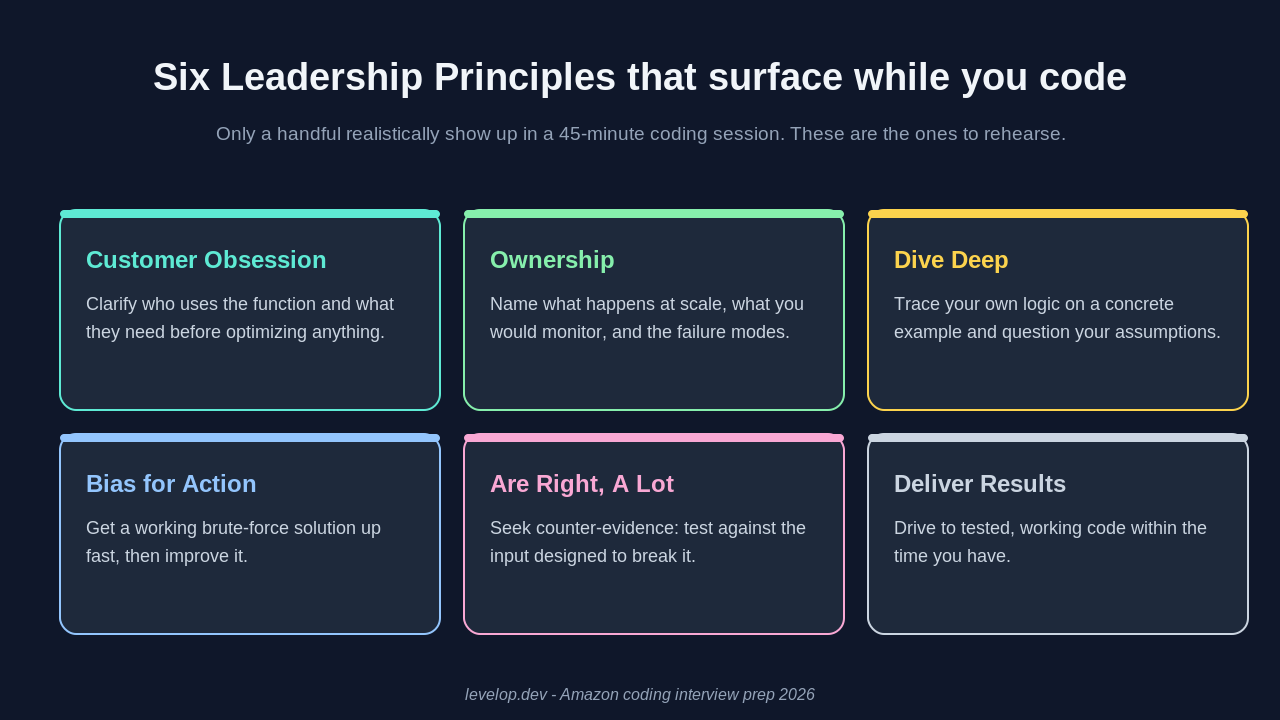
Customer Obsession
In a coding round this shows up as clarifying who uses the function and what they need before you optimize anything. When you ask what is the expected input size, and does this run on a hot path, you are working backward from the customer instead of coding in a vacuum.
Ownership
Owners think beyond the single function on the board. You show this by naming what happens at scale, what you would monitor, and what the failure modes are, even when the interviewer only asked for the happy path.
Dive Deep
This is the one interviewers watch most closely during coding. It means tracing your own logic on a concrete example, questioning your assumptions, and refusing to hand-wave a step you do not actually understand.
Bias for Action
Amazon values speed with reversible decisions. In a coding round, that looks like getting a working brute-force solution on the board quickly, then improving, rather than freezing while you search for the optimal answer first.
Are Right, A Lot
This is not about being right instantly. It is about seeking out counter-evidence: testing your solution against the input designed to break it, and adjusting when it does.
Deliver Results
You drove to working, tested code within the time. You did not leave the interviewer to imagine whether it would run.
A worked example: narrating a graph problem like an owner
Take a common Amazon-flavored question: given a grid of 1s (land) and 0s (water), count the number of islands. It is a straightforward flood fill. Plenty of candidates solve it silently in four minutes and think they aced it. Here is how you solve the same problem while surfacing three or four Leadership Principles out loud.
Start with Customer Obsession and clarify before coding: Before I write anything, can I confirm the grid can be large, say thousands by thousands? And can I mutate the input grid, or should I keep it read-only? That changes whether I use a visited set or flip cells in place.
That single question signals that you think about memory, mutation contracts, and the caller. Now the brute-force-first move, which is Bias for Action:
def num_islands(grid):
    if not grid or not grid[0]:
        return 0
    rows, cols = len(grid), len(grid[0])
    count = 0

    def sink(r, c):
        # Out of bounds or water: stop.
        if r < 0 or r >= rows or c < 0 or c >= cols or grid[r][c] != "1":
            return
        grid[r][c] = "0"  # Mark visited by sinking the land.
        sink(r + 1, c)
        sink(r - 1, c)
        sink(r, c + 1)
        sink(r, c - 1)

    for r in range(rows):
        for c in range(cols):
            if grid[r][c] == "1":
                count += 1
                sink(r, c)
    return count
As you write it, narrate the Ownership layer: I am sinking land in place to mark visited, which avoids an extra visited set. The tradeoff is that I am mutating the caller's grid, which is why I asked about that up front. If mutation were not allowed, I would switch to a separate visited set at the cost of memory proportional to the grid.
Now the Dive Deep and Are Right, A Lot moment. Do not wait for the interviewer to find the bug. Go find it yourself: Let me trace the recursion depth. On a grid that is entirely land, the recursion could go as deep as rows times cols. On a very large grid that risks a stack overflow. So for production input I would convert this to an iterative BFS or DFS with an explicit stack.
Then you deliver the improved version, which is Deliver Results:
from collections import deque

def num_islands_iterative(grid):
    if not grid or not grid[0]:
        return 0
    rows, cols = len(grid), len(grid[0])
    count = 0

    for r in range(rows):
        for c in range(cols):
            if grid[r][c] == "1":
                count += 1
                queue = deque([(r, c)])
                grid[r][c] = "0"
                while queue:
                    x, y = queue.popleft()
                    for dx, dy in ((1, 0), (-1, 0), (0, 1), (0, -1)):
                        nx, ny = x + dx, y + dy
                        if 0 <= nx < rows and 0 <= ny < cols and grid[nx][ny] == "1":
                            grid[nx][ny] = "0"
                            queue.append((nx, ny))
    return count
Same problem, same optimal time complexity of O(rows times cols). But the second candidate talked about the caller, chose a data structure deliberately, caught their own stack-depth risk, and drove to production-safe code. That candidate gave the interviewer three principles of evidence. The silent solver gave them a green checkmark and nothing to write down. If you want to go deeper on when BFS versus DFS is the right traversal, we break that down in BFS vs DFS vs DP.
Mapping principles to specific moments in the coding round
It helps to know exactly when in the session each principle has its opening. These are the moments to watch for.
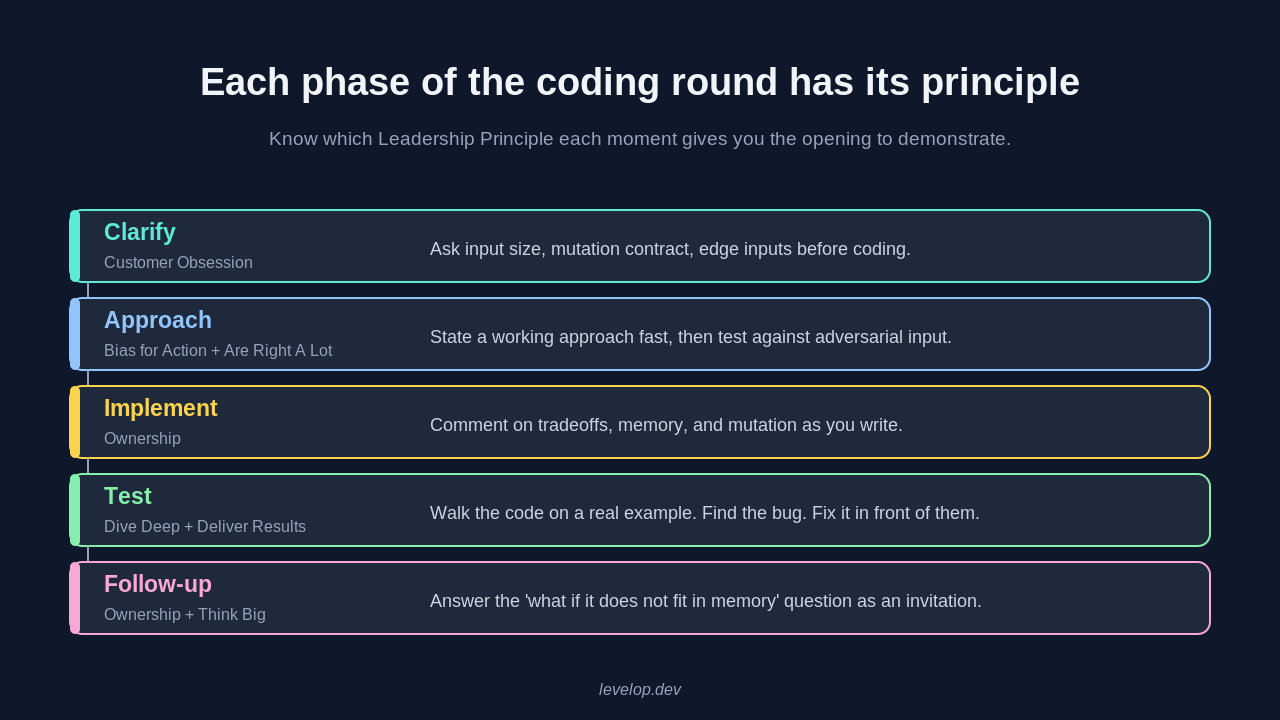
The clarifying phase, in the first two minutes, is where Customer Obsession lives. Ask about input size, constraints, edge inputs, and the contract before writing code.
The approach phase, where you pick brute force or optimal, is where Bias for Action and Are Right, A Lot show up. State a working approach fast, then reason about whether it is correct against adversarial input.
The implementation phase is where Ownership shows up, in your comments about tradeoffs, memory, and mutation. The testing phase, which too many candidates skip, is where Dive Deep and Deliver Results both live. Walk your code against a real example, find the off-by-one, and fix it in front of them.
The follow-up phase, when the interviewer asks what if the grid did not fit in memory, is pure Ownership and Think Big. Do not treat it as a trap. Treat it as the invitation it is.
What Dive Deep looks like when you hit a bug
Nothing reveals a candidate faster than a bug appearing on the board. The weak response is to get flustered and start randomly changing lines. The Amazon-strong response treats the bug as a chance to demonstrate exactly the principle the interviewer is grading.
Suppose your two-pointer solution returns the wrong result on a specific input. Here is the narration that turns a bug into a positive signal:
def two_sum_sorted(nums, target):
    left, right = 0, len(nums) - 1
    while left < right:
        current = nums[left] + nums[right]
        if current == target:
            return [left, right]
        elif current < target:
            left += 1
        else:
            right -= 1
    return []
It returns empty on this input, which should have a valid pair. Let me not guess. Let me trace it with the actual numbers. You then step through the pointers out loud, index by index, until you find the assumption that broke. Maybe the array was not actually sorted, which your algorithm requires. You say so: My approach assumes sorted input. I should have confirmed that at the start, that is on me. Two options: sort first at O(n log n), or switch to a hash map approach at O(n) time and O(n) space. Given we do not know the input is sorted, I will go with the hash map.
That sequence, owning the missed assumption, diving into the trace instead of guessing, and making a defensible decision, is worth more than a clean solution that never hit a snag. Interviewers are explicitly trained to value how you recover. We go further on this in our guide to why behavioral signal decides senior loops, and the same logic applies inside the coding room.
A pre-interview checklist for Amazon coding rounds
Run through this before every Amazon loop in your 2026 interview prep:
- Rehearse narrating, not just solving. Practice at least ten problems where you speak every clarifying question and tradeoff out loud, ideally recording yourself. Silent practice builds the wrong muscle.
- Prepare your clarifying questions as a reusable opener. Input size, mutation contract, edge inputs, and expected call frequency work for almost any problem and instantly signal Customer Obsession.
- Always brute force first, then optimize. Getting working code up fast is Bias for Action, and it gives you a safety net if you run low on time.
- Test every solution out loud with a concrete example. This is non-negotiable. It is where Dive Deep and Deliver Results are earned.
- Know the follow-up direction for common questions. For most Amazon problems there is a what if it does not fit in memory or what if this is called a million times a second follow-up. Have a direction ready.
- Read the published Leadership Principles the night before, through a coding lens. Ask of each: what would this look like if I demonstrated it while writing an algorithm?
Where structured practice fits
You cannot fake this narration layer on the day. It has to be rehearsed until talking through tradeoffs feels natural under pressure. That is exactly the kind of practice that is hard to do alone, because you need feedback on the story you are telling, not just whether your code passed. Structured mock interviews that grade communication alongside correctness are where this skill actually forms. That coaching gap is a large part of why we built Levelop, and you can explore more interview breakdowns on the Levelop blog.
The takeaway is simple to state and hard to master. At Amazon, your algorithm gets you in the room. The way you explain it, through the lens of the Leadership Principles, is what gets you the offer.
Frequently Asked Questions
Do Amazon coding interviews really assess Leadership Principles, or only the behavioral rounds?
Both. Every Amazon interviewer is assigned specific Leadership Principles to evaluate, and that assignment applies during the coding round too. Interviewers are trained to gather evidence of principles like Dive Deep, Ownership, and Are Right A Lot from how you approach and explain a technical problem, not only from your behavioral answers.
Which Leadership Principles matter most in a coding interview?
In practice, six show up most often: Customer Obsession for clarifying requirements, Bias for Action for getting a working solution fast, Dive Deep for tracing and testing your own logic, Are Right A Lot for checking against adversarial input, Ownership for naming tradeoffs and failure modes, and Deliver Results for driving to tested, working code within the time.
Should I mention the Leadership Principles by name while coding?
Generally no. Naming them can sound rehearsed. The stronger move is to demonstrate them through your behavior: ask the clarifying question, state the tradeoff, test the edge case. Let the interviewer recognize the principle in your actions rather than announcing it.
How is the Amazon coding interview different from Google or Meta in 2026?
The core algorithmic content overlaps heavily, but Amazon uniquely ties every interview, including coding, back to its published Leadership Principles and includes a Bar Raiser with veto power. Google and Meta weight raw problem-solving and code quality more heavily, while Amazon puts more emphasis on the behavioral signal embedded in how you work.
What is the single biggest mistake candidates make in Amazon coding rounds?
Solving silently and skipping the testing phase. Correct code with no narration gives the interviewer almost nothing to report against their assigned principles. Talking through your reasoning and testing your solution out loud is what turns a correct answer into a strong hire signal.
References
- Amazon, our Leadership Principles, amazon.jobs.
- Amazon Jobs, interviewing at Amazon and the bar raiser, amazon.jobs.
- Levelop, The Bar Raiser Round and behavioral interview breakdowns, levelop.dev/blog.