
Multi-Agent Orchestration Patterns: Sequential, Parallel, Hierarchical
Building one capable agent is hard. Coordinating several of them so they behave like a single reliable system is harder. As soon as you split work across a planner, a retriever, a coder, and a reviewer, you need something to decide who runs when, what they receive, and how their outputs combine. That something is an orchestrator, and the shape it takes is what we call multi agent orchestration.
This guide breaks down the three multi agent orchestration patterns you will actually reach for in production: sequential, parallel, and hierarchical. We cover what each one is good at, where it breaks, and how to pick between them. If you are still deciding on a framework to implement these, start with our AI agent orchestration frameworks guide, which maps the tooling landscape. This article focuses on the patterns themselves, which outlast any single framework.
What Is the Purpose of an Orchestrator Agent?
Before comparing patterns, it helps to answer a common question directly: what is the purpose of an orchestrator agent? An orchestrator agent is the control layer that turns a collection of specialized agents into a coordinated workflow. It does not usually do the domain work itself. Instead it decides which agent handles the next step, passes the right context to that agent, collects results, and decides whether the task is done or needs another pass.
Think of it as the difference between a group of skilled musicians and an actual orchestra. The musicians can each play, but without a conductor they cannot stay in time or hand off cleanly. The orchestrator agent is the conductor. Its job is coordination, not performance.
Concretely, an orchestrator agent owns four responsibilities. It handles routing, choosing which agent or tool runs next based on the current state. It handles context management, deciding what each agent needs to see so it is neither starved of information nor drowned in irrelevant tokens. It handles aggregation, merging partial results into a coherent whole. And it handles termination, knowing when the workflow is complete or has failed and should stop. The orchestration pattern you choose determines how these four responsibilities are wired together.
Why Agent Orchestration Patterns Matter
A single large language model call is stateless and self-contained. Multi-agent systems are neither. The moment you have more than one agent, you inherit every hard problem from distributed systems: ordering, partial failure, shared state, and cost that scales with the number of participants.
Picking the wrong pattern shows up as concrete pain. Run everything sequentially when steps are independent and your latency stacks up needlessly. Fan work out in parallel when steps actually depend on each other and you get race conditions and contradictory outputs. Nest agents too deeply and you lose the ability to trace what happened when something goes wrong. Agent orchestration patterns matter because they are the difference between a demo that works once and a system that holds up under real traffic.
The Three Core Multi-Agent Orchestration Patterns
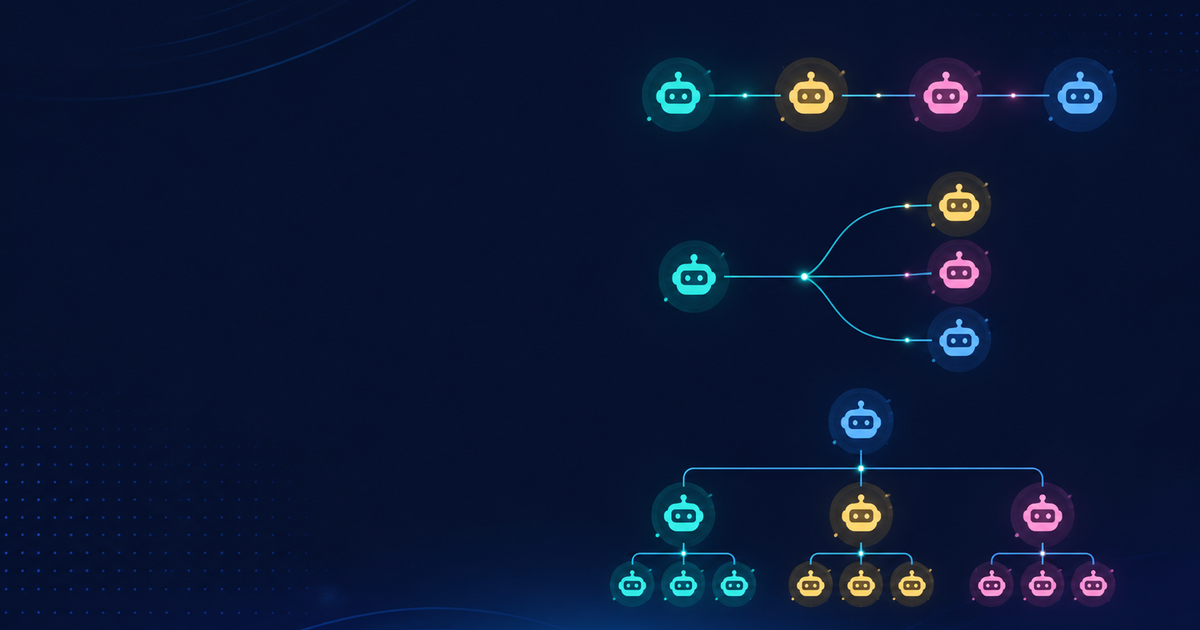
Almost every production multi-agent system is built from three primitives, or a combination of them. Understanding these three multi agent orchestration patterns gives you a vocabulary for reasoning about any agent architecture you encounter.

Sequential Orchestration
In the sequential pattern, agents run one after another in a fixed pipeline. The output of each agent becomes the input to the next. It is the assembly line of agent design: research, then draft, then edit, then format.
Sequential orchestration is the right choice when each step genuinely depends on the one before it. You cannot edit a draft that has not been written. The pattern is easy to reason about, easy to debug because state flows in one direction, and predictable in cost because you know exactly how many calls happen.
# sequential_orchestrator.py
def run_pipeline(task, agents):
    """Each agent transforms the output of the previous one."""
    state = {"task": task, "history": []}
    for agent in agents:
        result = agent.run(state)
        state["history"].append({"agent": agent.name, "output": result})
        state["current"] = result
    return state["current"]

pipeline = [research_agent, drafting_agent, editing_agent]
final = run_pipeline("Write a brief on vector databases", pipeline)
The weakness of sequential orchestration is latency. If you have five steps that each take three seconds, your user waits fifteen seconds even when some of those steps did not need to happen in that order. Sequential pipelines also propagate errors: a weak research step quietly poisons everything downstream. Guard against this with validation between stages rather than trusting each handoff blindly.
Parallel Orchestration
The parallel pattern runs multiple agents at the same time on independent subtasks, then merges their results. It is the pattern behind map-reduce style workloads: split a document into sections, summarize each section concurrently, then combine the summaries.
Parallel orchestration wins on latency whenever subtasks do not depend on each other. Summarizing ten documents takes roughly as long as summarizing one, because the work happens concurrently rather than in series. It also improves quality in ensemble setups, where several agents attempt the same task with different prompts and an aggregator picks or blends the best answer.
# parallel_orchestrator.py
import asyncio

async def run_parallel(subtasks, agent):
    """Run the same agent across independent subtasks concurrently."""
    results = await asyncio.gather(
        *[agent.run_async(sub) for sub in subtasks]
    )
    return aggregate(results)

sections = split_document(long_report)
summaries = asyncio.run(run_parallel(sections, summarizer_agent))
The cost of parallel orchestration is aggregation complexity and token spend. Merging outputs that disagree is its own problem, and running many agents at once multiplies your bill and your rate-limit exposure. The pattern also assumes true independence. If two parallel branches secretly write to the same state, you have reintroduced a race condition. Reserve parallelism for work that is genuinely partitionable.
Hierarchical Orchestration
The hierarchical pattern introduces layers. A top-level orchestrator, sometimes called a supervisor, breaks a goal into subtasks and delegates each to a worker agent or to a lower-level orchestrator. Workers report back, and the supervisor decides what to do next. This is where the orchestrator agent becomes a first-class component rather than a simple loop.
Hierarchical orchestration is the most flexible pattern and the one that scales to genuinely complex goals. A supervisor can dynamically decide it needs a new specialist mid-task, retry a failed branch, or reallocate work. It maps cleanly onto how human teams operate, with a lead delegating to specialists. We go deep on this structure in our guide to hierarchical supervisor and sub-agent architecture, which is worth reading if you plan to build supervisors that spawn workers.
# hierarchical_orchestrator.py
class Supervisor:
    def __init__(self, workers):
        self.workers = workers  # dict: name -> agent

    def run(self, goal):
        plan = self.decompose(goal)        # break goal into subtasks
        results = {}
        for step in plan:
            worker = self.workers[step["assignee"]]
            results[step["id"]] = worker.run(step["instruction"])
            if self.should_replan(results):
                plan = self.decompose(goal, context=results)
        return self.synthesize(results)
The trade-off is complexity and observability. Nested delegation makes it harder to answer the question of what actually happened, and a supervisor that replans too eagerly can loop forever or burn tokens chasing its own tail. Hierarchical systems demand strong tracing and hard limits on depth and iterations. This is not optional. Production supervisors need guardrails on how many times they can replan.
Choosing the Right Multi-Agent Orchestration Pattern
The pattern follows the dependency structure of your task. Ask one question first: do the steps depend on each other?
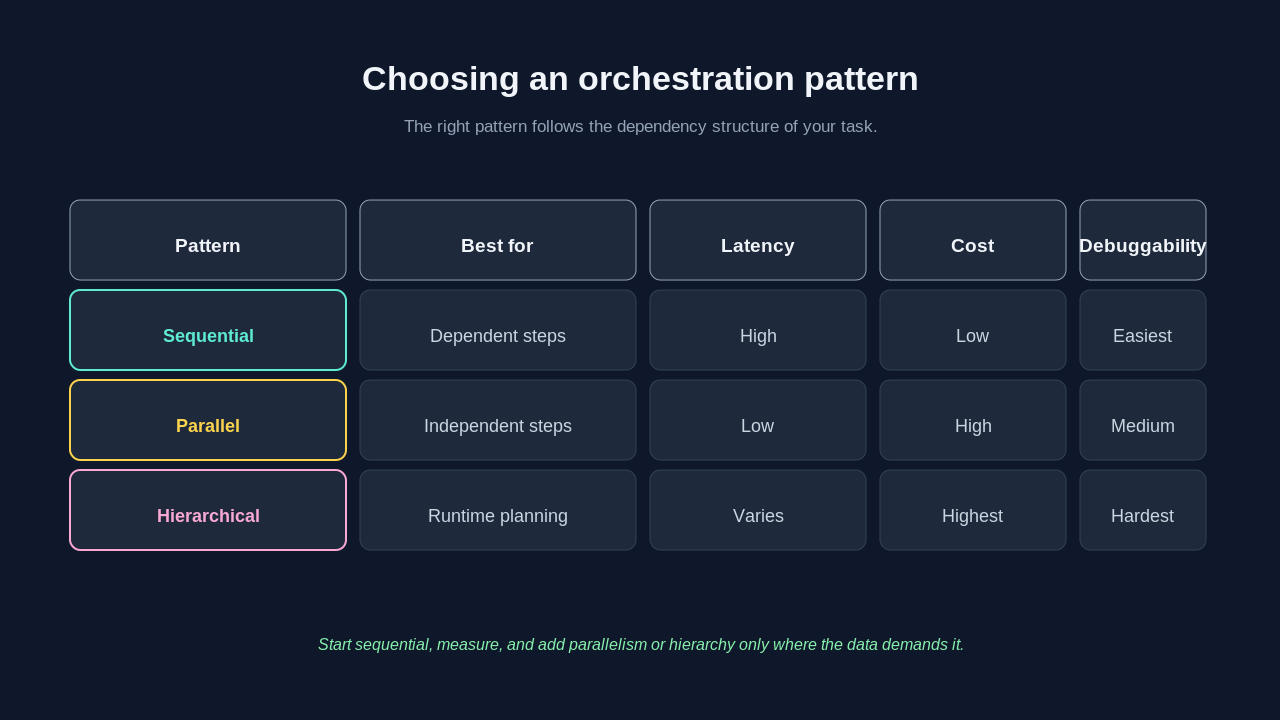
If every step depends on the previous one, use sequential. If the steps are independent, use parallel. If the plan itself has to be decided at runtime and can change based on intermediate results, use hierarchical. Most real systems are hybrids. A supervisor might delegate a batch job that runs its workers in parallel, where each worker internally runs a short sequential pipeline. The patterns compose.
Latency, cost, and debuggability push in different directions. Sequential is the easiest to debug and the slowest. Parallel is the fastest and the most expensive. Hierarchical is the most capable and the hardest to observe. There is no universally best choice, only the best fit for a given task shape and set of constraints. When you are unsure, start sequential, measure, and only add parallelism or hierarchy where the data shows you need it.
Production Concerns the Patterns Do Not Solve
Choosing a pattern is necessary but not sufficient. Whatever orchestration pattern you pick, three cross-cutting concerns will decide whether it survives contact with real users.
The first is error handling. In a multi-agent system, any agent can fail, time out, or return garbage. Your orchestrator needs retry logic, fallbacks, and a clear failure mode so one bad agent does not take down the whole run. We cover this in depth in our writeup on fault-tolerant agent pipelines.
The second is observability. When a hierarchical system produces a wrong answer, you need to trace which agent decided what and why. Without structured tracing you are debugging blind, and multi-agent systems are exactly where blind debugging fails. Instrument every agent call with its inputs, outputs, and latency from day one.
The third is cost. More agents mean more calls, and orchestration patterns multiply token usage in ways that are easy to underestimate. A hierarchical system that replans three times has effectively tripled its own workload. Budget for it, cap it, and monitor it. If you want the broader picture of how these pieces fit together across a full system, our guide on how to build multi-agent systems connects orchestration to memory, tools, and evaluation.
Common Mistakes to Avoid
Teams new to multi agent orchestration tend to make the same handful of errors. The most common is reaching for a hierarchical supervisor when a simple sequential pipeline would do. Complexity is a cost, and you should pay it only when the task demands runtime planning.
A second mistake is faking parallelism over dependent steps, which produces subtly inconsistent outputs that are hard to reproduce. A third is giving the orchestrator agent too much context, passing every agent the entire conversation history until token costs balloon and models lose focus. Pass each agent the minimum it needs. A fourth is skipping termination logic, which is how orchestrators end up in infinite loops. Always define what done means before you run.
A Note on Frameworks
You do not have to implement these patterns from scratch. Modern orchestration frameworks such as LangGraph, Microsoft AutoGen, and the AWS multi-agent orchestrator provide primitives for sequential chains, parallel fan-out, and supervisor-worker hierarchies out of the box. The value of understanding the patterns is that you can read any framework's abstractions and know immediately what shape of coordination it is offering, and whether that shape matches your task.
The patterns are the durable knowledge. Frameworks come and go, but a task with independent subtasks will always want parallelism, and a goal that needs runtime planning will always want a supervisor. Learn the patterns and the tools become interchangeable.
Frequently Asked Questions
What is the purpose of an orchestrator agent?
An orchestrator agent coordinates multiple specialized agents so they act as one system. It handles routing between agents, managing what context each one receives, aggregating their outputs, and deciding when the overall task is complete. It typically does not perform the domain work itself.
What are the main multi agent orchestration patterns?
The three core patterns are sequential, where agents run in a fixed pipeline and each feeds the next; parallel, where agents run concurrently on independent subtasks that are then merged; and hierarchical, where a supervisor decomposes a goal and delegates to worker agents at runtime. Most production systems combine them.
When should I use hierarchical orchestration instead of sequential?
Use hierarchical orchestration when the plan cannot be fixed in advance and must adapt to intermediate results, or when a supervisor needs to dynamically choose specialists and retry failed branches. If your steps are known ahead of time and run in a fixed order, sequential is simpler and easier to debug.
Does multi agent orchestration increase costs?
Yes. Every additional agent adds calls, and patterns like parallel fan-out and hierarchical replanning can multiply token usage quickly. Always set token budgets and iteration limits on orchestrators, and monitor spend as part of your observability setup.
Can I combine orchestration patterns in one system?
Absolutely, and most real systems do. A hierarchical supervisor might delegate work that runs in parallel, where each parallel worker executes a short sequential pipeline internally. The three patterns are composable building blocks, not mutually exclusive choices.
Wrapping Up
Multi agent orchestration comes down to three patterns and one question. Sequential for dependent steps, parallel for independent ones, and hierarchical for goals that need runtime planning. The question is always the same: how do these steps depend on each other? Answer that honestly and the right pattern usually picks itself.
Start simple, measure, and add complexity only where the evidence demands it. For the full tooling picture, revisit our AI agent orchestration frameworks guide, and browse more engineering writeups on the Levelop blog.
References
- LangGraph documentation, multi-agent workflows and supervisor architectures, langchain-ai.github.io/langgraph.
- Microsoft AutoGen documentation, conversational and group-chat agent orchestration, microsoft.github.io/autogen.
- Anthropic, Building effective agents, on composing agents and workflows, anthropic.com/research.
- AWS Labs, multi-agent orchestrator project documentation, github.com/awslabs.