
OpenCode vs Cursor vs Claude Code: Which Terminal-First AI Agent Wins?
If you spend your day writing code, you have almost certainly felt the pull of three very different tools. OpenCode wants to live in your terminal and run on any model you point it at. Cursor wants to live inside your editor and make the code in front of you smarter. Claude Code wants to take a task off your plate and drive the whole change itself. They all promise the same outcome, which is shipping working software faster, but they get there through opposite philosophies.
This guide is a working developer's comparison of OpenCode vs Cursor vs Claude Code in 2026. We will look at how each one is built, what it actually feels like to use, what it costs, and where each tool wins. If you want the wider field first, our ranking of the best AI coding agents in 2026 sets the context. This piece zooms into the three tools that developers argue about most.
The one-line summary
Before the detail, here is the short version. Cursor is an accelerator, where you drive and the AI assists. Claude Code is a delegator, where you assign a task and the agent drives. OpenCode is the open workshop, where you bring your own model and own your entire stack. None of them is strictly better. They are optimized for different working styles, and the right pick depends on where you already spend your time.
OpenCode: the open-source terminal workshop
OpenCode, built by the team behind SST (Serverless Stack), is the standout open-source option in this comparison. It is released under the MIT license, which means the agent itself is free. You pay only for the model provider you connect it to, and if you run a local model through Ollama, you can pay nothing at all.
The defining feature is that OpenCode is model-agnostic. It connects to a large catalog of LLM providers out of the box, including OpenAI, Anthropic, Google Gemini, and local models, so you are never locked to a single vendor. If a new frontier model ships next month, you can point OpenCode at it the same day. This is the opposite of the closed, opinionated approach that the other two tools take.
OpenCode runs primarily as a terminal user interface, and it also ships a desktop application and an IDE extension. The terminal experience is fast and keyboard-driven, which developers who live in tmux and vim tend to love. Because it is open source, it has attracted serious community momentum. It crossed 160,000 GitHub stars and was documented by Red Hat for OpenShift Dev Spaces in April 2026, which is about as close to an enterprise stamp of approval as an open-source project gets.
The privacy story is the other big draw. Paired with Ollama and a local model, OpenCode can run fully air-gapped, with no internet connection and no third-party servers touching your code. For teams in regulated industries, that single property can be the deciding factor.
The trade-offs are real. You are responsible for choosing and configuring models, managing API keys, and tuning the setup. The polish of a funded commercial product is not always there, and quality depends heavily on which model you connect. OpenCode gives you control, and control always comes with homework.
Cursor: AI inside the editor you already use
Cursor took a different bet. Instead of asking you to move to a terminal, it forked Visual Studio Code and built AI directly into the editor most developers already open every morning. That decision is the whole point. For people who spend their day reading and editing code visually, Cursor removes the context-switching tax that a terminal-first tool imposes.
In practice, Cursor feels like VS Code with a very capable pair programmer sitting next to you. Inline edits, multi-file changes, tab completion that predicts your next move, and a chat panel that can see your whole project all live in the same window where you already work. You keep your extensions, your themes, and your muscle memory. That familiarity is a genuine feature, not a small one.
Cursor's pricing in 2026 spans a free Hobby tier, Pro at 20 dollars a month, Pro+ at 60 dollars, Ultra at 200 dollars, and Teams at 40 dollars per user. The higher tiers mostly buy you more usage of frontier models from OpenAI, Anthropic, and Google, along with cloud agents and team features like shared rules, agentic code reviews, and SSO. Annual billing takes 20 percent off. For a solo developer, the 20 dollar Pro plan is the common starting point, and heavy users move up when they hit request limits.
The cost of Cursor's approach is that it is still fundamentally an editor. When you want an agent to go off and complete a large multi-step task on its own, Cursor can do it, but the metaphor is assistance rather than delegation. It is at its best when you stay in the loop and steer. If you want a deeper editor-to-editor look, our Cursor alternatives guide covers the crowded field of IDE-based competitors.
Claude Code: the delegator in your terminal
Claude Code is Anthropic's opinionated command-line agent, and it is built around whichever Claude model is currently topping coding benchmarks. In 2026 that means the Mythos-class models alongside Opus, which have consistently posted the strongest scores on SWE-bench, the benchmark that measures how well an agent resolves real GitHub issues.
Where Cursor assists and OpenCode hands you the raw tools, Claude Code is designed to take a task and run it end to end. You describe what you want, and the agent reads the codebase, plans the change, edits files, runs commands, checks the result, and keeps going until the job is done. You stay in control through explicit approvals, but the agent is the one doing the driving. This delegation model is why so many developers now keep a Claude Code session open in a second terminal while they work on something else.
Recent releases leaned hard into parallelism. Claude Code can spawn multiple sub-agents to tackle parts of a task at once, and combined with reusable skills and plugins, it turns a large refactor into something you can manage from a single terminal session. That multi-agent orchestration is a headline capability in 2026 rather than an experimental toggle.
Pricing runs through Anthropic's subscriptions. Claude Code is included with the 20 dollar Pro plan and the Max plans at 100 and 200 dollars a month, which mostly buy higher usage limits. On the team side, Claude Code ships with Team Premium rather than the base Team tier. In May 2026, Anthropic doubled the usage limits across all paid plans, which took some of the sting out of hitting a wall mid-task.
The trade-off is that Claude Code is tied to Claude models. That is a strength when Claude leads on coding quality, and a limitation if you want to shop across providers the way OpenCode lets you. If you are weighing Claude Code against the other major assistant, our Claude Code vs GitHub Copilot comparison goes deeper on that specific matchup, and our Claude Code vs Cursor piece covers the editor-versus-terminal question head on.
# OpenCode: open the terminal UI in your repo
opencode

# Cursor: open the project in the editor
cursor .

# Claude Code: start the agent and delegate a task
claude "add input validation to the signup form and run the tests"
Head to head: how they actually differ
The clearest way to see the difference is to line up the properties that matter when you are choosing a daily driver.
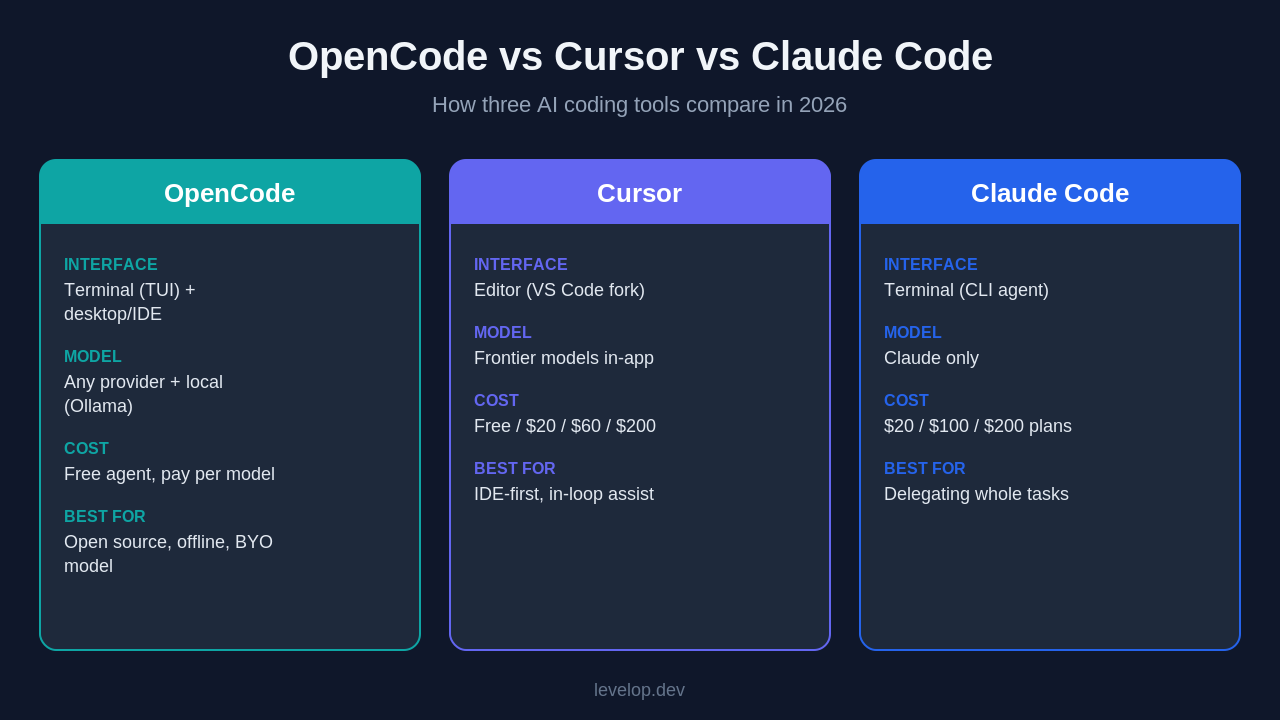
Interface. OpenCode is terminal-first with optional desktop and IDE surfaces. Claude Code is terminal-first and stays there. Cursor is editor-first and keeps you in a graphical IDE. If you think in files and windows, Cursor fits. If you think in commands and pipes, the other two fit.
Model choice. OpenCode is open season, connecting to a large catalog of providers and local models. Claude Code is Claude only. Cursor sits in the middle, letting you pick among frontier models from several vendors inside its own interface, but within Cursor's own product boundaries.
Control philosophy. Cursor keeps you in the driver's seat with the AI as a co-pilot. Claude Code asks you to delegate and approve. OpenCode hands you the workshop and expects you to wire it up. These are genuinely different relationships with the machine.
Cost model. OpenCode's agent is free, and you pay only for model usage or nothing with local models. Cursor and Claude Code are subscription products where the monthly fee bundles model access and usage limits. Over a year, a heavy OpenCode user on a cheap or local model can spend far less, at the price of doing more setup.
Openness and privacy. OpenCode is the only fully open-source option here and the only one that can run completely offline. For teams with strict data rules, that is often the entire decision.
Which one should you pick?
Match the tool to how you already work rather than to a benchmark number.
Pick Cursor if you live in an editor, value a smooth graphical experience, and want AI woven into the code in front of you without changing your habits. It is the lowest-friction entry point for most developers coming from VS Code.
Pick Claude Code if you want to delegate whole tasks and you trust a leading model to drive. It shines for large refactors, working through a backlog of issues, and running an agent in parallel while you focus elsewhere. It is the strongest terminal-first delegator in 2026.
Pick OpenCode if you want open source, model freedom, or the ability to run fully offline. It rewards developers who are comfortable configuring their own stack and who do not want to be locked to a single vendor or a single monthly bill.
Many teams end up using two of them. A common pattern is Cursor for interactive editing during the day and Claude Code or OpenCode running longer agentic tasks in the background. There is no rule that says you must commit to one.
A note on the moving target
All three tools ship updates constantly, and the coding-agent field is one of the fastest-moving corners of developer tooling right now. Pricing tiers change, model rankings shift, and features that are exclusive one month become table stakes the next. Treat any specific number here as a snapshot of mid-2026 and check the current docs before you commit budget. For a broader view of how these tools fit into a modern engineering workflow, browse the Levelop blog, where we track this space as it evolves.
Frequently asked questions
Is OpenCode really free?
The OpenCode agent itself is free and open source under the MIT license. You pay only for the language model you connect it to, whether that is a paid API from OpenAI, Anthropic, or Google, or a local model through Ollama that costs nothing beyond your own hardware. That makes the total cost very flexible compared to a fixed subscription.
Can Cursor and Claude Code use the same underlying models?
To a large degree, yes. Cursor lets you choose among frontier models from several vendors inside its editor, and Claude Code runs on Anthropic's Claude models. Both can end up using a top Claude model for a given task. The difference is the interface and the control model, not always the raw intelligence behind the answer.
Is a terminal-first agent better than an editor-based one?
Neither is better in the abstract. Terminal-first tools like Claude Code and OpenCode suit developers who work in the shell and want to delegate or script agentic work. Editor-based tools like Cursor suit developers who work visually and want AI inside the code they are reading. The best choice is the one that matches your existing workflow.
Which tool is best for a privacy-sensitive or regulated team?
OpenCode is the strongest option here because it is open source and can run fully air-gapped with a local model through Ollama, so your code never leaves your machine. Cursor and Claude Code are cloud services that send code to model providers, though both offer privacy modes and enterprise controls. For strict data-residency rules, the offline capability of OpenCode is often decisive.
Can I use more than one of these at once?
Yes, and many developers do. A frequent setup is Cursor for hands-on editing and a terminal agent like Claude Code or OpenCode for longer background tasks. Because they occupy different parts of your workflow, they complement each other rather than conflict.
Where Levelop fits
At Levelop we help engineers stay sharp on the tools and patterns that actually move the needle, from AI coding agents to system design and interview preparation. If you found this useful, the rest of our writing on modern developer workflows lives on the Levelop blog.