

Platform Engineering Team Structure: Roles, Hiring, and When to Start One
Back with another one in the series where I break down the parts of modern software delivery that took me a while to actually understand. This time it is the org chart question, not the tooling one. Most writing about platform engineering jumps straight to Backstage and internal developer portals. The harder problem, the one nobody hands you a template for, is the platform engineering team itself. Who sits on it, what they own, and the moment when spinning one up stops being premature and starts being overdue.
I got this wrong the first time I thought about it. I assumed a platform engineering team was just your best DevOps folks with a nicer job title. That framing quietly fails, because a platform team that behaves like a ticket queue produces a worse developer experience than no platform team at all. So let me walk through what actually changes when you build one on purpose.
What a platform engineering team actually is
A platform engineering team builds and runs an internal product whose customers are your own developers. That is the whole idea in one sentence, and every structural decision flows from taking the word "product" seriously. The output is not tickets closed. The output is a paved road that stream-aligned teams choose to use because it is genuinely the easiest path to production.
If you want the full grounding on why this discipline exists at all, I wrote a longer piece on what platform engineering is and why it is the biggest shift since DevOps. The short version: DevOps told every team to own their whole pipeline, and at scale that turned into every team reinventing the same CI, the same secrets management, and the same Kubernetes manifests. A platform engineering team absorbs that repeated work into a reusable internal platform so product teams can stay focused on shipping features.
The distinction I keep coming back to is customer versus servant. A servant team waits for requests and fulfills them. A platform engineering team studies its developers like a product manager studies users, then ships self-service capabilities that get adopted without a support ticket. That difference shapes who you hire.
When to start a platform engineering team
The honest answer is later than most engineering leaders want, and earlier than most finance teams will approve. There is no magic headcount, but there are signals.
The clearest signal is duplicated infrastructure work. When three separate squads have each written their own deployment scripts and none of them agree, you are already paying for a platform. You just have not organized it. A dedicated platform engineering team turns that scattered, redundant cost into one maintained asset.
A second signal is cognitive load. If your product engineers spend a meaningful slice of their week wrestling with Terraform, debugging pipeline YAML, or chasing down why a pod will not start, that is load stolen from feature work. Team Topologies, the book by Matthew Skelton and Manuel Pais that most of this thinking traces back to, frames the platform team's entire purpose as reducing the cognitive load on stream-aligned teams. When that load is visibly hurting delivery, the timing is right.
A third signal is scale. Industry guidance from Gartner has suggested that a large majority of software organizations will operate platform teams as internal providers of reusable services by the middle of this decade. That prediction only makes sense past a certain size. Below roughly a few dozen engineers, a lightweight shared-tooling approach usually beats a formal team.
The core roles on a platform engineering team
This is the part I most underestimated. A platform engineering team is not a pile of interchangeable infrastructure engineers. It is a small cross-functional product team, and the roles are distinct.
Platform product manager
The role people skip, then regret skipping. A platform product manager treats the internal platform like any other product: they interview developers, maintain a backlog, prioritize by impact, and measure adoption. Without this role, platform teams build what is technically interesting instead of what developers actually need, and adoption quietly stalls. If you can only make one non-engineering hire on a new platform team, make it this one.
Platform engineers
The builders. They design and maintain the golden paths, the templates, the internal APIs, and the abstractions that hide infrastructure complexity. Good platform engineers have strong backend instincts and care about developer experience the way a library author cares about API ergonomics. They are writing software for other engineers, so empathy for the caller is part of the job description, not a nice-to-have.
Site reliability and operations
Reliability engineers make sure the platform itself does not become the new single point of failure. When your whole company deploys through one paved road, that road has to stay up. This role overlaps with classic SRE work: define service level objectives for the platform, run incident response for platform outages, and build the observability that both the platform team and its customers depend on.
Developer experience and enablement
Someone has to close the loop between the platform and the humans using it. Enablement engineers write the docs, run onboarding, gather feedback, and advocate internally. On smaller teams this blends into the platform engineer role, but as the team grows it deserves a dedicated owner, because documentation and adoption work is the first thing that gets dropped under pressure.
Depending on your stack you may also fold in specialists: a security engineer to bake guardrails into the paved road, or a data platform engineer if internal data tooling is part of the mandate. The tools these roles reach for matter too, and I compared the leading options in the best platform engineering tools for 2026.
How to structure the team using Team Topologies
Team Topologies gives the cleanest model I have found for placing a platform engineering team inside a wider org. It defines four fundamental team types, and the platform team is one of them. The mental model is that stream-aligned teams (your product squads) are the customers, and the platform team exists to make their flow of work smoother.
The critical structural rule is the interaction mode. Team Topologies describes the platform team's default relationship to product teams as "X-as-a-Service." You consume the platform the way you consume a cloud API. You do not file a ticket and wait for a human, and the platform team does not sit in your standups managing your work. That self-service boundary is what keeps a platform team from decaying back into a shared-services bottleneck.
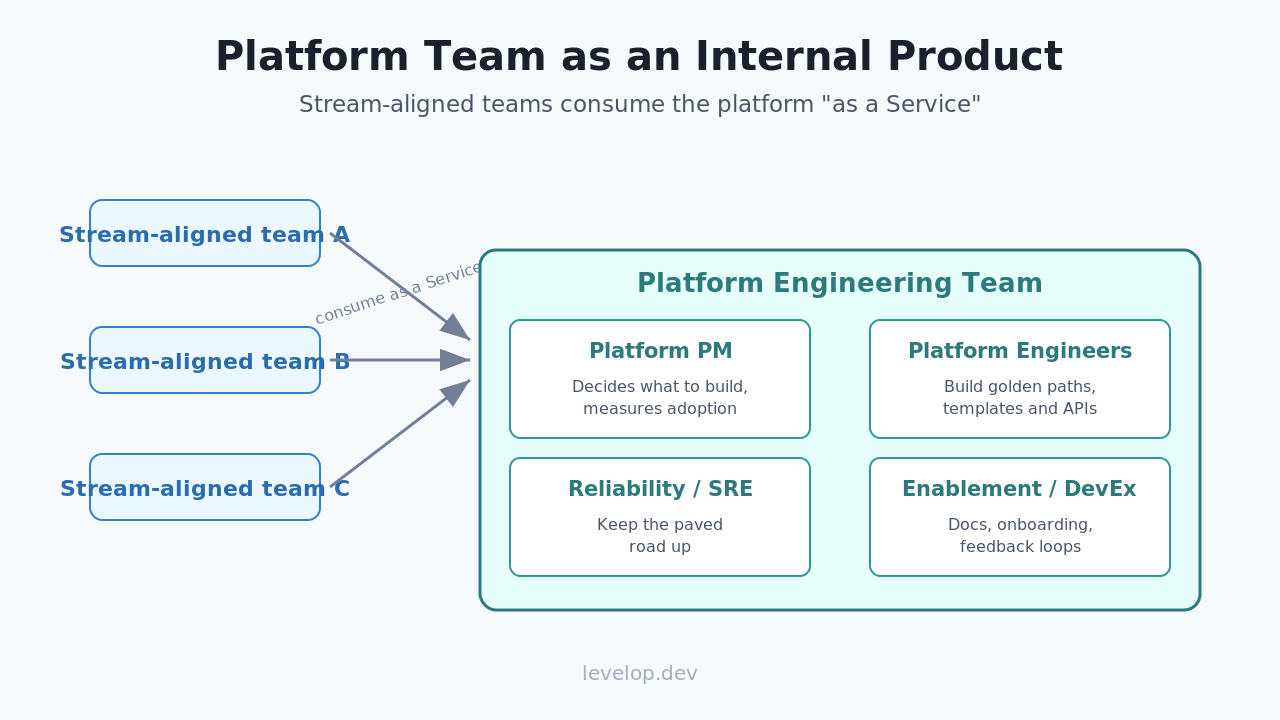
One warning from experience. The platform team should not own the product teams' outcomes, and product teams should not be able to reach past the self-service interface to demand custom work. The moment either boundary erodes, you are back to a central operations group wearing a platform costume.
Team size and a sane hiring sequence
Start smaller than feels comfortable. A first platform engineering team of three to five people is enough to build a meaningful paved road for a mid-sized engineering org, and a small team is forced to build self-service capabilities rather than absorb manual toil, because it simply cannot answer every ticket by hand.
The hiring sequence I would follow, having watched a few of these go wrong, moves from technical direction to adoption support in a deliberate order.
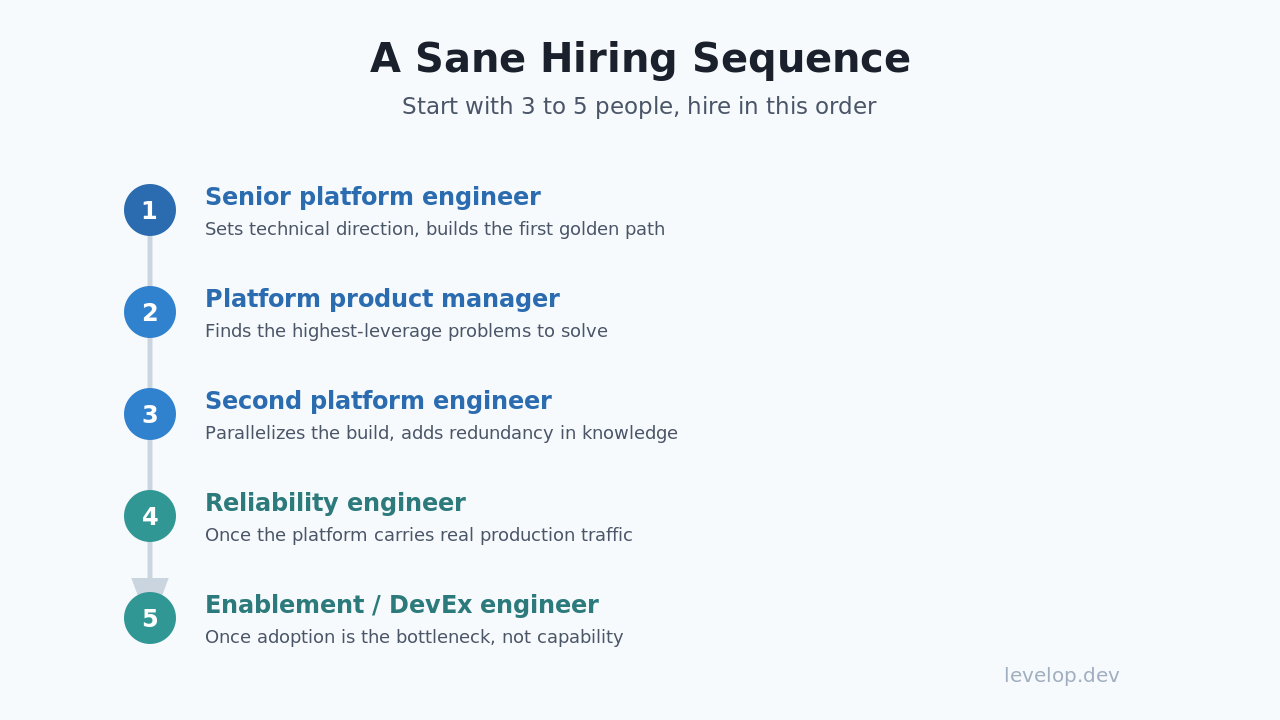
Ratios matter more than absolute size. A common rule of thumb from platform engineering practitioner reports is one platform engineer for every ten to fifteen product engineers they serve, adjusted for how mature your tooling already is. If the ratio drifts far below that, the platform team gets overwhelmed and starts cutting corners on reliability. Drift far above it and you are overinvesting in platform relative to the value it returns.
What "done right" looks like in practice
A healthy platform engineering team ships a golden path that a new service can adopt in minutes, not weeks. Concretely, a developer should be able to describe what they want and have the platform provision the rest. Something like this is the target developer experience.
apiVersion: platform/v1
kind: Service
metadata:
  name: payments-api
  team: checkout
spec:
  language: go
  # the platform provisions CI, deploy pipeline, observability,
  # secrets, and a production-ready k8s namespace from this alone
  runtime: kubernetes
  observability: enabled
  slo:
    availability: "99.9%"
The developer writes ten lines. The platform engineering team is what turns those ten lines into a running, observable, secured service. That is the entire value proposition compressed into a file, and it is the standard I would hold a new team to within its first couple of quarters.
Common mistakes I have seen
I have watched teams treat the platform as a project with an end date. It is not. A platform is a product with a lifecycle, and the team is permanent staffing, not a temporary tiger team that disbands after launch.
Another common miss is measuring the wrong things. Counting the number of internal tools built tells you nothing. Adoption rate, the fraction of teams voluntarily using the paved road, and developer-reported satisfaction tell you almost everything. If teams are routing around your platform to do their own thing, no amount of tooling output makes the team successful.
The last one, the one I fell into conceptually at the start, is skipping the product manager and letting engineers self-direct entirely. Smart engineers left to prioritize their own work will optimize for the interesting problem over the impactful one. The platform product manager exists to keep the team pointed at real developer pain.
Metrics that tell you the team is working
Lean on the DORA metrics for the org as a whole: deployment frequency, lead time for changes, change failure rate, and time to restore service. A platform engineering team that is doing its job should move these in the right direction across the product teams it serves, because that is the entire point of reducing their cognitive load.
Layer platform-specific measures on top: paved-road adoption percentage, onboarding time for a new service, and a periodic developer experience survey. Together these tell you whether the platform is a product people choose or a mandate people tolerate.
Frequently asked questions
What is a platform engineering team?
A platform engineering team builds and operates an internal platform, treating the company's own developers as its customers. Instead of every product squad reinventing CI pipelines, deployment, and infrastructure, the platform team provides these as reusable self-service capabilities so product teams can focus on shipping features.
How big should a platform engineering team be?
Start with three to five people for a mid-sized engineering organization. A useful ratio is roughly one platform engineer per ten to fifteen product engineers served, adjusted for how mature your existing tooling is. Grow the team only when adoption and reliability demands clearly exceed current capacity.
When should a company start a platform engineering team?
Start one when duplicated infrastructure work and developer cognitive load are measurably slowing delivery, usually somewhere past thirty to forty engineers. Below that scale, a lightweight enabling group sharing common tooling is generally more cost-effective than a dedicated platform engineering team.
What roles are on a platform engineering team?
The core roles are a platform product manager who prioritizes by developer impact, platform engineers who build the golden paths and internal APIs, reliability or SRE engineers who keep the platform available, and developer experience or enablement engineers who handle docs, onboarding, and feedback loops.
What is the difference between a platform engineering team and a DevOps team?
DevOps distributed operational ownership to every product team, which at scale caused each team to duplicate infrastructure work. A platform engineering team centralizes that repeated work into a reusable internal product consumed on a self-service basis, reducing duplication while preserving each team's autonomy over their own delivery.
I have been mapping how these teams form and grow while building out the engineering-practices material on Levelop, and the team-structure question turned out to be the one that most often decides whether a platform effort sticks or quietly dies.