

AI Cost Optimization: How to Cut LLM Costs in 2026
Running a large language model in a demo is cheap. Running one in production, across thousands of users and millions of API calls a day, is where the bill starts to hurt. By 2026, AI cost optimization, also called LLM cost optimization, has moved from a nice-to-have to a core engineering discipline, because the gap between a naive integration and a tuned one can be the difference between a feature that pays for itself and one that quietly drains the budget.
The good news is that most of the savings come from a handful of well-understood levers. This guide walks through where your LLM spend actually goes, and the concrete techniques (prompt caching, model routing, batching, semantic caching, and token trimming) that teams use to reduce LLM costs by 60 to 80 percent without a visible drop in quality. Get these LLM cost optimization levers right and the cost reduction compounds.
Why LLM Costs Spiral in Production
The trouble with token-based pricing is that it scales with usage, not with value. A single request looks trivial at a fraction of a cent. Multiply it by a long system prompt, a growing conversation history, retrieved context, and heavy traffic, and the numbers compound fast.
Three patterns drive most of the waste. The first is sending every request to your most capable (and most expensive) model, even when a cheaper one would answer just as well. The second is re-sending the same large prefix, such as a system prompt or a document, on every call and paying full price for it each time. The third is bloated context: stuffing more tokens into the prompt than the task actually needs. Fixing these three is where the largest wins live.
Where Your LLM Bill Actually Goes
Before optimizing, measure. Cost per request is a simple function of input tokens, output tokens, and the per-token price of the model you chose.
# cost_estimate.py
def request_cost(input_tokens, output_tokens, in_price, out_price):
    # prices are dollars per 1,000,000 tokens
    return (input_tokens * in_price + output_tokens * out_price) / 1_000_000

# Example: a frontier model at $5 input / $25 output per million tokens
daily = request_cost(1200, 400, 5.0, 25.0) * 50_000
print(f"${daily:,.2f} per day")  # ${800.00} per day
That $800 a day, or roughly $24,000 a month, is for one workload at moderate volume. The price gap between models is enormous: the cheapest usable models run around $0.44 per million input tokens, while top-tier models can reach $30 input and $180 output per million. That is close to a 100x spread, which is exactly why routing matters.
If you want to control token counts on the input side, tightening what you send is its own discipline. Our guide to the LLM context window covers how to keep prompts lean without losing accuracy.
Prompt Caching: The Highest-Leverage Lever
Prompt caching is usually the single biggest win in production. When a large chunk of your prompt stays the same across requests, such as a system prompt, tool definitions, or a reference document, the provider can store the computed state and skip recomputing it on later calls.
How Prompt Caching Works
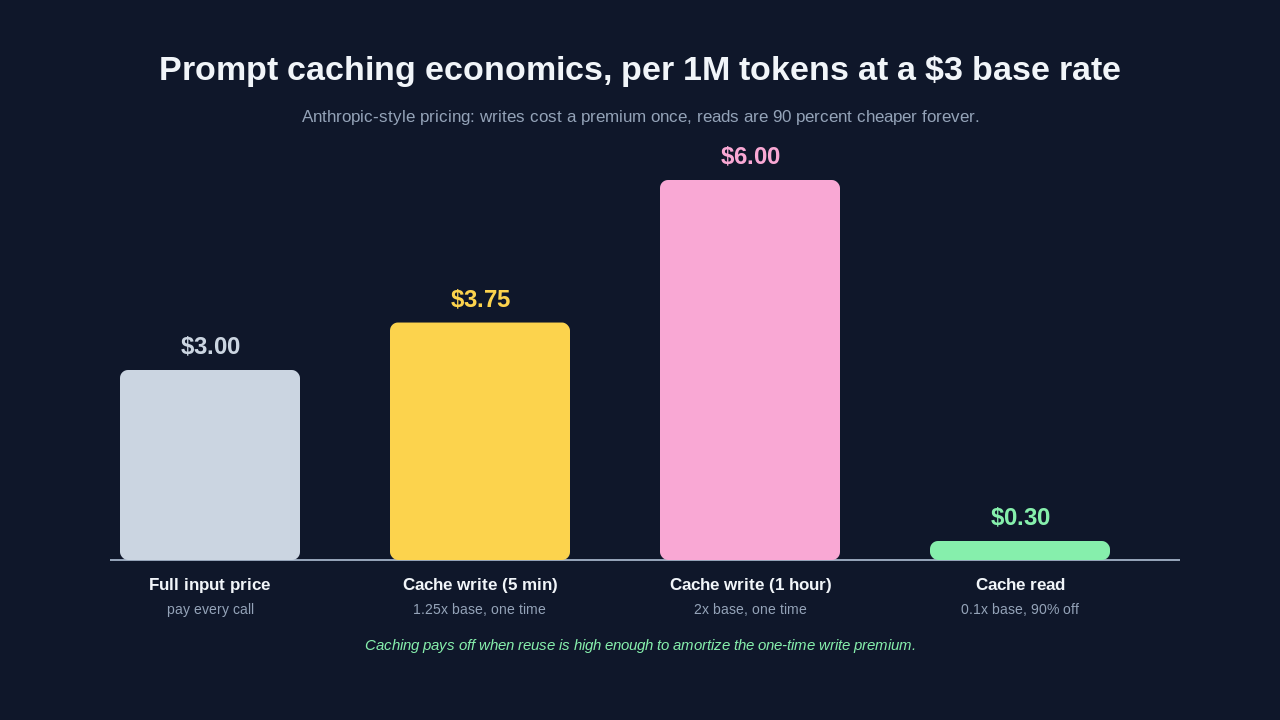
You mark a stable prefix as cacheable. The first call pays a write cost, and every subsequent call that hits the cache pays a steep discount instead of the full input price. On Anthropic's API, cache reads cost 0.1x the base input price, a 90 percent discount. A five-minute cache write costs 1.25x base and a one-hour write costs 2x. At a $3 base rate, that is about $3.75 per million to write a short cache, $6 per million for the long tier, and $0.30 per million to read. OpenAI takes a different shape, billing cached input at roughly 50 percent of the normal rate.
# Anthropic-style cached prefix
messages = client.messages.create(
    model="claude-opus-4-6",
    system=[{
        "type": "text",
        "text": LONG_SYSTEM_PROMPT,          # stable across every request
        "cache_control": {"type": "ephemeral"}
    }],
    messages=[{"role": "user", "content": user_question}],
)
The catch is that caching only pays off when your hit rate is high enough to amortize the write premium. If your cacheable prefix changes on every call, you pay the write cost without ever collecting the read discount.
Model Routing: Send Each Request to the Cheapest Capable Model
Model routing is the practice of classifying each request and sending it to the least expensive model that can handle it. Simple lookups, formatting, and classification go to cheaper models; genuinely hard reasoning goes to the frontier model. Teams that add a tuned routing layer commonly report bill reductions in the 40 to 85 percent range with no visible quality loss, precisely because most production traffic is easier than the hardest case you designed for.
# router.py: route by a cheap difficulty signal
def choose_model(task_type, token_budget):
    if task_type in {"classify", "extract", "format"}:
        return "small-fast-model"      # ~$0.44 / 1M input
    if token_budget > 8000 or task_type == "reasoning":
        return "frontier-model"        # premium tier
    return "mid-tier-model"
Routing does add complexity: you need a cheap, reliable signal for difficulty and a fallback path when the small model is not confident. A common pattern is to let the small model attempt the task and escalate to a larger one only when a confidence check or validation step fails. If you are already instrumenting agents, our post on LLM observability tools explains how to capture the signals a router needs.
Batching and Asynchronous Requests
Not every workload is interactive. Nightly summarization, bulk classification, embeddings backfills, and evaluation runs do not need a response in two seconds. For those, batch APIs trade latency for a discount. Anthropic's Batch API runs at roughly 50 percent off standard pricing, turning a $5 / $25 per million job into about $2.50 / $12.50. If a meaningful share of your volume is offline, moving it to batch is close to free money.
The rule of thumb: if a human is not waiting on the answer, it should probably run as a batch.
Semantic Caching and Token Trimming
Prompt caching only helps when the prefix matches exactly. Semantic caching goes further by matching on meaning: if a new query is close enough to one you have already answered, you return the stored answer and skip the model call entirely. Because it bypasses generation, semantic caching saves both input and output tokens, which prefix caching cannot do. The trade-off is correctness, so you set a similarity threshold conservatively and only serve cached answers on high-confidence matches.
Token trimming is the quiet companion to all of this. Shorter system prompts, summarized histories instead of full transcripts, and retrieving three relevant chunks instead of twenty all cut input tokens directly. Since you pay per token, trimming context is a permanent discount on every request. Good caching strategies at the application layer reinforce these gains.
Putting It Together: A Layered Cost Strategy
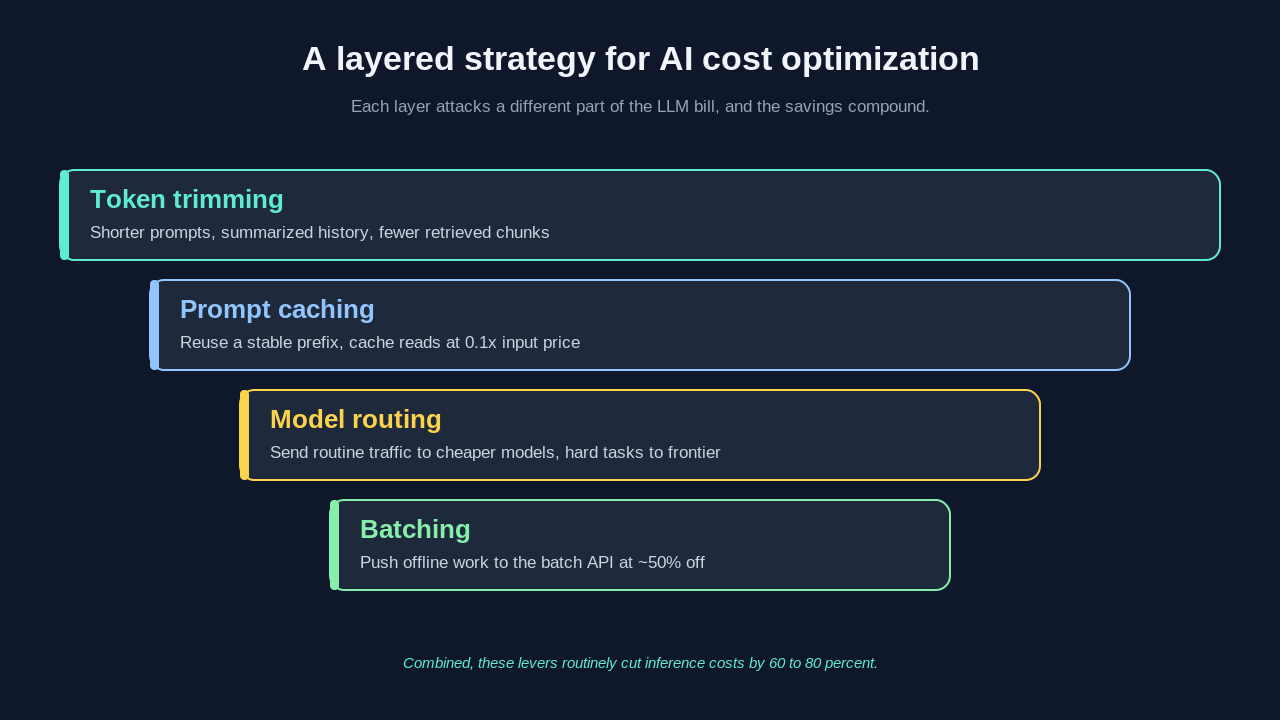
No single technique wins alone. The teams with the lowest bills stack them for maximum cost reduction. First trim the context so every request is lean. Then cache stable prefixes so repeated calls are cheap. Then route so easy work never touches the expensive model. Then push everything that can tolerate latency into batch. When prompt caching and routing are combined, savings north of 70 percent are common, and adding batching and trimming pushes many workloads into the 60 to 80 percent reduction range.
How to Measure and Monitor Cost
Optimization without measurement is guessing. Log token counts and model choice on every request, attribute cost to features and users, and watch cache hit rate as a first-class metric. A dashboard that breaks spend down by model and by endpoint tells you where the next lever should go, and it catches regressions such as a prompt change that quietly killed your cache hit rate. Treat cost as an SLO you monitor continuously, not a surprise you reconcile at the end of the month.
Conclusion
AI cost optimization in 2026 is not about one clever trick. It is about understanding token economics and layering a few reliable techniques: trim the context, cache what repeats, route to the cheapest capable model, and batch what can wait. Done together, these routinely cut inference costs by more than half while keeping quality intact. Start by measuring where your spend goes, pick the lever that matches your biggest cost driver, and iterate.
For more engineering deep dives, visit the Levelop blog, or explore what we are building at Levelop.
Frequently Asked Questions
What is AI cost optimization?
AI cost optimization is the practice of reducing what you spend to run models in production without sacrificing quality. For LLMs, it centers on token economics: cutting the number of tokens you send and receive, caching repeated content, and choosing the cheapest model that can do each job.
How much can prompt caching actually save?
It depends on your cache hit rate, but cache reads are heavily discounted, about 90 percent off input price on Anthropic and roughly 50 percent on OpenAI. Workloads with a large, stable prefix and high reuse can cut input costs dramatically. Caching pays off only when reuse is high enough to amortize the one-time write premium.
Is model routing worth the added complexity?
For most production apps, yes. Because the price gap between the cheapest usable model and a frontier model can approach 100x, sending routine traffic to a smaller model typically yields 40 to 85 percent savings. The complexity is a difficulty signal and a fallback path, which are manageable with good instrumentation.
What is the difference between prompt caching and semantic caching?
Prompt caching reuses the computed state of an exact matching prefix and saves on input tokens. Semantic caching matches queries by meaning and returns a stored answer, skipping the model call entirely, which saves both input and output tokens at the cost of some correctness risk.
Where should I start if I only have time for one change?
Measure first, then attack your biggest cost driver. For most teams that is either an expensive default model, which you fix with routing, or a large repeated prefix, which you fix with prompt caching. Both are high-impact and relatively quick to implement.
References
- Anthropic, Prompt caching, docs.anthropic.com/en/docs/build-with-claude/prompt-caching.
- Anthropic, Message Batches API, docs.anthropic.com/en/docs/build-with-claude/batch-processing.
- OpenAI, Prompt caching, platform.openai.com/docs/guides/prompt-caching.
- OpenAI, Batch API, platform.openai.com/docs/guides/batch.