

LLM Model Routing: Cut Costs Without Losing Quality
Most teams pay frontier-model prices for questions a small model could answer for a fraction of a cent. An LLM router fixes that. Instead of sending every request to your most expensive model, an LLM router looks at each prompt and picks the cheapest model that can still answer it well. The savings are real: on many production workloads, LLM model routing cuts inference spend by 40 to 85 percent while keeping answer quality close to a single frontier model.
This guide explains how LLM routing works, the main routing strategies, the tools worth knowing in 2026, and how to build a simple router yourself. It is a companion to our deeper pillar on AI cost optimization, which covers the full set of levers for reducing LLM costs.
What is LLM model routing?
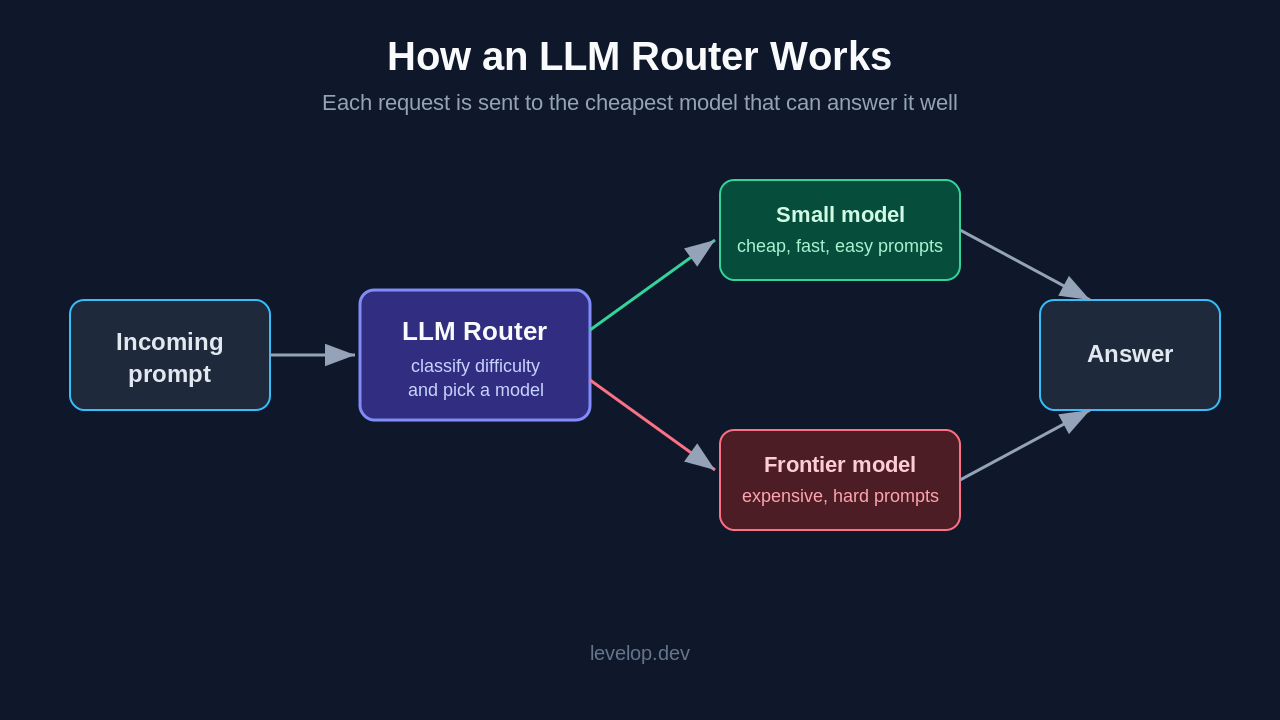
LLM model routing is the practice of dynamically choosing which language model handles a given request, based on the request itself. A router sits between your application and the model providers. When a prompt arrives, the router decides: does this need GPT-class reasoning, or will a smaller and cheaper model do the job just as well?
The economics make the case obvious. A frontier model can cost 10 to 30 times more per token than a capable small model. Yet a large share of real traffic is simple: short factual answers, classification, formatting, extraction, and routine chat. Sending all of that to your most expensive model is like taking a taxi to check the mailbox.
Model routing turns model choice into a per-request decision instead of a fixed setting. That single change is often the highest-leverage cost move a team can make, because it applies to every call without degrading the hard queries that genuinely need a big model.
Why LLM routing matters for cost and quality
Three forces make routing valuable right now.
First, the model landscape is crowded. In 2026 you can choose from dozens of models across price and capability tiers, from tiny open-weight models to frontier reasoning systems. That variety is exactly what a router exploits.
Second, price gaps between tiers are enormous and widening. Small models have improved fast, so the quality penalty for using them on easy prompts keeps shrinking while the price gap stays large. That is the ideal condition for routing to pay off.
Third, latency matters. Smaller models usually respond faster. Routing easy prompts to them improves p50 and p95 latency at the same time it cuts cost, which is a rare win where cost and speed move together instead of trading off.
The catch is quality. A naive router that sends too many hard prompts to a weak model will tank your output. The whole engineering problem of LLM model routing is deciding, cheaply and quickly, which bucket a prompt belongs in.
How LLM routers decide: the main strategies
There are three dominant routing strategies, and most production systems combine them.
Predictive routing
A predictive router looks at the prompt before any model runs and predicts which tier can handle it. This is usually a lightweight classifier, sometimes a small model itself, trained on labeled examples of easy versus hard prompts. RouteLLM, the open framework from LMSYS, popularized this approach by training routers on human preference data to predict when a cheap model will match a strong one.
Predictive routing is fast because the decision happens once, up front, with no wasted model calls. The tradeoff is that the classifier can be wrong, and keeping it accurate as your traffic shifts takes ongoing work.
Cascade routing
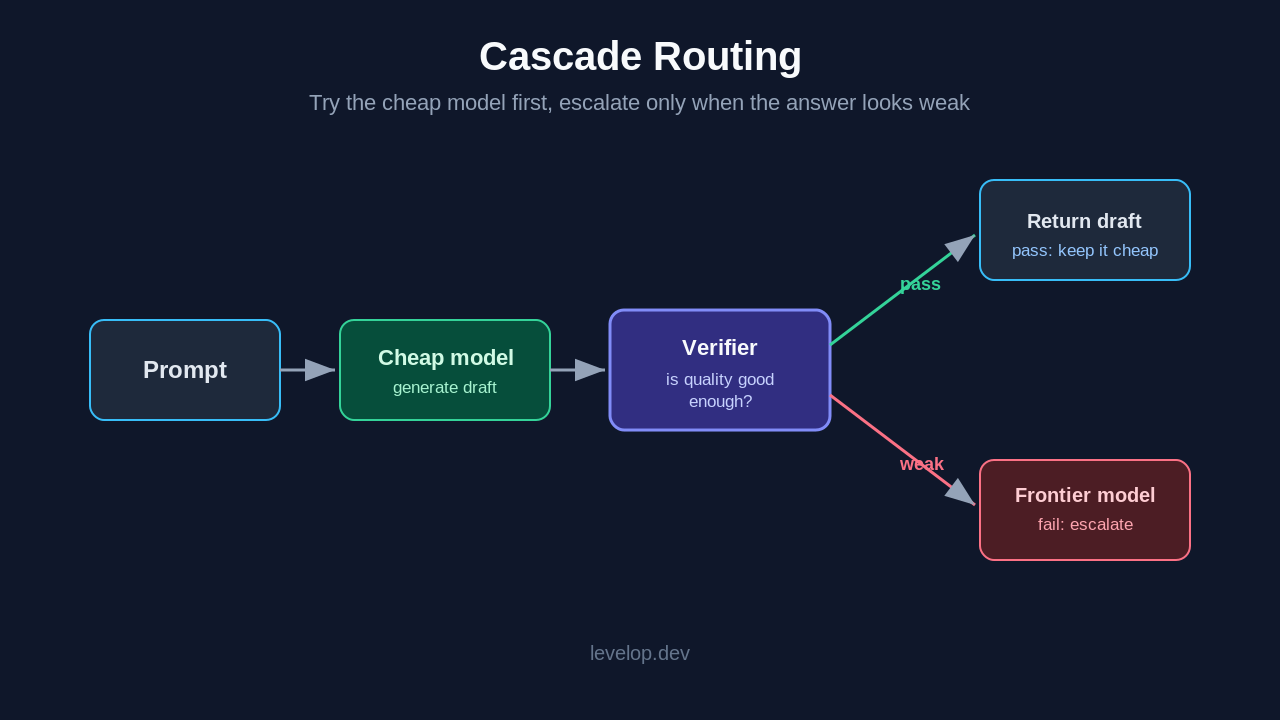
A cascade router tries the cheap model first, checks the result, and escalates to a stronger model only if the cheap answer looks weak. The "looks weak" check can be a confidence score, a verifier model, or a simple heuristic such as the response being too short or hedging.
Cascades are attractive because they are conservative: hard prompts still reach a strong model, just after one cheap attempt. The cost is added latency on escalated queries, since those pay for two model calls instead of one. On workloads where most prompts are easy, the average cost still drops sharply.
Rule-based routing
The simplest routers use explicit rules: route by task type, prompt length, user tier, or the presence of certain keywords. Send code generation to a coding model, route bulk classification to a small model, and reserve the frontier model for a labeled "complex" endpoint.
Rules are transparent and easy to debug, which is why many teams start here. They break down when traffic is messy and a single endpoint carries a wide mix of difficulty. That is where predictive or cascade routing earns its keep.
# A minimal cascade router: try cheap first, escalate on low confidence
def answer(prompt, cheap_model, strong_model, verifier):
    draft = cheap_model.generate(prompt)
    score = verifier.rate(prompt, draft)   # 0.0 to 1.0 quality estimate
    if score >= 0.7:
        return draft, "cheap"
    # cheap answer looked weak, escalate
    return strong_model.generate(prompt), "strong"

# rule-based pre-filter can short-circuit before the cascade
def route(prompt, models, verifier):
    if len(prompt) < 200 and "code" not in prompt.lower():
        return answer(prompt, models["small"], models["frontier"], verifier)
    return models["frontier"].generate(prompt), "frontier"
LLM routing tools and platforms in 2026
You do not have to build routing from scratch. The ecosystem has matured, and several options cover different needs.
RouteLLM is the reference open-source framework for predictive routing. It ships trained routers and a benchmark, and it is a good place to understand the research behind cost-quality routing. Martian and NotDiamond offer managed routers that pick a model per request and expose the decision through an API, which suits teams that want routing without training their own classifier. OpenRouter gives you a single API across many providers, and while its core value is aggregation, it makes multi-provider routing far easier to wire up.
On the cloud side, Azure AI Foundry ships a built-in model router that selects among a family of models per request. LiteLLM, widely used as a proxy layer, includes routing and fallback strategies that let you define model groups, load balancing, and automatic failover in configuration rather than code.
The right choice depends on how much control you want. Managed routers are fastest to adopt. Open frameworks like RouteLLM give you the most control over the cost-quality curve but ask for more engineering. A proxy like LiteLLM sits in the middle, giving you routing plus provider fallback with modest setup. To watch what any of these actually do in production, pair them with tracing from one of the LLM observability tools so you can see routing decisions per request.
Measuring whether your router works
Routing is only a win if you can prove the quality held up. Track four numbers.
Cost per query is the headline metric: total model spend divided by request count, tracked before and after routing. Quality retention measures how close routed output stays to an all-frontier baseline, measured on a held-out evaluation set. Escalation rate, for cascade routers, tells you what fraction of prompts needed the strong model, and it directly drives your realized savings. Misroute rate captures how often the router sent a hard prompt to a weak model and produced a bad answer.
The trap is optimizing cost alone. A router that saves 80 percent but quietly degrades your hardest 5 percent of queries can cost you more in lost trust than it saves in tokens. Build an evaluation set of representative prompts, score routed versus baseline output, and treat quality retention as a gate, not a nice-to-have. Our guide to LLM evaluation covers how to build those evaluation sets properly.
Common pitfalls with LLM model routing
The most frequent mistake is routing on prompt length alone. Length correlates weakly with difficulty, and short prompts can hide hard reasoning tasks. Use task-aware signals, not just character counts.
The second is ignoring the router's own cost. A heavy classifier or a verifier model adds latency and spend to every request. Keep the routing decision cheap relative to the models it chooses between, or the overhead eats your savings.
The third is set-and-forget. Traffic drifts, new models ship, and prices change. A router tuned six months ago may now send prompts to a model that is no longer the best price-performance pick. Re-evaluate routing decisions on a schedule.
Finally, routing multiplies your failure modes. Now two or more providers can fail, rate-limit, or change behavior. Build fallback into the router itself, so a provider outage degrades gracefully to another model rather than dropping the request.
Routing versus caching: use both
Model routing pairs naturally with caching. Where routing picks the cheapest model for a new request, caching avoids the model call entirely for repeated or near-repeated requests. If you have not layered in caching yet, our guide to prompt caching for LLMs shows how to cut inference costs on repeated context.
The strongest cost stacks combine them: cache first to skip work you have already done, then route whatever is left to the cheapest capable model. Each lever attacks a different slice of spend, and together they compound.
Conclusion
LLM model routing is one of the highest-leverage cost levers available in 2026 because it applies to every request without asking your users to accept worse answers. Start simple with rule-based routing, add a cascade or predictive layer where traffic is mixed, and always gate on quality retention with a real evaluation set. Combined with caching and the other techniques in our AI cost optimization guide, a well-tuned LLM router turns model choice from a fixed cost into a controllable one.
Frequently asked questions
What is an LLM router?
An LLM router is a component that sits between your application and multiple language models and decides, per request, which model should handle each prompt. It aims to send easy prompts to cheaper models and reserve expensive frontier models for hard prompts, so you cut cost without losing quality on the requests that need it.
How much can LLM model routing save?
Reported savings vary by workload, but teams commonly see 40 to 85 percent lower inference cost when a large share of their traffic is simple. The exact figure depends on how much of your traffic is easy enough for a small model and how aggressive your quality bar is. Measure cost per query before and after to know your real number.
What is the difference between predictive and cascade routing?
Predictive routing decides which model to use before any model runs, using a lightweight classifier that estimates prompt difficulty. Cascade routing tries the cheap model first and escalates to a stronger model only if the cheap answer looks weak. Predictive routing is faster; cascade routing is more conservative because hard prompts still reach a strong model.
Does LLM routing add latency?
It can. A predictive router adds a small, fixed classification step. A cascade router adds latency only on escalated prompts, since those pay for two model calls. On workloads that are mostly easy prompts, average latency often improves because small models respond faster than frontier models.
Which LLM routing tool should I use?
If you want routing without training a classifier, managed services like Martian or NotDiamond are fastest to adopt. If you want full control over the cost-quality curve, the open-source RouteLLM framework is the reference implementation. If you already run a proxy layer, LiteLLM adds routing and fallback in configuration, and Azure AI Foundry offers a built-in model router on that cloud.