
Vibe Coding for Production: What Changes When Stakes Are High
Vibe coding is fun when nobody is watching. You describe what you want, an AI writes the code, you run it, and something appears on screen in minutes. For a weekend prototype or a demo, that loop is a genuine superpower. The trouble starts the moment real users, real money, or real data show up. Vibe coding apps that live in production play by different rules, and the gap between "it works on my machine" and "it survives a Tuesday morning traffic spike" is where most AI-first projects quietly fall apart.
This guide is about that gap. If you already know the basics, our developer's guide to vibe coding covers the foundations. Here we focus on one question: what actually changes when you take vibe coding into production, and how do you build vibe coding apps that hold up when the stakes are high? Shipping vibe coding production apps is a different discipline from shipping a demo, and the sooner you internalize that, the fewer incidents you will debug later.
What "production grade vibe coding" actually means
Vibe coding, a term popularized by Andrej Karpathy in early 2025, describes a style of development where you lean on natural language prompts and let the model handle most of the implementation. In a prototype, you accept whatever the model produces because the only judge is you. Production grade vibe coding flips that relationship. The code still comes from an AI, but you become responsible for everything the AI forgot: failure modes, security boundaries, data correctness, and the ability to change the system safely six months later.
Put simply, a prototype answers "can this work at all?" A production system answers "does this keep working, safely, for people who did not build it?" The vibe coding workflow does not have to change dramatically, but your standard for accepting output does.
What changes when stakes are high
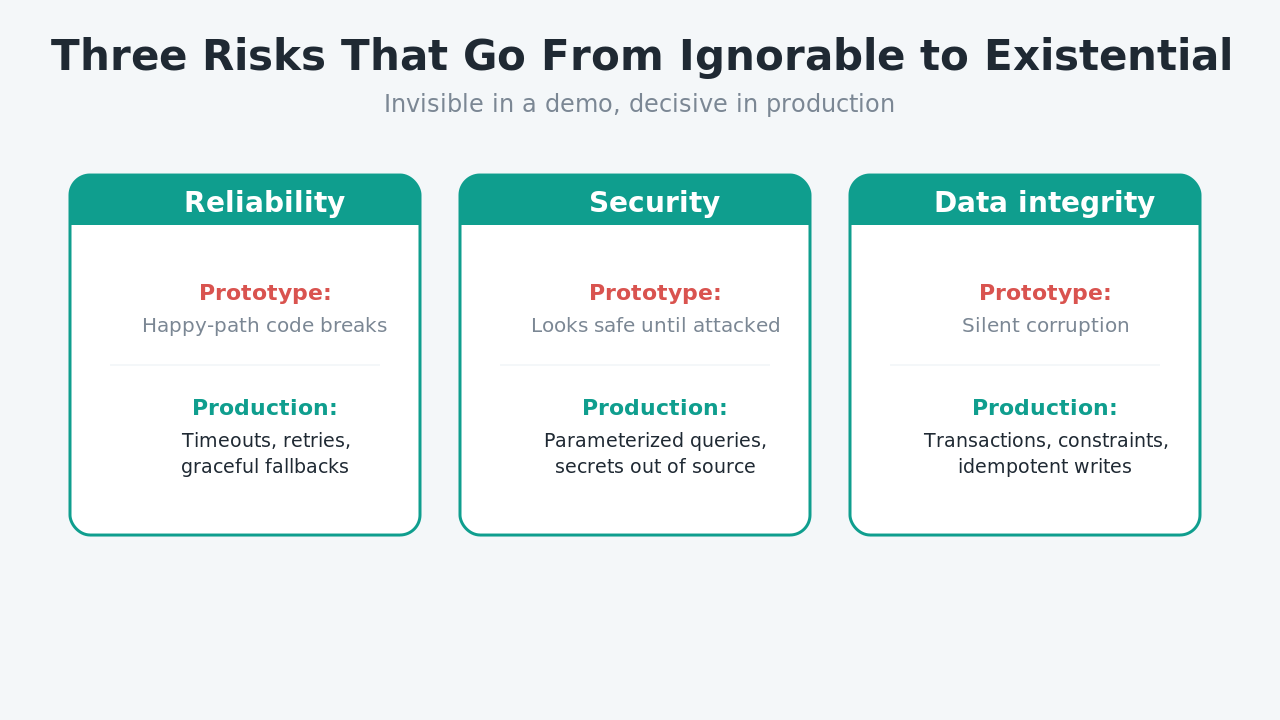
When you move vibe coding apps from a sandbox to production, three categories of risk go from "ignorable" to "existential." None of them are visible in a happy-path demo, which is exactly why they get skipped.
Reliability and error handling
AI-generated code tends to assume the happy path. Ask a model for a function that fetches a user's orders and it will usually give you clean code that works when the network is up, the database responds, and the input is well formed. Production is none of those things. Networks time out, third-party APIs return 500s, and users send input nobody anticipated.
Here is a typical piece of vibe-coded code that looks fine in a demo:
# prototype: no error handling, no timeout, no retry
def get_user_orders(user_id):
    response = requests.get(f"https://api.internal/orders?user={user_id}")
    return response.json()["orders"]
The same intent, hardened for production, needs to consider timeouts, non-200 responses, malformed payloads, and a sensible fallback:
# production grade: explicit failure handling
import requests
from requests.exceptions import RequestException

def get_user_orders(user_id, timeout=3):
    try:
        response = requests.get(
            "https://api.internal/orders",
            params={"user": user_id},
            timeout=timeout,
        )
        response.raise_for_status()
        payload = response.json()
    except (RequestException, ValueError) as exc:
        logger.warning("order fetch failed for %s: %s", user_id, exc)
        return []  # degrade gracefully instead of crashing the page
    return payload.get("orders", [])
The AI can write the second version too. The difference is that you have to ask for it, review it, and confirm the failure behavior matches what the business actually wants. That judgment is the human's job.
Security and secrets
Security is the most dangerous blind spot in vibe coding apps, because insecure code often behaves identically to secure code right up until someone attacks it. Models routinely produce string-concatenated SQL, hardcoded credentials, missing authorization checks, and permissive CORS settings. We wrote a full breakdown in the hidden risks of vibe coding, and the OWASP Top 10 remains the best checklist for what to look for.
Two rules cover most of the damage. First, never let AI-generated code build queries by string formatting. Use parameterized queries every time:
# unsafe: classic injection vector an AI may hand you
cursor.execute(f"SELECT * FROM users WHERE email = '{email}'")

# safe: parameterized, the database handles escaping
cursor.execute("SELECT * FROM users WHERE email = %s", (email,))
Second, keep secrets out of source entirely. If the model hardcodes an API key, move it to an environment variable or a secrets manager before the code ever reaches a shared branch. A leaked key in a Git history is expensive to rotate and easy to miss.
Data integrity
Prototypes can lose data and nobody cares. Production systems that corrupt or drop user data lose trust, and trust does not come back. Vibe-coded code often skips transactions, ignores race conditions, and treats writes as if they always succeed. When two requests update the same record at once, or a multi-step write fails halfway through, you get silent corruption that is very hard to trace later.
The fix is boring and essential: wrap related writes in transactions, add the right database constraints, and make operations idempotent where retries are possible. These are exactly the details an AI omits unless you insist on them.
A workflow for building vibe coding apps that survive production
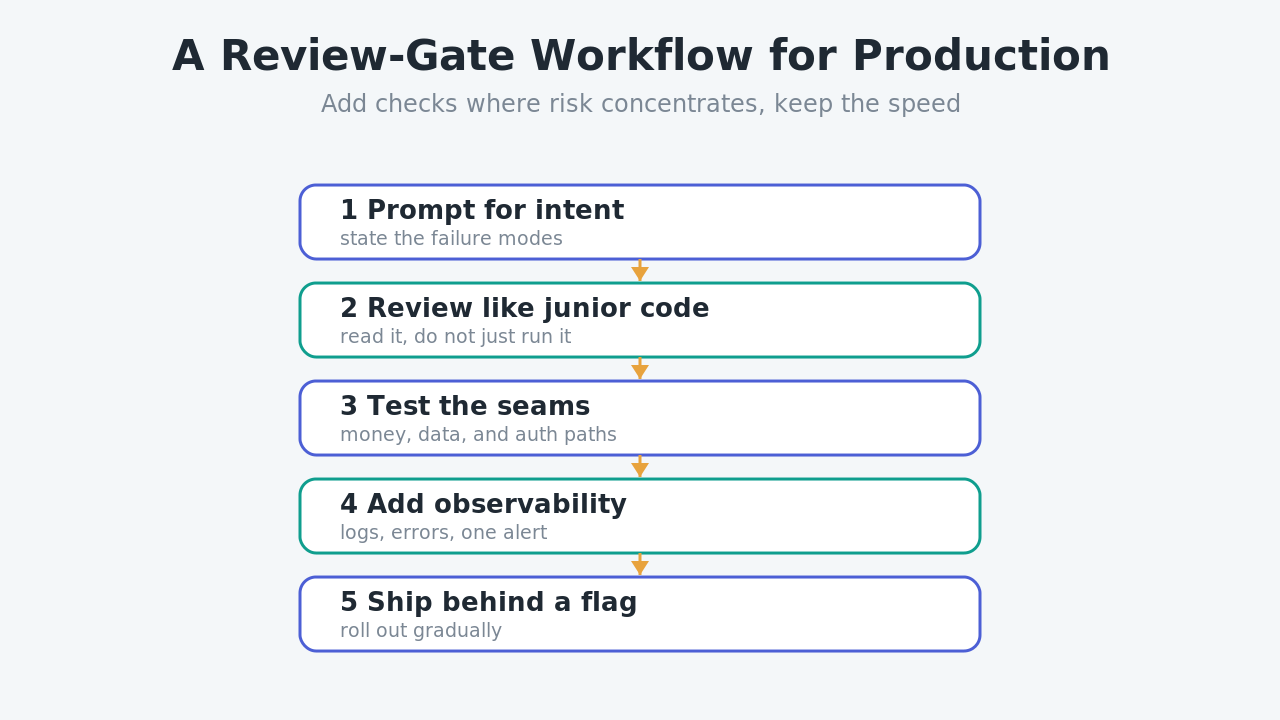
You do not need to abandon vibe coding to ship reliable software. You need a workflow that adds review gates at the points where risk concentrates. This mirrors the approach in our vibe coding best practices guide, tuned specifically for the production transition.
- Prompt for intent, not just output. Describe the failure modes you care about in the prompt itself. "Fetch the orders" produces fragile code. "Fetch the orders, return an empty list on failure, time out after three seconds, and log the error" produces something closer to shippable.
- Review every generated block as if a junior engineer wrote it at 2am. Read the code, do not just run it. Ask where it breaks, what it trusts, and what it assumes about input.
- Write tests around the seams. You do not need 100 percent coverage. You need tests on the paths where money moves, data changes, or auth is enforced.
- Add observability before launch, not after the first incident. Structured logs, error tracking, and a basic metric on latency and error rate will tell you what the demo never could.
- Ship behind a flag and roll out gradually. Let a small slice of traffic hit the new path first so a bad assumption fails small instead of failing everyone.
Vibe coding examples: prototype versus production
Concrete vibe coding examples make the shift obvious. Consider a signup endpoint. The prototype version stores the user and returns success:
// prototype
app.post("/signup", async (req, res) => {
  const { email, password } = req.body;
  const user = await db.users.insert({ email, password });
  res.json({ id: user.id });
});
This "works" in a demo and is unshippable in production. It stores a plaintext password, trusts unvalidated input, has no rate limiting, and leaks a database error straight to the client on any failure. The production version addresses each of those:
// production grade
app.post("/signup", rateLimiter, async (req, res) => {
  const parsed = signupSchema.safeParse(req.body);
  if (!parsed.success) {
    return res.status(400).json({ error: "invalid input" });
  }
  const { email, password } = parsed.data;
  try {
    const hash = await bcrypt.hash(password, 12);
    const user = await db.users.insert({ email, passwordHash: hash });
    return res.status(201).json({ id: user.id });
  } catch (err) {
    if (err.code === "UNIQUE_VIOLATION") {
      return res.status(409).json({ error: "email already registered" });
    }
    logger.error("signup failed", { err });
    return res.status(500).json({ error: "something went wrong" });
  }
});
Same feature, same intent, but the second version validates input, hashes the password, handles duplicate accounts, rate limits abuse, and never leaks internal errors. An AI can produce this if you ask for it explicitly. The lesson across these vibe coding examples is consistent: the model supplies the raw capability, and you supply the standards.
Testing and observability for vibe coding in production
The reason teams get burned by vibe coding in production is that the feedback loop that felt so tight during prototyping goes silent once real users arrive. You stop seeing the code run, so you need instruments that see it for you.
Focus on three layers. Unit tests protect the logic where correctness matters most. Integration tests confirm that your AI-generated pieces actually talk to each other and to real dependencies. And runtime observability, meaning logs, traces, and alerts, tells you what is happening when nobody is looking. You do not need a heavyweight platform on day one. A structured logger, an error tracker, and one alert on your error rate will catch the majority of production surprises before your users have to report them.
When not to ship vibe-coded code
Discipline includes knowing when to slow down. Some contexts raise the stakes high enough that pure vibe coding is the wrong tool until a human has gone deep. Authentication and authorization logic, anything touching payments or financial calculations, code handling regulated or personal data, and core algorithms other systems depend on all deserve careful, hands-on engineering rather than a fast prompt-and-ship loop. Use the AI to draft, absolutely, but treat these areas as review-heavy by default. The cost of a subtle bug in these zones is measured in breaches, refunds, and compliance findings, not a broken demo.
Conclusion
Vibe coding is not the enemy of production quality. It is a faster on-ramp that skips steps you used to be forced to take, which means you now have to add those steps back deliberately. The teams that succeed with vibe coding apps at scale are not the ones who prompt the most cleverly. They are the ones who pair fast generation with old-fashioned engineering judgment: handle failure, lock down security, protect data, test the seams, and watch the system in production.
If you are building with AI and want more on shipping responsibly, browse the rest of the Levelop blog or start at levelop.dev. The vibe is optional. The engineering is not.
References
OWASP Top 10 web application security risks, owasp.org.
Vibe coding, origin and overview, Wikipedia.
Store config in the environment, keep secrets out of source, The Twelve-Factor App.
Frequently Asked Questions
Can vibe coding be used for production apps?
Yes, but not without review. Vibe coding is excellent for generating working code quickly, and plenty of production systems include AI-generated code. The catch is that you must add the parts the model tends to skip: error handling, security review, tests on critical paths, and observability. Treat AI output as a strong first draft from a fast junior engineer, not as finished, shippable code.
What is the biggest risk of vibe coding in production?
Security is the most dangerous because insecure code often looks and behaves exactly like secure code until it is attacked. Models routinely produce SQL injection vulnerabilities, hardcoded secrets, and missing authorization checks. Always use parameterized queries, keep secrets out of source, and run generated code against a checklist like the OWASP Top 10 before it ships.
How is production grade vibe coding different from prototyping?
Prototyping asks whether something can work at all, so you accept whatever runs. Production grade vibe coding asks whether it keeps working safely for people who did not build it. The workflow is similar, but the standard for accepting each piece of generated code is much higher: you demand failure handling, data integrity, and security rather than just a passing happy path.
Do I still need to write tests if the AI writes the code?
Yes, arguably more than before. You did not write the code, so you have less intuition about where it breaks. You do not need exhaustive coverage, but you do need tests on the paths where money moves, data changes, or authentication is enforced. Tests are how you verify behavior you cannot hold entirely in your head.
Which parts of an app should not be vibe coded?
Be cautious with authentication and authorization, payment and financial logic, code that handles regulated or personal data, and core algorithms other systems depend on. You can still use AI to draft these, but treat them as review-heavy and engineer them by hand where the cost of a subtle bug is high. Everything else is fair game for a faster prompt-driven loop.