

The Hidden Risks of Vibe Coding: Security, Quality, and What Every Developer Should Know
Vibe coding changed how fast we ship. You describe what you want in plain English, an AI spits out a working app, and suddenly you have a prototype in minutes instead of weeks. I was genuinely excited about it when I first tried it. But after spending the last few months building with these tools and reading every incident report I could find, I realized we’re not talking enough about what goes wrong when you trust AI-generated code without question.
This isn’t a hit piece on vibe coding. I use it. I wrote about what vibe coding actually is and even put together a step-by-step guide to doing it well. But the risks are real, they’re growing, and ignoring them will cost you. So let’s look at what’s actually happening.
The Numbers Paint a Clear Picture
Here’s where things get uncomfortable. By June 2025, AI-generated code was adding more than 10,000 new security findings per month across studied repositories. That’s a 10x jump from December 2024. And it’s only accelerating.
In 2026, AI generates roughly 46% of all new code on GitHub, with projections hitting 60% by year-end. That’s not a niche trend anymore. That’s half the codebase.
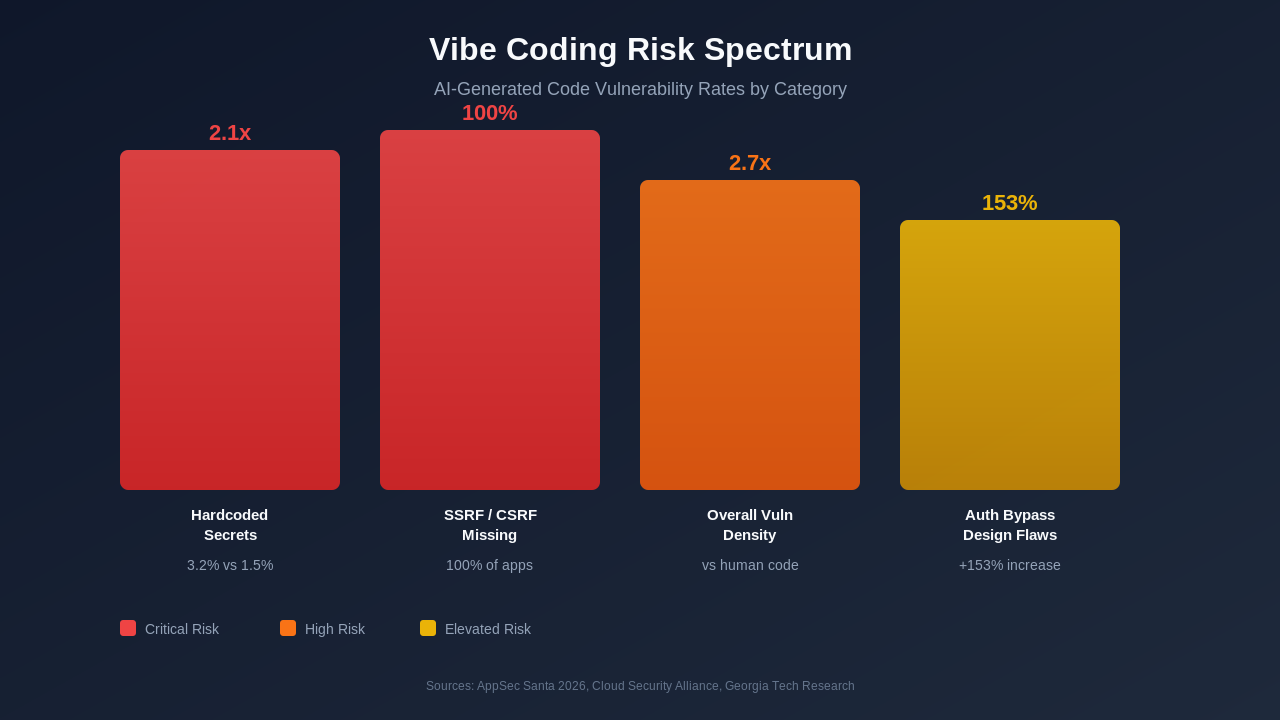
Multiple independent studies have converged on similar findings. AI-generated code has 2.7x higher vulnerability density compared to human-written code. When researchers at AppSec Santa tested 534 code samples across six major LLMs against the OWASP Top 10, they found that 45% of AI-generated code samples introduce critical security vulnerabilities. Not edge cases. Core vulnerabilities like SQL injection, XSS, and authentication bypass.
The CVE numbers tell the same story. In March 2026 alone, 35 CVEs were directly attributed to AI-generated code. That’s up from 15 in February and just 6 in January. Georgia Tech researchers estimate the actual number is 5 to 10 times higher than what’s currently detected.
What Actually Goes Wrong
The vulnerabilities aren’t random. They follow predictable patterns, which means they’re preventable once you know what to look for.
Hardcoded Credentials and Secrets Exposure
This is the most common and most embarrassing failure mode. AI-assisted commits expose secrets at twice the rate of human-written code: 3.2% versus 1.5%. When you tell an AI to “connect to the database,” it often generates code with the connection string right there in the source file. It’s doing what you asked. It just doesn’t think about what happens when that code hits a public repository.
Secrets exposure rose by 40% in AI-generated projects in 2025. The AI doesn’t understand that a database URL with embedded credentials belongs in an environment variable, not in your React component.
Missing Security Fundamentals
When researchers tested vibe-coded applications for basic security hygiene, the results were striking. Every single app with a URL-handling feature introduced server-side request forgery (SSRF) vulnerabilities. Across all tested applications: zero had CSRF protection, and zero set security headers.
The AI prioritizes making the feature work. Security is treated as a non-functional requirement, something to add later. When tested on whether AI models would choose between secure and insecure implementation methods, they chose the insecure option 45% of the time.
Authentication and Session Management
Design-level security flaws saw a 153% increase in AI-generated code. Authentication bypass and improper session management are particularly common because AI models pattern-match against training data that includes millions of insecure examples. The AI learned from the internet, and the internet is full of tutorials that skip auth for the sake of simplicity.
Real Incidents That Should Make You Pause
These aren’t hypothetical risks. Real companies, real users, real data exposed.
The Moltbook Breach
In January 2026, the social network Moltbook was breached within three days of launching. The platform was built entirely through vibe coding, and the founder publicly stated they hadn’t written a single line of code. Attackers found a misconfigured Supabase database with no row-level security enabled. The result: 1.5 million API authentication tokens and 35,000 email addresses exposed.
The vulnerability wasn’t exotic. It was a missing configuration that any experienced developer would check for. But the AI didn’t flag it, and nobody reviewed the output.
The Lovable Security Crisis
Lovable, a vibe coding platform valued at $6.6 billion with eight million users, has faced three documented security incidents exposing source code, database credentials, and user records. In one case, a researcher found they could access another user’s source code, database credentials, AI chat histories, and customer data from a free account. A critical BOLA vulnerability was left open for 48 days after the company closed a bug bounty report without escalation.
When the platform generating your code has its own security problems, the risk compounds.
The Technical Debt Tsunami
Security vulnerabilities are just one dimension of the problem. The code quality issues from vibe coding create a different kind of risk: technical debt that compounds silently until it becomes unmanageable.
Code duplication increased 48% in projects using AI code generation, while refactoring activity dropped 60%. AI coding agents tend to generate new code instead of reusing or refactoring what already exists. Every prompt creates fresh output, disconnected from the patterns and abstractions you’ve already established.
Industry analysts projected that 75% of companies would see their technical debt reach moderate-to-high severity in 2026, with rapid AI adoption cited as a primary contributing factor.
The more insidious problem is what I call “false confidence.” AI-generated tests often mirror the same flawed assumptions as the code they’re testing. The tests pass, the CI pipeline goes green, and everyone feels good about code that nobody actually understands. Then a production incident happens and nobody knows how to debug it because nobody wrote it.
How This Connects to AI Coding Agents
If you’ve been following the AI coding agents space, you’ll notice these risks are amplified when agents operate autonomously. Agentic AI CVEs grew 255.4% year over year, from 74 to 263. When an agent can write, test, and deploy code with minimal human oversight, the attack surface expands dramatically.
The best AI coding agents are getting better at catching some of these issues. Tools like Claude Code and Cursor have added security scanning and review capabilities. But they’re still generating the insecure code in the first place. The guardrails are reactive, not proactive.
Understanding how these agents actually work under the hood helps explain why. They optimize for functional correctness, getting the feature to work as described. Security requires thinking about what the code should NOT do, which is a fundamentally different reasoning mode that current models still struggle with.
What You Can Actually Do About It
The answer isn’t to stop using vibe coding. It’s too productive to abandon. The answer is to treat AI-generated code the way you’d treat code from a very fast but very junior developer: always review it, never trust it blindly.
Build Security Into Your Prompts
Instead of “build a login page,” try “build a login page with parameterized SQL queries, bcrypt password hashing, CSRF tokens, secure session cookies with HttpOnly and SameSite flags, and rate limiting on login attempts.” The more specific you are about security requirements, the better the output.
# Bad prompt result
db.execute(f"SELECT * FROM users WHERE email='{email}'")

# Good prompt result
db.execute("SELECT * FROM users WHERE email = %s", (email,))
Run Automated Security Scanning
Every AI-generated codebase should go through SAST (Static Application Security Testing) and SCA (Software Composition Analysis) before it touches production. Tools like Snyk, Semgrep, and Checkmarx can catch the most common vulnerability patterns. Make these part of your CI pipeline, not an afterthought.
Audit Database Configurations
The Moltbook breach happened because row-level security wasn’t enabled. If you’re using Supabase, Firebase, or any backend-as-a-service with vibe coding, manually verify every RLS policy, every auth rule, every API endpoint permission. The AI won’t do this for you.
Review Before You Ship
This sounds obvious, but it’s the step most people skip when vibe coding. A first-quarter 2026 assessment of more than 200 vibe-coded applications found that 91.5% contained at least one vulnerability traceable to AI hallucination. Code review catches these. Ship-and-fix doesn’t.
Keep Humans in the Loop for Architecture
Let the AI write implementation code. Keep architectural decisions, security boundaries, and data flow designs in human hands. The AI is great at “how.” It’s unreliable at “should we.”
The Bottom Line
Vibe coding is a powerful tool that’s here to stay. The productivity gains are real. But so are the risks, and they scale with adoption. Every line of AI-generated code that ships without review is a lottery ticket you might not want to cash.
The developers who will thrive in this era are the ones who use AI to move faster while maintaining the discipline to verify what it produces. The ones who understand that “it works” and “it’s secure” are two very different statements.
If you’re new to vibe coding, start with the fundamentals. Understand what it is and how to do it properly. Then come back here and build in the security practices from day one. Your future self (and your users) will thank you.
Frequently asked questions
What are the biggest security risks of vibe coding?
The most common risks include hardcoded credentials in source code, missing CSRF protection, server-side request forgery (SSRF) vulnerabilities, SQL injection from unsanitized inputs, and absent security headers. Studies show AI-generated code has 2.7x higher vulnerability density compared to human-written code, with 45% of samples containing OWASP Top 10 vulnerabilities.
Is vibe coding safe for production applications?
Vibe coding can be used for production applications, but only with proper security review, automated scanning, and human oversight. Without these guardrails, the risk is significant. A 2026 assessment of 200+ vibe-coded apps found that 91.5% had at least one vulnerability traceable to AI hallucination. The code needs the same review you would give to any junior developer's pull request.
How does vibe coding create technical debt?
AI coding tools generate new code instead of reusing existing abstractions, leading to a 48% increase in code duplication and a 60% drop in refactoring activity. The AI also generates tests that mirror the same assumptions as the code being tested, creating a false sense of confidence. Over time, this produces codebases that nobody fully understands, making debugging and maintenance increasingly difficult.
What happened in the Lovable vibe coding security incident?
Lovable, a $6.6 billion vibe coding platform with eight million users, experienced three documented security incidents. Researchers discovered they could access other users' source code, database credentials, AI chat histories, and customer data from free accounts. A critical BOLA vulnerability remained open for 48 days after the company closed a bug bounty report without properly escalating it.
How can I make vibe coding more secure?
Start by being specific about security requirements in your prompts. Run automated SAST and SCA scans on every AI-generated codebase. Manually audit database configurations, especially row-level security policies. Always review code before deploying. Keep architectural and security boundary decisions in human hands, and let the AI handle implementation details within those boundaries.