

Spec-Driven Development vs Vibe Coding: When to Use Each
Spec-driven development vs vibe coding is the question every engineering team is quietly arguing about in 2026. One camp ships prototypes at a speed that felt illegal two years ago. The other camp watched those prototypes rot into unmaintainable swamps by month three. Both camps are right, and that is the point of this post.
I run engineering at Levelop, and the vibe coding vs spec driven development choice shapes my AI coding workflow every week. The skill that matters in 2026 is not picking a side. It is knowing which mode a given task calls for and switching deliberately. This is the decision framework I use, with the tradeoffs spelled out.
The Two Workflows, Defined
Vibe coding is the improvise-with-an-agent style Andrej Karpathy named in early 2025. You describe what you want, the agent generates code, you run it, you react, you prompt again. The defining trait is that you mostly do not read every line. You accept output and steer by feel. If you want the full breakdown, we wrote a vibe coding guide.
Spec-driven development (SDD) is the opposite ordering. You write a structured, testable specification first, and AI agents derive the plan, tasks, implementation, and tests from it. The spec lives in your repo as the source of truth. When the software changes, you change the spec and re-derive. Our complete spec-driven development guide walks the full loop.
The cleanest way to hold the difference: in vibe coding, the prompt is disposable and the code is the artifact. In spec-driven development, the spec is the artifact and the code is closer to a build output.
The Core Difference: Where the Source of Truth Lives
Everything else flows from one decision: what is the authoritative description of your system? In vibe coding, it is the code plus whatever lives in your head. That works until someone else, or a future you, needs to know why the code does what it does. The intent was never written down. It leaked out one prompt at a time and evaporated.
In spec-driven development, the authoritative description is a written spec a test could check. The code is derived from it and verified against it. That single change ripples into how reviewable the work is, how well it survives a team, and how it behaves when requirements shift.
This is why spec-driven development is really context engineering at the feature level. A spec is the highest-density context object you can hand an agent: it compresses intent, constraints, and acceptance criteria into the form a model can act on.
Head-to-Head on the Dimensions That Matter
Here is the honest scorecard. Neither workflow wins every row, which is why both still exist. The diagram below lays the two modes side by side.
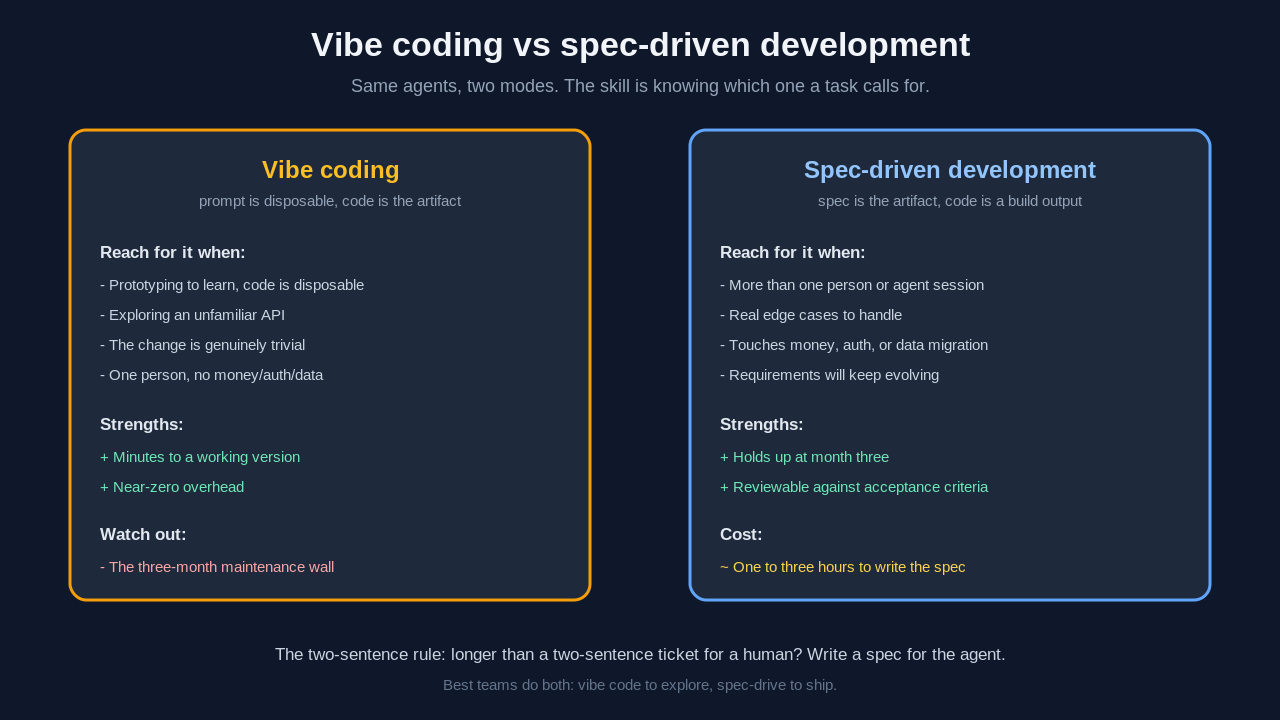
Dimension                  | Vibe Coding          | Spec-Driven Development
---------------------------|----------------------|------------------------
Time to first version      | Minutes              | Hours (spec first)
Maintainability at month 3 | Degrades fast        | Holds up
Reviewability              | One giant diff       | Small tasks vs criteria
Works across a team        | Poorly               | Well, spec is shared truth
Changing requirements      | Re-prompt and hope   | Edit spec, re-derive
Risk on money, auth, data  | High                 | Managed
Overhead cost              | Near zero            | One to three hours
Best for                   | Exploration          | Production
Read it as tradeoffs, not a verdict. The speed advantage of vibe coding is real and large. The maintainability advantage of SDD is also real, and it shows up later, which is why teams underprice it.
What Spec-Driven Development Changes About Code Review
The dimension most teams overlook is reviewability, and it deserves elaboration because it compounds. Reviewing a vibe-coded change means evaluating an unfamiliar implementation against an intent that exists only in the author's memory, an inherently subjective exercise that degrades as the diff grows. Spec-driven development reframes the task entirely: each task maps to a named, pre-agreed acceptance criterion, so the reviewer is no longer adjudicating taste but verifying conformance. That shift, from "is this good code" to "does this satisfy the spec," is what makes agent-generated work auditable at scale, and it is the reason organizations adopting agentic engineering treat the specification as a governance artifact rather than mere documentation.
The Three-Month Wall
The most documented failure pattern in AI-assisted development is what I call the three-month wall. Weeks one and two feel magical. Then around month three, AI-generated code that nobody specified becomes code nobody owns. A simple change turns into a troubleshooting session, because one edit breaks two things you did not know were connected. Every prompt was a tiny redesign, and a few hundred of them produce a system with no coherent design.
We covered the quality and security angle in the hidden risks of vibe coding, but the deeper issue is architectural: vibe coding risks code with no recoverable intent. When it breaks, there is no spec to check behavior against, so debugging becomes archaeology. Spec-driven development pays an hour up front to avoid that wall.
The Decision Framework
Reach for vibe coding when
You are prototyping to learn and the code is disposable. You are exploring an unfamiliar API and do not yet know what you want. The change is trivial. You are the only person who will touch it, and it does not touch money, auth, or stored data. Here, a spec would be pure ceremony. Just talk to the agent.
Reach for spec-driven development when
More than one person or agent session will touch the work. The feature has real edge cases. It touches money, authentication, or a data migration. You know requirements will evolve. The cost of a wrong implementation is higher than the cost of the spec.
The heuristic I give my team
If you would write a ticket longer than two sentences
for a human teammate, write a spec for the agent.

If you would be fine throwing the result away on Friday,
vibe code it.
The two-sentence rule catches almost every real case. Anything substantial enough to need explanation deserves a spec. Anything you would happily delete does not.
The Hybrid Workflow Most Good Teams Run
Here is what the "pick a side" takes miss. The 2026 consensus, echoed in comparisons like Augment Code's guide and Turing Post's breakdown, is not vibe coding or spec-driven development. It is both, in sequence. You vibe code to explore, then spec-drive to ship.
Phase 1 (explore): vibe code a throwaway spike
                   -> goal: understand the problem
Phase 2 (specify): write the spec from what you learned
                   -> goal: capture intent that survives
Phase 3 (ship):    agents derive plan, tasks, and code
                   -> goal: production-grade, reviewable output
The spike is not wasted work. It is research that makes the spec sharper. The mistake is stopping after phase one and shipping the spike, which hits the three-month wall at speed. When you reach phase three, the agent matters: the better the AI coding agent, the more leverage a precise spec buys. GitHub Spec Kit is the most agent-agnostic on-ramp (we wrote a hands-on Spec Kit guide), and the vibe coding tools comparison covers exploration.
Same Feature, Both Ways
Take a streak-freeze we built for Levelop's practice tracker, so learners do not lose a 40-day streak over one missed day. The vibe-coded version would start with: "Add a streak freeze. Give them a freeze every week or so." That works in the happy path, but "every week or so" is not checkable, timezone handling is unspecified, and the banking limit is a guess.
The spec-driven version started with acceptance criteria a test could verify: a learner with seven consecutive active days earns one freeze (max two banked); a missed day consumes a freeze at midnight in the learner's timezone, not UTC; consumption is visible in the activity log within five seconds. From that, the agent derived a schema change, an event consumer, and a timezone edge-case matrix. Two months later a new contributor changed the banking limit by editing one line of the spec. That is the difference in a single feature.
Where This Fits in the Bigger Shift
In February 2026, almost exactly a year after coining "vibe coding," Karpathy declared that era over and named the new default agentic engineering: you are not writing the code 99% of the time, you are orchestrating agents and acting as oversight. The New Stack has a good write-up of that shift. Agentic engineering needs something for the agents to be engineered against, and that something is the spec. Vibe coding was the exploratory mode all along; spec-driven development is what you graduate to when you decide to keep what you built. Browse more deep dives on the Levelop blog.
Frequently asked questions
What is the main difference between spec-driven development and vibe coding?
The source of truth. In vibe coding the code is the artifact and the prompts are disposable, so intent is never written down. In spec-driven development a structured spec is the source of truth, and the code and tests derive from it. Vibe coding optimizes for exploration speed; spec-driven development optimizes for maintainability.
Is vibe coding dead in 2026?
No. It is no longer the recommended way to ship production software, but it is still the best mode for prototyping, exploring APIs, and learning what you want to build. Even Karpathy frames the new agentic engineering default as orchestrating agents against intent, which leaves room for fast, disposable exploration.
When should I use spec-driven development instead of vibe coding?
When more than one person or agent session touches the work, when the feature has real edge cases, when it touches money, authentication, or data migrations, or when requirements will change. The rule: if you would write a ticket longer than two sentences for a human, write a spec for the agent.
Can I use both vibe coding and spec-driven development together?
Yes, and most strong teams do. Vibe code a throwaway spike to explore, write a spec from what you learned, then let agents build the production version against it. The failure mode is stopping after the spike and shipping it, which leads straight to the three-month wall.
Does spec-driven development slow you down?
Up front, yes, by roughly one to three hours per feature. That is wasted on trivial or disposable work, which is why you vibe code those. On anything you maintain, the spec pays for itself within weeks by eliminating requirements drift and making future changes start from an edit to the spec.
What is the three-month wall in vibe coding?
The three-month wall is the common point where a vibe-coded project becomes hard to maintain. Early progress is fast, but because no spec captured intent, accumulated AI-generated code becomes code nobody owns. Small changes start breaking unrelated things, and debugging turns into reverse-engineering. Spec-driven development avoids it by keeping recoverable intent in the repo from the start.
We publish engineering deep dives like this on the Levelop blog every week. If you are leveling up your AI-assisted workflow or preparing for system design interviews, that is where to find us, or start at levelop.dev.