

Golden Paths in Platform Engineering: What They Are and How to Build Them
Every engineering org I have worked with hits the same wall as it grows. The first ten engineers all know how to ship. They share the same context, the same shortcuts, the same tribal knowledge about how to get a service into production. Then the team doubles, doubles again, and suddenly nobody agrees on how anything should be done. There are four ways to spin up a service, three logging setups, and a new hire who spends two weeks just trying to deploy a hello world.
A golden path is the fix for that. It is the single, opinionated, well-supported route through your systems that a developer can follow to go from idea to running software without having to become an expert in your entire infrastructure first. If you have read our guide on what platform engineering actually is, golden paths are the thing platform teams build to make all of that real.

This post breaks down what a golden path is, where the idea came from, how it differs from the terms people confuse it with, and a practical sequence for building your first one. I will keep it grounded in what actually works, not the glossy vendor version.
What is a golden path in platform engineering
A golden path is a paved, opinionated route for accomplishing a common engineering task. It bundles the tools, templates, documentation, and automation a developer needs so that the recommended way to do something is also the easiest way to do it. Think of it as the path of least resistance that also happens to be the path your platform team actively supports.
If you have searched for golden path platform engineering guidance and come away with vague definitions, that is the practical version: one supported route, built and maintained by a platform team, that most developers follow because it is genuinely the easiest way to ship.
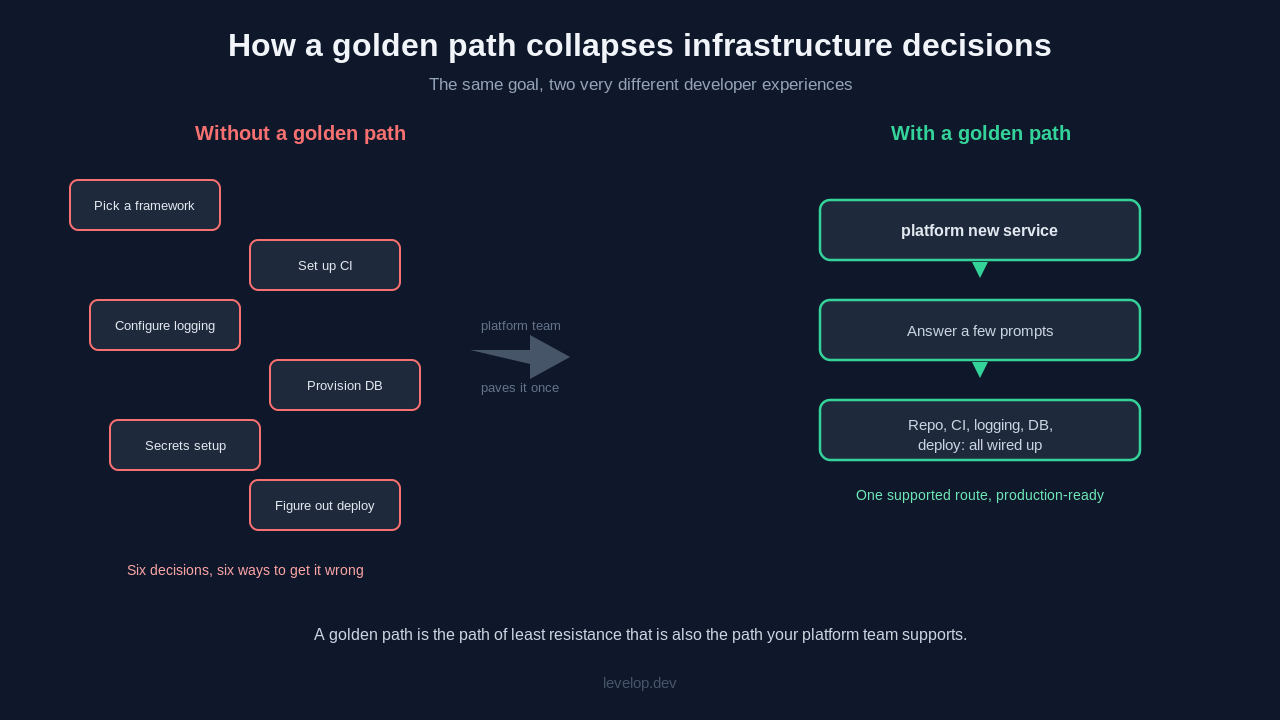
The classic example is creating a new service. On a team without a golden path, a developer has to pick a language framework, set up a repository, wire up CI, configure logging and metrics, provision a database, get secrets management working, and figure out how to deploy. Each of those is a decision, and each decision is a chance to get it wrong or to diverge from what everyone else does. On a team with a golden path, the developer runs one command or clicks one button, answers a few questions, and gets a production-ready service with all of that already wired up correctly.
Where the golden path idea came from
The term was popularized by Spotify, whose engineering team wrote about using golden paths to solve fragmentation across their software ecosystem. As Spotify grew past a few hundred engineers, the freedom that made small teams fast started to work against them. Every squad reinvented the basics, and moving between teams meant relearning how to ship. Golden paths were their answer: a supported, documented, well-lit route through the most common tasks, paired with the freedom to step off the path when you had a good reason.
That last part matters and gets lost a lot. Spotify did not mandate the golden path. They made it the default and the best-supported option, then let teams deviate when their needs were genuinely different. The path was golden because it was good, not because it was compulsory. That philosophy is what separates a golden path from a corporate standard nobody likes.
Golden path vs paved road vs guardrails
These three terms get used interchangeably, and the sloppiness causes real confusion in planning meetings. They are related but not the same.
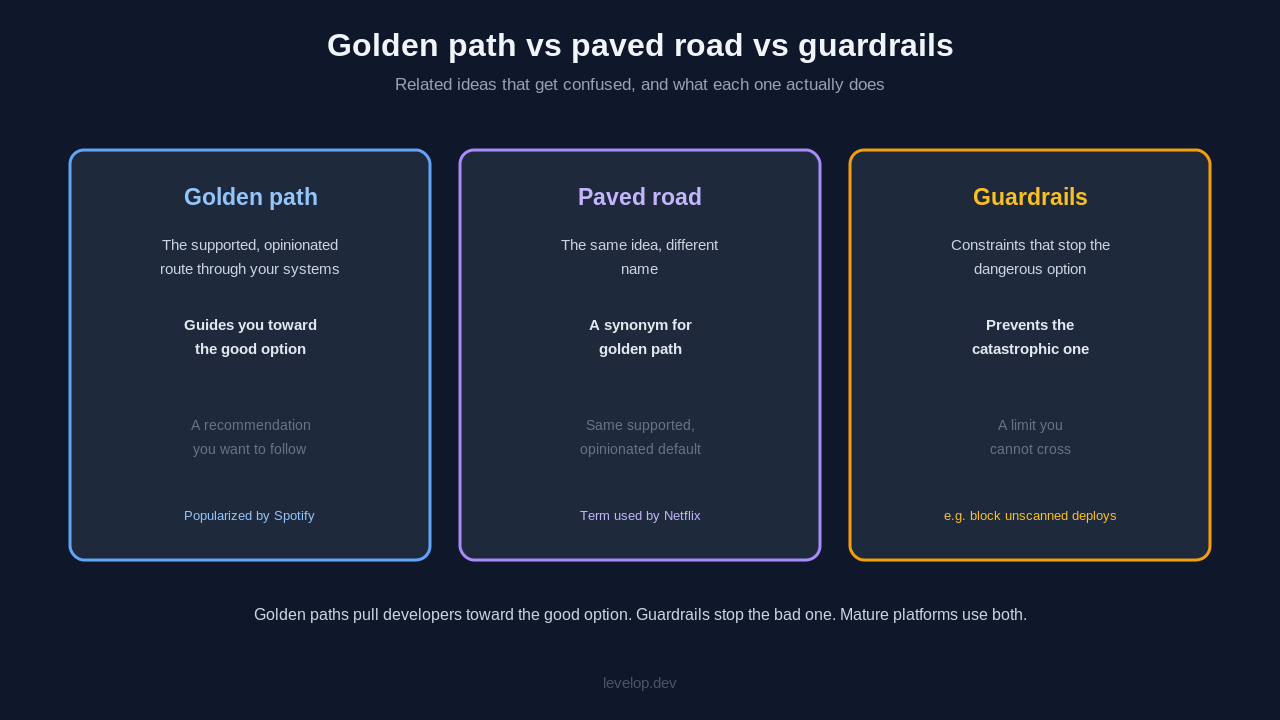
A paved road is essentially a synonym for a golden path. Netflix and others use paved road to describe the same concept: the supported, opinionated way to do a thing. If someone on your team says paved road, they almost certainly mean golden path.
Guardrails are different. A guardrail is a constraint that stops you from doing something dangerous, like a policy that blocks a deploy without a passing security scan, or a limit on how much a service can auto-scale. Golden paths guide you toward the good option. Guardrails prevent the catastrophic one. A mature platform uses both: golden paths for the happy case, guardrails so that stepping off the path cannot take production down.
Why golden paths matter
The honest business case for golden paths is cognitive load. Every decision a developer has to make about infrastructure is attention taken away from the actual product. A golden path removes dozens of those decisions and hands them to a platform team that can make them once, well, for everyone.
The payoffs compound. Onboarding gets faster because a new hire follows the same path everyone else does instead of assembling a mental map of your systems. Consistency improves because services are built from the same templates, which makes them easier to operate, monitor, and secure. Incident response gets calmer because the person paged at 2 a.m. is looking at a familiar structure, not a bespoke snowflake.
There is a governance angle too. When security, compliance, and reliability practices are baked into the golden path, you get them by default rather than by nagging. The Cloud Native Computing Foundation platforms white paper makes this point well: good platforms reduce the effort teams spend on non-differentiating work so they can focus on what actually moves the business.
How to build your first golden path
You do not build a golden path by writing a fifty-page standards document and hoping people read it. You build it by making the good option genuinely easier than the bad one. Here is the sequence I would follow.
1. Start with the most common, most painful workflow
Do not try to pave everything at once. Find the task developers do most often that currently causes the most friction. For most teams that is creating and deploying a new service, but it could be adding a new API endpoint, spinning up a data pipeline, or shipping a frontend app. Pick one, and pick the one where a win will be obvious to everybody.
2. Talk to the developers who actually walk the path
Sit with three or four engineers and watch them do the task the current way. Write down every step, every decision, every place they get stuck or copy something from an old repo. That list of pain points is your specification. The golden path exists to eliminate those exact steps, so if you skip this you will pave a road nobody needed.
3. Build a template, not a tutorial
The heart of a golden path is executable, not written. A software template that scaffolds a new service with everything wired up beats a wiki page explaining how to wire it up yourself. Tools like Backstage, Port, and Humanitec exist specifically to make these templates self-service. If you want a deeper comparison, we covered the best platform engineering tools for 2026 separately.
A minimal service template usually scaffolds the repository, a starter application in your preferred framework, a CI pipeline, logging and metrics wiring, a Dockerfile, and deployment configuration. The developer answers a couple of prompts, and the template produces a working, deployable service.
# What a golden-path service scaffolder feels like to use
$ platform new service
? Service name:        payments-api
? Language:            Go
? Team:                payments
? Needs a database?    yes (Postgres)

Created repo, CI pipeline, Dockerfile, k8s manifests,
logging + metrics, and a Postgres instance.
Your service is deploying now: https://backstage/catalog/payments-api
4. Make it self-service and discoverable
A golden path only works if developers can find and use it without filing a ticket. This is where an internal developer portal or platform comes in: it gives the path a front door. The whole point of self-service is that a developer can go from wanting a new service to having one without waiting on another human. If your golden path requires a Slack message to the platform team, it is not a golden path yet.
5. Add guardrails, not gates
Bake the non-negotiables into the path so they happen automatically: security scanning in CI, sensible resource limits, required tags, standardized logging. The goal is that following the golden path means you are compliant and safe by default. Resist the urge to turn every guardrail into an approval step, because a path with ten gates is just bureaucracy with better branding.
6. Measure adoption and iterate
A golden path is a product, and your developers are the users. Track how many new services are created through the path versus around it. If adoption is low, that is feedback that the path is missing something or is harder to use than the old way. Talk to the people who went around it, fix the gap, and try again. The best platform teams treat this like any other product loop.
Common mistakes to avoid
A few failure patterns show up again and again. Paving too many paths at once spreads a small platform team thin and none of the paths get good enough to win adoption. Building for the platform team instead of the developer produces something technically impressive that nobody wants to use. Treating the path as done at launch lets it rot as your stack evolves, and a stale golden path is worse than none because it teaches people the platform team cannot be trusted to keep things current.
The last one is organizational: not having anyone who clearly owns the path. Golden paths need a product owner and a team that treats them as long-lived products, which is exactly why how you structure and staff a platform engineering team matters so much to whether any of this sticks.
Who owns golden paths
Golden paths are owned by the platform engineering team, and they are arguably the team's core deliverable. The platform team's job is not to run infrastructure on behalf of developers. It is to build the paths, templates, and self-service tooling that let developers run their own things safely. This is the shift from the old ops model to the platform-as-a-product mindset that defines modern platform engineering.
In practice that means a small, cross-functional platform team with a product owner, a few engineers who build and maintain the paths, and a habit of treating internal developers as customers whose adoption has to be earned. If you get the ownership right, the golden paths tend to follow.
Golden paths FAQ
What is a golden path in platform engineering?
A golden path is a paved, opinionated, well-supported route for a common engineering task, such as creating and deploying a new service. It bundles the templates, tooling, automation, and documentation a developer needs so the recommended way to do something is also the easiest way, reducing cognitive load and keeping services consistent.
What is the difference between a golden path and a paved road?
They mean the same thing. Golden path is the term Spotify popularized, and paved road is the term Netflix and others use. Both describe the supported, opinionated default route through your systems. If a colleague says paved road, they almost certainly mean golden path.
Are golden paths mandatory for developers?
Good golden paths are not mandatory. They win by being the easiest and best-supported option, so most developers choose them voluntarily, while teams with genuinely different needs can step off the path. Making a golden path compulsory before it is actually good is the fastest way to lose developer trust.
What tools do you use to build a golden path?
Internal developer platforms and portals like Backstage, Port, and Humanitec are the common choices. They provide software templates and scaffolders that let developers self-serve a fully wired-up service, plus a catalog and front door that make the path discoverable without filing a ticket.
How do you measure whether a golden path is working?
Track adoption: how many new services or tasks go through the path versus around it. Pair that with time-to-first-deploy for new services and onboarding time for new hires. Low adoption is feedback that the path is missing something, so treat it like a product and iterate based on why developers went around it.
Golden paths are where platform engineering stops being a buzzword and starts being useful. Get one right, on the workflow that hurts the most, and you will feel the difference in how fast people ship. If you want the bigger picture this fits into, start with our guide to platform engineering, and browse more breakdowns like this on the Levelop blog.