

The 12-Week Coding Interview Study Plan
Yes, twelve weeks is enough time to go from rusty to FAANG-ready, but only if you treat it like a training block instead of an open-ended grind. A vague "I'll do LeetCode until I feel confident" plan almost always fails, because confidence is not a milestone you can schedule. A week-by-week coding interview prep plan is different: it gives every week a job, builds in recovery, and plans for the two things nobody warns you about, the mid-cycle crisis and the late breakthrough.
This is the exact coding interview study plan we recommend to engineers preparing for Google, Meta, Amazon, and similar tech companies. If you have ever wondered how long to prepare for coding interviews, this is our answer: twelve focused weeks of structured interview preparation, not an open-ended grind. It assumes you have a full-time job and can commit ten to fourteen focused hours a week. If you have more time, you compress; if you have less, you extend the phases rather than skipping them.
Why a week-by-week plan beats "just grind more problems"
Most people prepare by opening a problem list and solving whatever is next until they run out of energy. That feels productive and teaches you very little. Research on skill acquisition, going back to Anders Ericsson's work on deliberate practice, is consistent on one point: improvement comes from focused repetition against a specific weakness with immediate feedback, not from raw volume. Solving three hundred random problems builds familiarity. Solving forty problems that all attack the same pattern, with review, builds transfer.
A coding interview study plan structured by week does three things a problem list cannot. It sequences skills so each week builds on the last. It forces spaced review, which the testing effect shows is how memory actually consolidates. And it protects you from the biggest failure mode in interview prep, which is quitting in week five because you feel like you are not improving. You will feel that. The plan expects it.
We teach patterns rather than problem counts for exactly this reason, and if you want the deeper argument, we made the full case in why we teach 12 patterns instead of 2,500 problems. The 12-week structure below is how you internalize those patterns on a schedule.
The 12-week plan at a glance
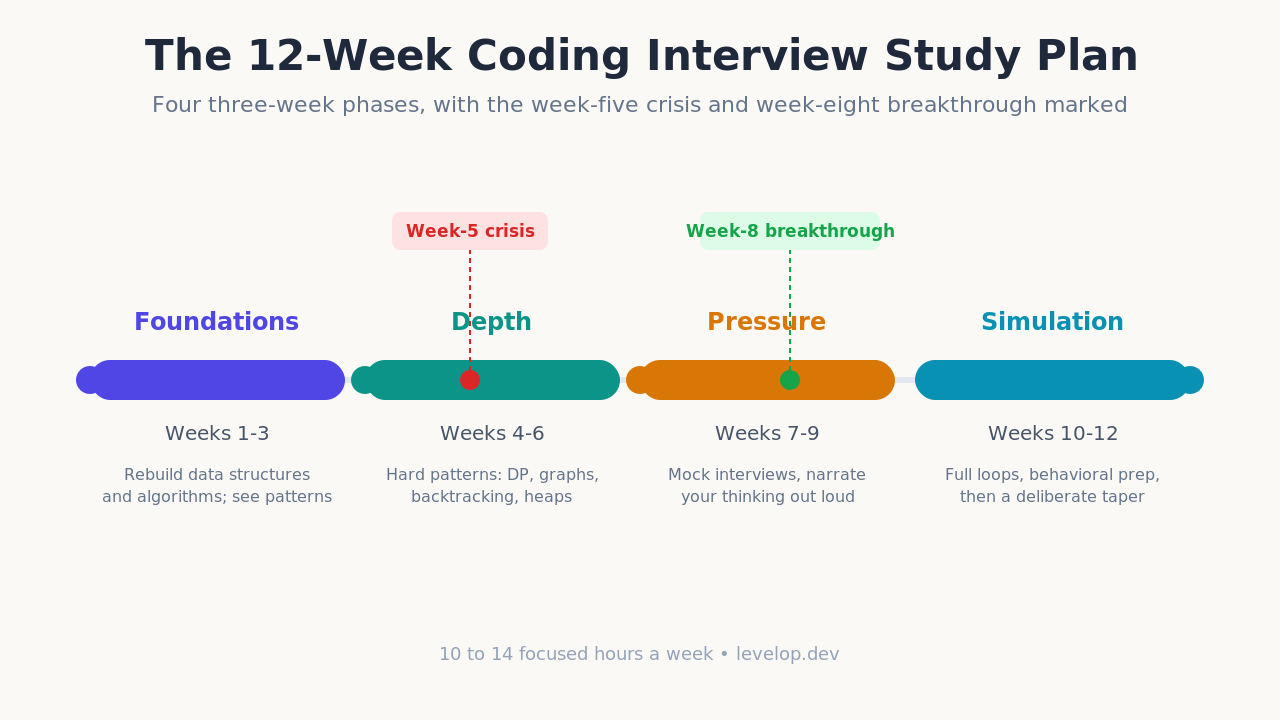
This week by week coding interview prep breaks into four three-week phases, each with a different center of gravity:
- Weeks 1 to 3, Foundations: rebuild fundamentals and learn to see patterns.
- Weeks 4 to 6, Depth: go deep on the hard patterns and push through the plateau.
- Weeks 7 to 9, Pressure: add mock interviews, communication, and a first pass at system design.
- Weeks 10 to 12, Simulation: full interview loops, behavioral prep, and a deliberate taper.
Keep a single tracker for the whole cycle. It does not need to be fancy. The point is that at any moment you can see what pattern you are weak on and how long since you reviewed it.
# study_tracker.py: minimal spaced-review tracker
from datetime import date, timedelta

# One row per attempt. Score: 1 = failed, 2 = solved with hints, 3 = clean.
attempts = []

def log(problem, pattern, score):
    attempts.append({"problem": problem, "pattern": pattern,
                     "score": score, "day": date.today()})

def due_for_review(today=None):
    today = today or date.today()
    # Anything scored below 3 and older than 3 days needs a re-attempt.
    return [a for a in attempts
            if a["score"] < 3 and today - a["day"] >= timedelta(days=3)]

def weakest_patterns():
    from collections import defaultdict
    totals = defaultdict(list)
    for a in attempts:
        totals[a["pattern"]].append(a["score"])
    return sorted(totals, key=lambda p: sum(totals[p]) / len(totals[p]))
The weakest_patterns() call is the one you run every weekend. It tells you where next week's hours should go, instead of leaving it to how you feel.
Weeks 1 to 3: Foundations
The goal of the first three weeks is not to solve hard problems. It is to rebuild your core data structures and algorithms and start recognizing patterns, the foundation of all interview problem solving. Spend week one on arrays, strings, hashing, and two pointers. Spend week two on stacks, queues, linked lists, and sliding window. Spend week three on trees, recursion, and binary search.
Do roughly five problems per pattern, and after each one write a single sentence: what was the trigger that told you which pattern to use. That sentence matters more than the solution. Interviews are won or lost in the first two minutes, when you decide what kind of problem you are looking at. If you cannot articulate the trigger, you have memorized a solution, not learned a pattern.
Two of our pattern deep-dives pair well with this phase: two pointers, the pattern hiding inside every sorted-array problem and sliding window, the pattern that turns O(n squared) into O(n). Read the trigger sections, then go find problems that match.
By the end of week three you should be able to look at a problem statement and name the likely pattern before you write a line of code. You will not be fast yet. That is fine.
Weeks 4 to 6: Depth, and the week-five crisis
Now the difficulty climbs. Weeks four through six cover the patterns that carry the most interview weight and cause the most pain: dynamic programming, graphs and BFS/DFS, backtracking, heaps, and intervals. These are the patterns that separate people who pass from people who almost pass.
Here is the honest part. Somewhere around week five, most people hit a wall. You will solve a dynamic programming problem, feel good, then completely blank on a nearly identical one the next day. Your solve rate will feel like it is going backward. This is the crisis moment, and it is not a sign that you are failing. It is the exact point where familiarity is being forced to become understanding, and that transition feels terrible from the inside.
The mistake people make in week five is to respond by grinding harder and later into the night, which accelerates burnout and makes retention worse. The correct response is to shrink your scope. Pick the single pattern that is hurting most, usually dynamic programming, and spend three days doing nothing else, re-solving problems you have already seen until the state transitions feel automatic. Our guide on what to do when you are stuck on a coding problem is built for exactly these days.
If you survive week five without quitting, you have already outlasted most of your competition. That is not a motivational line. Attrition in self-directed interview prep is enormous, and the people who reach the interview loop are disproportionately the ones who pushed through this specific dip.
Weeks 7 to 9: Pressure and the breakthrough
Weeks seven through nine change the nature of the work. Until now you have been solving problems alone, at your own pace. That is not what an interview is. An interview is solving a slightly-too-hard coding question while talking out loud to a technical interviewer who is judging you. Those are different skills, and the second one is trained separately.
Start mock interviews this phase, at least two per week, with a real human whenever possible. The first few will be humbling. You will freeze, over-explain, or go silent while you think. That is the point. Practice narrating your approach before you code, stating your plan, and checking in as you go. We break the mechanics down in how to communicate your thought process during a coding interview, and the 30-minute pacing plan will keep you from running out of clock.
This is also where the breakthrough usually arrives. Around week eight, something clicks: a problem you would have stared at blankly in week two now sorts itself into a recognizable pattern within seconds, and you find yourself explaining your approach out loud without panic. The breakthrough is not that problems got easier. It is that pattern recognition became automatic, which frees up the working memory you used to spend on "what kind of problem is this" and lets you spend it on communication and edge cases instead.
If you are targeting senior roles, add two or three light system design sessions in this phase so the topic is not brand new in week ten. You are not aiming for mastery yet, just vocabulary and the shape of the conversation. Our coding interview prep guide for 2026 maps how the two tracks fit together.
Weeks 10 to 12: Simulation and taper
The last three weeks are about turning capability into reliability under real conditions. Run full mock loops: back-to-back rounds, timed, with a short break between, mimicking the real onsite interview process. Mix in problems you have never seen so you practice the actual skill of the interview, which is handling the unknown, not reciting the known.
Weeks ten and eleven are also when you finally sit down with behavioral prep, which technical candidates love to leave until the night before and then regret. Have five or six stories ready in a structured format, each covering a different competency, so the behavioral interview questions never catch you improvising. Our breakdown of the 20 behavioral questions you will face in every FAANG interview gives you the frameworks so you are not improvising about the hardest thing you ever debugged at 11pm the night before your loop.
Week twelve is the taper, and this is the instruction people ignore at their peril. In the final three to four days before your interview, reduce volume sharply. Do a handful of easy and medium problems to stay warm, review your notes and your pattern triggers, and sleep. You cannot cram algorithmic intuition in the last week, and trying to will only leave you tired and anxious on the day that matters most. Athletes taper before a race for a reason. Your brain is the muscle here.
Crisis moments are a feature, not a bug
The reason this plan names the week-five crisis and the week-eight breakthrough explicitly is that surprise is what makes them dangerous. An engineer who hits a plateau and thinks "this always happens around now, keep going" behaves completely differently from one who thinks "I am not cut out for this." The curve is the same. The interpretation is what decides who quits.
If you find yourself off-plan, behind, or demoralized in the middle of the cycle, the answer is almost never to abandon the structure. It is to shrink scope to your single weakest pattern, protect your sleep, and trust the tracker over your mood. Motivation is a lagging indicator. It shows up after competence, not before it, which is why the people who wait to feel ready never start.
Where to go next
A plan is only useful if you start it. Pick your interview date, count back twelve weeks, and put the four phases on a real calendar today. If you want the pattern library the Depth phase depends on, and a structured way to practice it, that is what we built Levelop around, and the full Levelop blog has a deep-dive for every pattern in this plan and the wider craft of software engineering interviews. The engineers who get offers are rarely the ones who studied the most. They are the ones who studied on a structure and did not quit in week five.
Frequently asked questions
Is 12 weeks really enough time to prepare for FAANG interviews?
For most working engineers with a reasonable CS foundation, yes. Twelve weeks at ten to fourteen focused hours a week is enough to internalize the core patterns, build communication skills through mocks, and run realistic simulations. If your fundamentals are very rusty, extend the Foundations phase rather than compressing the later ones. The plan is about depth per phase, not a fixed calendar.
How many hours a week does this coding interview study plan require?
Plan for ten to fourteen hours of focused work, not passive reading. Focused means solving, reviewing, and mocking with your full attention, not watching solution videos while half-distracted. Three deliberate hours beat eight scattered ones. If you can only manage six or seven hours some weeks, keep the structure and let the cycle run longer than twelve weeks.
What if I plateau or lose motivation halfway through?
Expect it around week five; it is the most common point to stall. Do not respond by grinding harder. Shrink your scope to the single pattern hurting most, re-solve problems you have already seen until the approach is automatic, protect your sleep, and measure progress with a tracker instead of by feel. The plateau is the transition from familiarity to understanding, and it resolves if you stay in it.
Should I study system design during these 12 weeks?
If you are interviewing for mid-level roles, a light touch is enough. For senior and above, add two or three short system design sessions starting in week seven so the topic is not new in the final phase. You want vocabulary and the shape of the conversation early, then focused practice at the end. Do not let it crowd out coding practice before week seven.
When should I stop practicing before the interview?
Taper in the last three to four days. Reduce volume sharply, do a few easy and medium problems to stay warm, review your pattern triggers and behavioral stories, and prioritize sleep. Cramming in the final week raises anxiety and lowers performance. Intuition is built over the twelve weeks, not the final night.